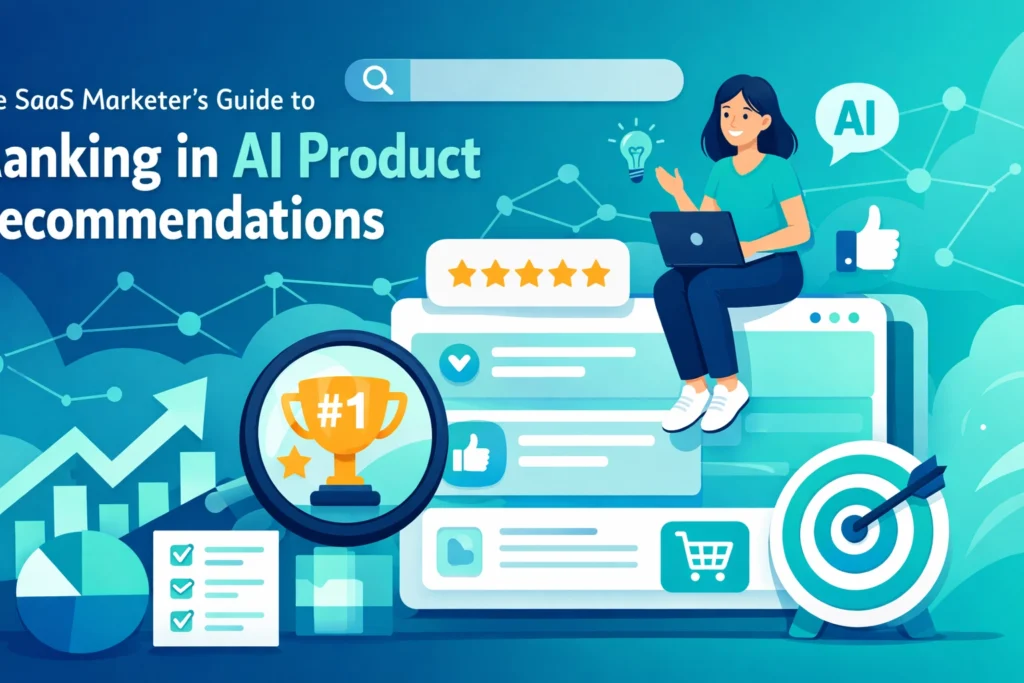
For years, the SaaS marketing playbook was simple: win the Google SERP, capture the click, and move them down the funnel.
But the funnel has changed. Today, your potential customers aren’t just “Googling” for solutions; they are asking AI. When a VP of Sales asks Perplexity, “What’s the best CRM for a 50-person remote team?” or a CTO asks ChatGPT to “Compare Snowflake vs. BigQuery for a startup,” you are either in that answer or you are invisible.
Getting your software recommended by Large Language Models (LLMs) isn’t just about SEO anymore. It’s about Generative Engine Optimization (GEO).
In this guide, we’ll break down exactly how SaaS marketing leaders can ensure their products are the ones being recommended during the AI discovery phase.
Why AI Product Recommendations are the New High-Ground
In traditional search, users browse a list of links. In AI search, the model synthesizes those links into a single, authoritative recommendation.
If an AI tool recommends your competitor and omits you, the user might never even know you exist. AI models act as a “filter” that can either be your greatest lead gen source or a wall between you and your market. To scale in 2026, you need to understand how these models “think” about your brand.
At Citemetrix, we call this AI Visibility. The goal is to move from being a “hidden” brand to a “cited” brand.
Step 1: Build AI-Optimized Content (The “Comparison” Strategy)
One of the biggest mistakes SaaS marketers make is creating content that only talks about themselves. AI models learn by association and comparison. If you never mention your competitors on your site, AI models struggle to understand where you fit in the market landscape.
To rank in AI recommendations, you must build content that AI systems naturally want to cite when answering “solution-aware” questions.
The Comparison Framework
AI models love structure. When creating comparison pages or “Best [Category] Tools” listicles, use this specific structure to make your content highly “parseable” for LLMs:
- Evaluation Criteria Section: Explicitly state how you are ranking the tools. Use consistent labels like Features, Pricing, Ease of Use, and Integration Depth.
- The Comparison Chart: LLMs are excellent at reading tables. Build a summary table that includes the Rank, Software Name, “Best For” use case, and Pricing.
- The Deep Dive: For each product (including your own), provide a summary of core pain points it solves.

Caption: An example of an LLM-friendly comparison table that helps AI models categorize your SaaS product.
By positioning your product first but including comprehensive, honest data about competitors, you provide the “training data” the AI needs to recommend you for specific use cases.
Step 2: Use ModelScore™ as Your North Star
How do you know if your strategy is actually working? You can’t just check your Google Search Console and see “AI Rankings.”
This is why we developed ModelScore™. It’s a proprietary metric inside the Citemetrix dashboard that measures your brand’s authority across the major AI models (ChatGPT, Claude, Gemini, and Perplexity).
ModelScore™ is calculated based on four key pillars:
- Citation Rate: How often LLMs cite your domain as a source.
- Brand Demand: How often users are asking about your specific product in AI prompts.
- Authority: The perceived “expert” status of your brand within your niche.
- Technical Readiness: How easily AI crawlers can access and interpret your data.
If you want to beat a competitor in AI share of voice, you need to know their ModelScore™ versus yours. You can get your ModelScore here and see exactly where you stand.
Step 3: The “Double Leverage” Citation Play
Generating new content is great, but getting mentioned in existing high-authority content is faster.
AI models don’t just read your website; they look for “social proof” across the web. They prioritize content from high-authority domains that are already ranking in the top 10 of Google. We call this “Double Leverage”: when a page has both high SEO rankings and high AI citation frequency.
How to execute this:
- Identify the Winners: Use AI search trackers to see which articles ChatGPT or Perplexity cite when asked for “Best [Your Category] Software.”
- The Outreach Gap: Find the listicles that are being cited but don’t mention your brand.
- The Pitch: Reach out to those publishers with a unique data point, a mini case study, or a “Best For” angle that their current list is missing.
When you land a spot on an article that AI is already citing, you effectively “piggyback” your way into AI recommendations overnight.

Caption: Mapping the flow of citations from high-authority domains to AI model responses.
Step 4: Technical AI Readiness (Don’t Block the Bots)
You can have the best product in the world, but if the AI crawlers can’t read your site, you won’t get recommended. SaaS sites are often heavy on JavaScript and gated content, which can be a nightmare for AI bots.
Implement llms.txt
A new standard is emerging for AI-ready websites: the llms.txt file. Similar to a robots.txt, this file provides a simplified, text-based version of your key site information specifically for LLMs. It helps models quickly understand your product’s value proposition without getting lost in your UI code.
Freshness Signals
AI models are increasingly prioritizing “fresh” data. Ensure your high-converting bottom-of-funnel (BOFU) pages include “Last Updated” dates. When an AI sees a page updated in February 2026 versus a competitor updated in 2024, it is significantly more likely to cite the newer data for pricing and feature sets.
Check your technical readiness with the Citemetrix AI Crawler Guide.
Step 5: Master the “Best For” Niche
AI models are moving away from “The Best Overall” and moving toward “The Best for [Specific Use Case].”
As a SaaS marketer, you should stop trying to be the “Best CRM” and start trying to be the “Best CRM for mid-sized medical device companies.” When you define a specific niche, the LLM has a “hook” to hang your brand on.
Try this exercise:
Go to ChatGPT and ask: “Who are the top 3 players in [Your Category] and what is the specific strength of each?”
If the AI can’t define your specific strength, your marketing messaging is too generic. You need to update your site’s headers and meta-data to reflect a specific “Point of View.”

Caption: A CiteMetrix dashboard showing how different AI models perceive a brand’s core strengths.
Measuring Success: Beyond the Click
In the AI era, success isn’t just a click to your website. Success is an AI telling a buyer: “You should use [Your Brand] because it integrates perfectly with your existing stack and has the best reporting for your industry.”
This is “Zero-Click Influence.” To track this, you need to monitor your AI Share of Voice (SoV) alongside your traditional metrics.
Are you being mentioned more often this month than last month? Is the sentiment of those mentions positive? Are you winning the “Comparison” prompts?
Summary Checklist for SaaS Marketers
- Baseline your visibility: Run 10-20 prompts through AI tools to see if you appear.
- Check your ModelScore™: Use Citemetrix to get a data-driven view of your AI authority.
- Audit your comparisons: Ensure you have “Alternative” and “Comparison” pages that use structured tables.
- Update your technicals: Add an
llms.txtand ensure your site is crawlable by GPTBot and other AI crawlers. - Claim your citations: Identify the top 5 external articles AI cites for your keywords and get your brand added to them.
The transition from SEO to GEO is the biggest shift in digital marketing since the move to mobile. The brands that optimize for AI discovery today will be the ones that dominate the software landscape for the next decade.
Ready to see what AI says about your brand?
Join the Citemetrix beta for free →