If you've been following our Generative Engine Optimization 101 guide, you know that AI assistants like ChatGPT and Perplexity are changing how people find information. But to really understand this shift, we need to talk about the fundamental unit of AI search: the prompt.
For decades, marketers have obsessed over keywords. We've built entire strategies around them. We've paid good money to rank for them.
But here's the thing: when someone opens ChatGPT and types "What's the best project management tool for a remote team of 15 people?" , that's not a keyword. That's a prompt. And it plays by different rules.
Let's break it down.
What Exactly is a Prompt?
A prompt is a question, command, or statement you give to an AI system to get a response. It's how you talk to AI.
Unlike typing "best project management software" into Google, a prompt is conversational. It's specific. It often includes context, constraints, and intent all wrapped into one sentence (or paragraph).
Here are some examples:
- "Recommend a CRM for a B2B SaaS company with a 10-person sales team"
- "Compare Notion and Asana for managing content calendars"
- "What are the top analytics platforms for e-commerce brands in 2026?"
See the difference? These aren't just search terms. They're full requests with built-in context.

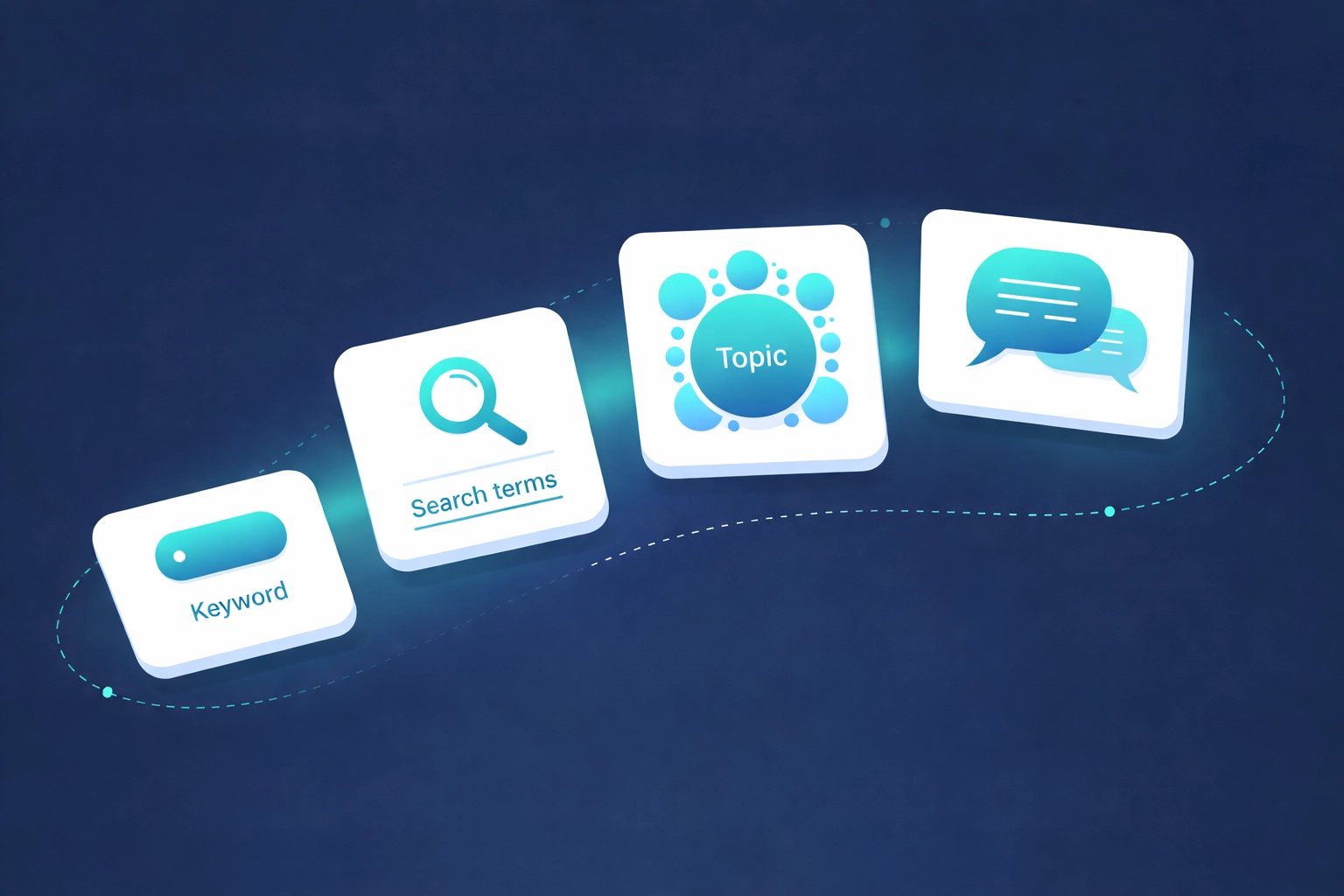
Prompts vs. Keywords vs. Queries vs. Topics
Let's clear up some confusion. These terms get thrown around a lot, but they're not the same thing.
Keywords
Keywords are individual words or short phrases that describe a topic. They're the building blocks of traditional SEO.
Example: "CRM software," "project management," "email marketing tools"
Keywords are static. They don't carry intent or context on their own. Search engines match them to documents, and you get a list of results.
Search Queries
A search query is what you type into a traditional search engine. It can be a keyword, a question, or a phrase. Google then returns a ranked list of links.
Example: "best CRM for small business"
Queries are still primarily about retrieval. You ask, the search engine points you to pages, and you do the work of finding your answer.
Topics
Topics are broader themes or subject areas. They're useful for content planning and establishing authority.
Example: "Customer relationship management," "marketing automation," "sales enablement"
Topics help you organize your content strategy, but they're not what users actually type.
Prompts
Prompts are conversational inputs to AI systems. They generate direct responses, not lists of links.
Example: "I run a 50-person marketing agency. What CRM would you recommend and why?"
Here's the key difference: prompts don't just retrieve information , they synthesize it. The AI reads, processes, and generates an answer based on everything it knows.
A Side-by-Side Comparison
| Aspect | Keyword | Search Query | Prompt |
|---|---|---|---|
| Format | Single word or short phrase | Word, phrase, or question | Full sentence or command |
| Context | None | Minimal | Often includes specifics |
| Response | Used for indexing | List of ranked links | Synthesized, direct answer |
| Interaction | Static | Static | Dynamic (can refine in real-time) |
| User effort | High (you find the answer) | Medium (you click and read) | Low (answer is delivered) |
This table isn't just academic. It represents a fundamental shift in how people find and consume information.
Why Prompts Matter for GEO, AIEO, and AIO
If you're working on Generative Engine Optimization (GEO), AI Engine Optimization (AIEO), or AI Optimization (AIO) , whatever you want to call it , prompts are your new battlefield.
Here's why:
1. Prompts Reveal True Intent
Keywords are vague. "CRM software" could mean someone wants to buy one, compare options, learn what CRM means, or find news about the industry.
Prompts are specific. "What's the best CRM for a real estate team that needs mobile access?" tells you exactly what this person needs. The AI uses that specificity to generate a tailored response.
If your brand isn't associated with that specific use case in the AI's training data or retrieval sources, you won't get mentioned. Period.
2. Prompts Are Conversational
People refine their prompts in real-time. They ask follow-up questions. They say "tell me more about option 2" or "what about pricing?"
This creates a dialogue, not a one-and-done query. Your brand needs to be relevant enough to appear in multiple turns of that conversation.
3. Prompts Generate Answers, Not Options
When someone searches Google, they get 10 blue links and choose where to click. Your job is to rank and earn that click.
When someone prompts ChatGPT, they get one answer. Maybe it mentions 3-5 brands. Maybe just one. The AI has already done the choosing.
If you're not in that answer, you don't exist for that user.

4. Prompts Can't Be "Ranked" the Traditional Way
You can't pay for position one in an AI response (at least not yet). You can't stuff prompts with keywords. The AI synthesizes information based on what it has learned and what it can retrieve.
This means your visibility depends on:
- Being in the training data (your content was used to train the model)
- Being in retrieval sources (your content is indexed and pulled in real-time)
- Being associated with the right concepts (when someone asks about your category, the AI connects you to it)
That's a completely different game than traditional SEO.
What This Means for Your Brand
If you've built your entire marketing strategy around keywords, you're not wrong , you're just incomplete.
Keywords still matter for traditional search. But prompts are how a growing number of people (especially younger demographics and power users) are getting their information.
Here's what you should be thinking about:
Think in Questions, Not Keywords
Your audience isn't typing "marketing analytics platform." They're asking "What tools can help me understand which content drives revenue?"
Create content that answers those specific questions. Be the source the AI wants to cite.
Add Context to Your Content
Generic content gets generic treatment. Content that addresses specific use cases, industries, team sizes, or problems is more likely to be pulled into prompt responses.
"Best CRM" is less useful than "Best CRM for B2B SaaS startups with product-led growth models."
Build Topical Authority
AI models associate brands with topics based on patterns in their training data. If your brand consistently publishes expert content about a topic, you're more likely to be cited when someone prompts about that topic.
This takes time, but it compounds.
Monitor What AI Says About You
Here's the part most brands miss: they have no idea what AI assistants are saying about them.
When someone asks ChatGPT to recommend a tool in your category, does your brand come up? What does it say? Is the information accurate?
You can't optimize what you can't see.

How CiteMetrix Helps You Win the Prompt Game
This is exactly why we built CiteMetrix.
Traditional analytics show you rankings and traffic. But they can't tell you whether ChatGPT mentions your brand when someone asks for recommendations in your space.
CiteMetrix tracks your AI citations across major AI platforms. You can see:
- When you're mentioned in AI responses
- What's being said about your brand
- How you compare to competitors
- Your ModelScore™ : a single metric for your overall AI visibility
Because in the age of prompts, visibility isn't just about ranking. It's about being part of the answer.
The Bottom Line
Prompts are the new search queries. They're more specific, more conversational, and more powerful than keywords ever were.
If you're serious about GEO, AIEO, or whatever we end up calling AI optimization, you need to understand how prompts work : and how to make sure your brand shows up when they're asked.
Start by shifting your mindset from "what keywords do we rank for?" to "what questions do we answer?"
Then make sure you can actually see the results.
Ready to see what AI says about your brand? Get your ModelScore → citemetrix.com