Open your analytics dashboard. You can probably tell me, within a few percentage points, how much traffic came from organic search last month. Paid search. Social. Email. Referral. Direct.
Now tell me how many prospects asked an AI assistant about your category and never saw your brand in the response.
You can't. Nobody can. And that's the biggest blind spot in modern marketing.
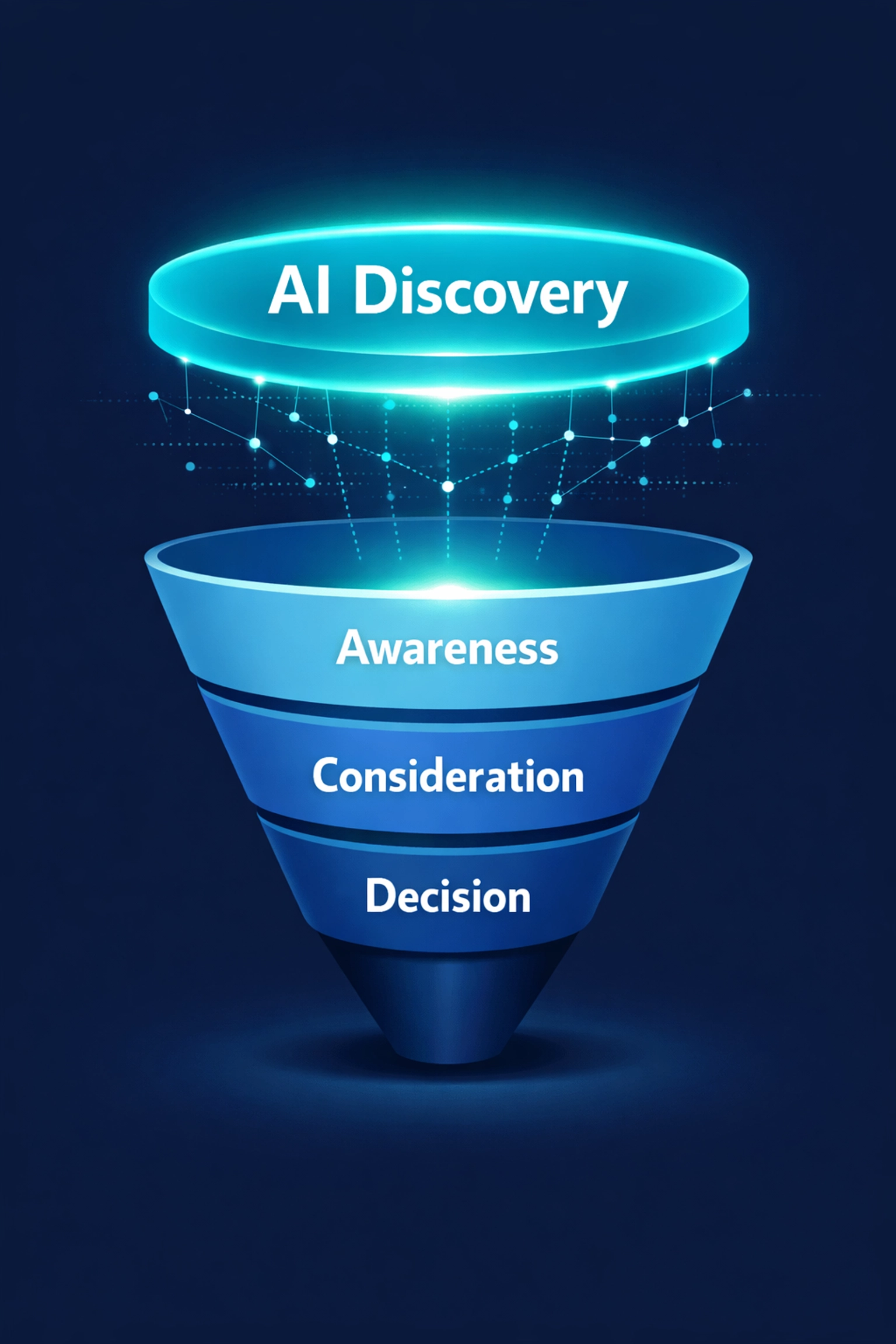
There's a funnel stage before your funnel
Marketers have spent years optimizing every stage of the buyer's journey: awareness, consideration, decision. We track impressions, clicks, conversions, and everything in between. We've built a sophisticated measurement infrastructure that accounts for nearly every touchpoint between a prospect and a purchase.
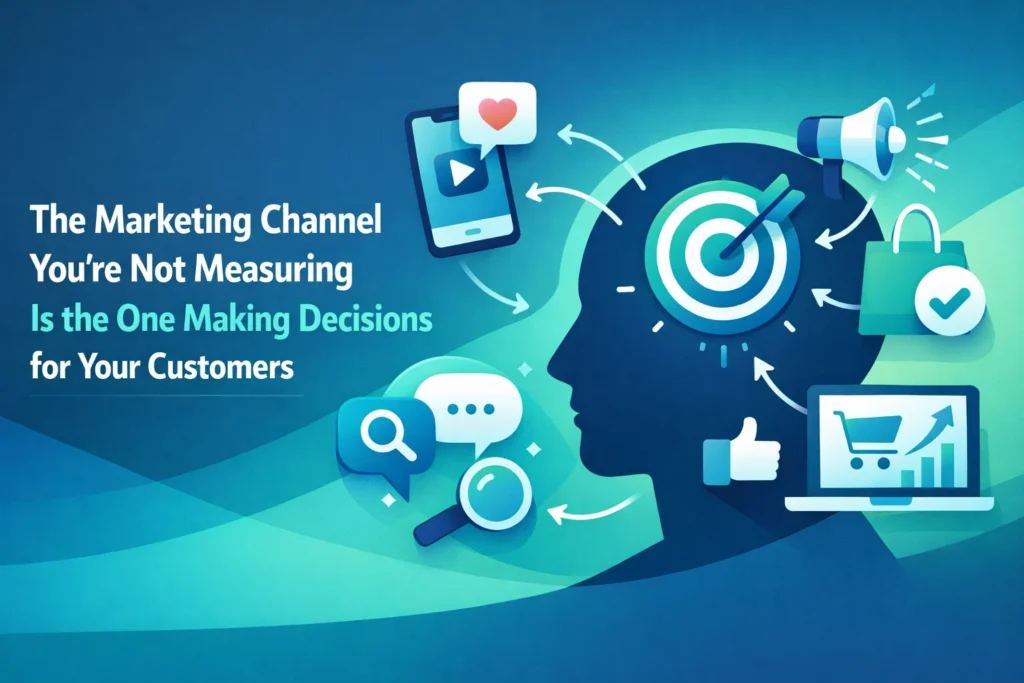
But a new stage has quietly inserted itself before all of that : and it has no analytics attached to it.
When a buyer opens ChatGPT and asks "What's the best project management tool for a remote team of 20?", the AI's response determines which brands enter that person's consideration set. If you're mentioned, you're in the running. If you're not, you don't exist. There's no click, no impression, no pageview. The prospect makes a mental shortlist based entirely on what the AI tells them, and your analytics never register a thing.
This is the pre-funnel. And for a growing number of buyers, it's where the real decision gets made.
The numbers are bigger than you think
It's easy to dismiss this as a niche behavior. It's not.
ChatGPT has over 200 million weekly active users. Perplexity is processing millions of queries per day. Google's AI Overviews now appear on a significant and growing percentage of search results, answering questions directly instead of showing ten blue links. Microsoft Copilot is embedded in the browser and operating system used by over a billion people.
The research backs this up. Studies consistently show that a growing share of consumers : particularly younger demographics and professionals : are using AI assistants as their first step when researching products and services. They're not replacing Google entirely, but they're increasingly starting with AI and then using Google to verify or purchase.
That means a meaningful percentage of your prospects are forming their first impression of your brand through a channel you have zero visibility into.
Citation rate: the metric you should be tracking
In traditional SEO, we track rankings. Position 1 through 10, maybe 20. The metric is clear: where do you show up in the results?
AI search doesn't have positions. There's no ranking. The AI either mentions your brand in its response or it doesn't. The closest equivalent to a search ranking is your citation rate : the percentage of relevant queries where AI platforms mention your brand.
Here's why this matters more than it might sound: citation rate varies wildly by platform.
A brand might be mentioned by ChatGPT in 40% of relevant queries but only 10% of the time on Perplexity. Claude might never mention them at all. Each AI platform draws from different training data, different source indexes, and different recency windows. Your visibility isn't uniform : it's fragmented across platforms in ways you can't predict without measuring.
And citation rate isn't static. It shifts as models get updated, as new content gets indexed, as competitors publish new material that changes how the AI perceives your category. A brand that's well-represented in ChatGPT today might lose ground next month after a model update.

Tracking your citation rate over time, across platforms, is how you turn AI visibility from an abstract concern into a measurable, improvable marketing channel.
The trend is the story
A single citation rate snapshot tells you where you stand. A trend tells you where you're heading.
If your citation rate is rising across platforms, something you're doing is working. Maybe your content strategy is producing the kind of comprehensive, authoritative pages that AI models favor. Maybe a PR push generated enough third-party mentions to shift how AI perceives your brand. Maybe a competitor stumbled and you moved up by default.
If your citation rate is declining, something has changed : and you need to find out what before the damage compounds. A model update might have reshuffled the sources it draws from. A competitor might have published a comparison page that now dominates the AI's narrative about your category. Your pricing page might have changed in a way that the AI hasn't picked up yet, so it's citing outdated information and steering people elsewhere.
Without the trend data, you're blind to all of this. You're making content and marketing decisions without knowing whether they're improving or degrading your visibility in the fastest-growing discovery channel in a decade.
How to start measuring this today
The manual version: pick 10–15 queries your ideal customer would ask an AI assistant. Run them across ChatGPT, Perplexity, and Claude. Record whether your brand is mentioned in each response. That's your baseline citation rate per platform.
Do the same thing in two weeks. Then again in a month. Plot the numbers. You'll start seeing patterns that no other marketing metric is showing you.
Doing this manually doesn't scale
That exercise gives you a snapshot, but it doesn't give you the trend, the platform breakdowns, or the competitive context you need to act on the data. It also takes hours that most marketing teams don't have, and AI responses change frequently enough that manual spot-checks miss the shifts between measurements.
Several platforms have been built to automate AI visibility tracking. A few worth looking at:
- CiteMetrix : Tracks citation rates across six AI platforms with trend charts, platform-by-platform breakdowns, and competitive benchmarking. Includes a composite visibility score and remediation tools. Disclosure: this is my platform.
- Profound : Monitors AI mentions across 10+ models with workflow features for larger teams. Enterprise-focused.
- Otterly AI : Tracks brand visibility across five AI platforms. Straightforward monitoring for teams getting started.
- PromptMonitor : Monitors eight AI platforms with a focus on keyword-level tracking. Lighter-weight option for individual practitioners.
The important thing isn't the tool : it's the decision to start measuring. Every week you're not tracking your AI citation rate is a week of lost data you can't get back.
The invisible channel won't stay invisible
There will come a day : probably sooner than most people expect : when AI visibility metrics sit alongside organic traffic and paid search in every marketing dashboard. When CMOs ask "what's our citation rate across AI platforms?" the same way they currently ask "what's our domain authority?"
When that day arrives, the brands with 12 months of trend data will have an enormous advantage over the brands just starting to measure. They'll know which content drives AI citations. They'll know which platforms they're strong on and which they're weak on. They'll have a playbook that took a year to build.
You can be one of those brands, or you can be the one scrambling to catch up.
Ready to see what AI says about your brand? Get your baseline citation rate and start tracking your visibility across platforms. Start your free trial at CiteMetrix →
Eric Richmond is the founder of Expert SEO Consulting and has spent 20+ years helping brands navigate changes in how people find information online. He writes about the intersection of AI, search, and brand visibility.