Part 6 of The AI Visibility Gap series
Most companies have hundreds of pages on their website. Blog posts, landing pages, product pages, case studies, whitepapers, help docs, about pages. Years of content investment, carefully crafted and optimized for search engines.
AI platforms are ignoring almost all of it.
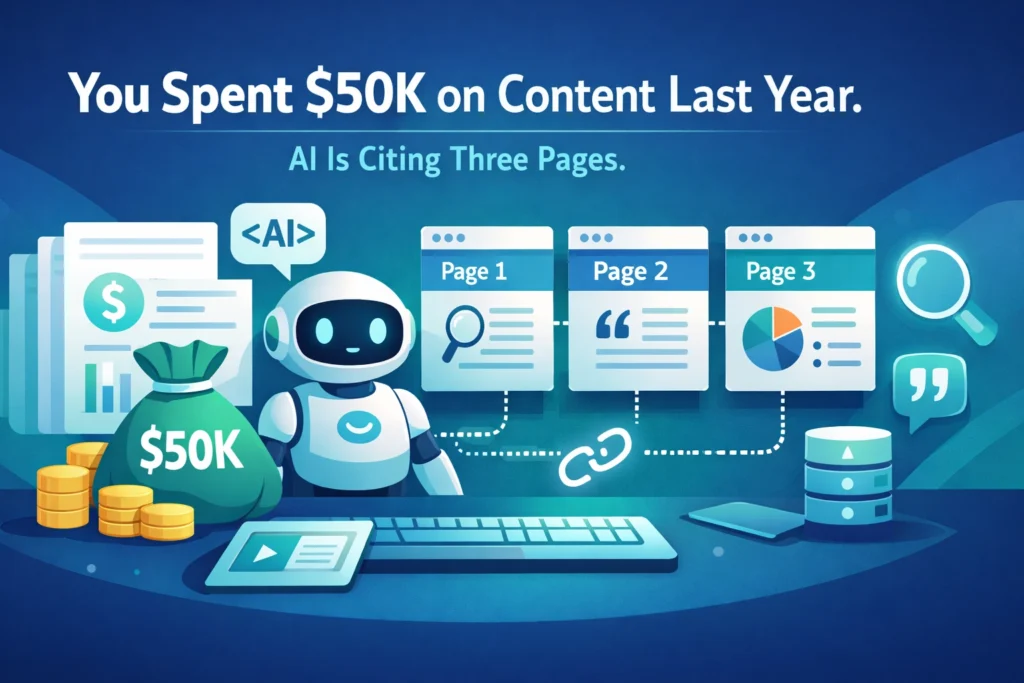
When ChatGPT, Perplexity, or Claude answers a question about your category and mentions your brand, they don't pull from your entire website. They pull from a tiny handful of pages : sometimes as few as two or three : that they've determined are the most relevant, most authoritative, most useful sources for the query at hand.
Every other page you've published? Invisible. Not cited. Not referenced. Not influencing the AI's narrative about your brand.
That gap between the content you've created and the content AI actually uses is one of the most important : and most overlooked : insights in modern content strategy.
AI doesn't browse your website. It cherry-picks.
Google's approach to content is relatively democratic. It crawls your entire site, indexes hundreds of pages, and shows different pages for different queries. A blog post might rank for one keyword while your pricing page ranks for another. Your content portfolio works as a whole.
AI platforms work differently. When they construct a response about your category, they're synthesizing information from across the internet : and they're choosing sources based on a very different set of criteria than Google uses.
AI tends to favor pages that are comprehensive. Not 500-word blog posts, but deep, thorough resources that cover a topic from multiple angles. Pages that answer the question fully rather than introducing a concept and then asking the reader to "contact us to learn more."
AI tends to favor pages that are well-cited elsewhere. If other sites link to and reference a particular page on your site, AI models treat that as a signal of authority. A page nobody links to is a page the AI is less likely to trust.
AI tends to favor pages with structured, clear information. Pricing tables. Feature comparisons. Detailed specifications. FAQ sections. Content that's organized in a way that makes it easy for a model to extract and synthesize specific facts.
This means the content strategy that works for Google SEO doesn't necessarily work for AI visibility. You might have 200 blog posts that drive steady organic traffic : and none of them might be the pages AI platforms are using to form their opinion of your brand.

The pages AI cites tell you what it values
When you discover which of your pages are actually being referenced by AI platforms, you learn something profound about your content strategy: what's working and what's noise.
If AI consistently cites your comprehensive comparison page, that tells you authoritative, balanced content that contextualizes your brand within the broader market is what models find valuable. If it cites your technical documentation but ignores your marketing pages, that tells you AI is drawn to specificity and substance over positioning language.
If it cites a third-party review site instead of your own pages, that's an even more important signal. It means the AI trusts someone else's description of your brand more than your own. That's not a criticism : it's a content opportunity. It means you haven't created the definitive resource about your own product that an AI would prefer to cite.
And here's the insight that changes content strategy entirely: the pages AI cites for your brand are also the pages shaping AI sentiment and accuracy about your brand. If AI is pulling from an outdated comparison page that lists your old pricing, that's where the inaccurate pricing information is coming from. If it's pulling from a lukewarm review, that's where the tepid sentiment originates.
Source pages aren't just an attribution metric. They're the root cause of every other AI visibility problem.
Most content strategies are optimized for the wrong channel
Here's the uncomfortable truth for content marketers: the content calendar that drives your blog : weekly posts, keyword-targeted articles, seasonal campaigns : is optimized for Google's crawl-and-rank model. Produce a lot of content. Target long-tail keywords. Build topical authority through volume.
AI platforms don't reward volume. They reward depth.
A single, definitive, 3,000-word guide to your product category : one that's comprehensive, regularly updated, well-structured, and referenced by other sites : may be worth more in AI visibility than 50 blog posts combined. Because AI doesn't need 50 sources about your brand. It needs one or two really good ones.
This doesn't mean blog content is useless. It means the purpose of your content needs to expand beyond driving organic traffic. Some content should be designed specifically to be the page AI platforms cite when they talk about you. That's a different brief, a different format, and a different success metric than what most content teams are currently working toward.

Your competitor's content is shaping your narrative
Source pages don't just include your own website. AI platforms also pull from comparison sites, review platforms, industry publications, forums, and competitor websites.
When a competitor publishes a detailed comparison page : "[Competitor] vs. [Your Brand]: Which Is Better for Enterprise Teams?" : and that page gets referenced by AI platforms, your competitor is literally writing the script that AI uses to describe you. They control the framing. They choose which features to highlight. They set the tone.
And if you haven't created your own comprehensive comparison content, the AI has no alternative source. It uses what's available. That often means your competitor's version of the story.
This is why understanding source attribution matters so much. It's not just about knowing which of your pages AI cites. It's about knowing what other pages are influencing the AI's narrative about your brand : and deciding whether you need to create better alternatives.
How to discover your AI source pages
The manual approach requires using AI platforms that show their sources. Perplexity is the most transparent : it cites specific URLs for every claim. Claude and ChatGPT sometimes reference sources when web browsing is enabled.
Try this: ask Perplexity five to ten questions about your brand and your category. For each response that mentions you, look at the cited sources. Note:
- Which of your pages are cited? (And which aren't?)
- Which third-party pages are cited?
- Are any competitor pages being used to describe you?
- Are the cited pages current, or are they outdated?
Then ask the same questions about your top competitor. Look at their cited sources. Are they being represented by their own content, or by third-party content? How does their source profile compare to yours?
This exercise usually produces a few immediate insights: pages you didn't expect to be cited, pages you wish were cited but aren't, and third-party content you didn't know existed that's actively shaping the AI narrative about your brand.
Doing this manually doesn't scale
Source attribution is the most platform-dependent of all AI visibility metrics : each model draws from different sources at different times, and the sources can change between queries. Tracking this systematically requires monitoring across platforms over time, which is impractical to do by hand.
Several AI visibility tools track source page attribution. A few to consider:
CiteMetrix (citemetrix.com) : Tracks which source pages AI platforms reference when mentioning your brand, classified by content type (blog post, comparison page, documentation, review, etc.). Shows your attribution rate : the percentage of citations where AI references your own content vs. third-party sources : and helps identify which pages to improve or create. Disclosure: this is my platform.
Profound (profound.com) : Source tracking across 10+ AI models with enterprise features. Strong attribution reporting for larger teams managing multiple brands.
Peec AI (peec.ai) : Partial source attribution across five platforms. Useful for basic understanding of which pages AI references.
Otterly AI (otterly.ai) : Monitors brand mentions across five platforms with some source visibility. Lighter-weight but accessible.
The specific tool matters less than the strategic shift: start thinking of your content not just as traffic-driving assets, but as AI-influencing assets. The pages AI cites are the pages that write your brand's story in the AI era.
The $50K question
If you spent $50,000 on content last year and AI is only citing three pages, that's not necessarily a failure. Those three pages might be incredibly effective at representing your brand. The question is whether they're saying what you want them to say : and whether there are gaps in the AI narrative that you could fill by creating new content specifically designed to be cited.
The most valuable content investment you make this year might not be another 50 blog posts. It might be one definitive resource page that becomes the page AI reaches for whenever someone asks about your category.
Traditional content strategy asks: "What will rank on Google?"
AI-era content strategy asks: "What will AI cite when it describes our brand?"
Those are very different questions. And the brands that start answering the second one will have a significant head start when everyone else catches up.
Ready to see which pages AI actually cites when talking about your brand? Start tracking your AI visibility →
Eric Richmond is the founder of Expert SEO Consulting and has spent 20+ years helping brands navigate changes in how people find information online. He writes about the intersection of AI, search, and brand visibility.