For years, technical SEO was about making things easy for Googlebot. We obsessed over sitemaps, canonicals, and crawl budgets. But the game just changed.
Today, there’s a new set of "users" visiting your site: Large Language Model (LLM) crawlers.
If ChatGPT, Claude, or Perplexity can't effectively crawl and parse your data, your brand won't show up in their answers. It’s that simple. You could have the best product in the world, but if you fail the technical AI readiness test, you are effectively invisible to the millions of people moving away from traditional search.
As an in-house or technical SEO, your job is no longer just about "ranking." It’s about "indexing for inference."
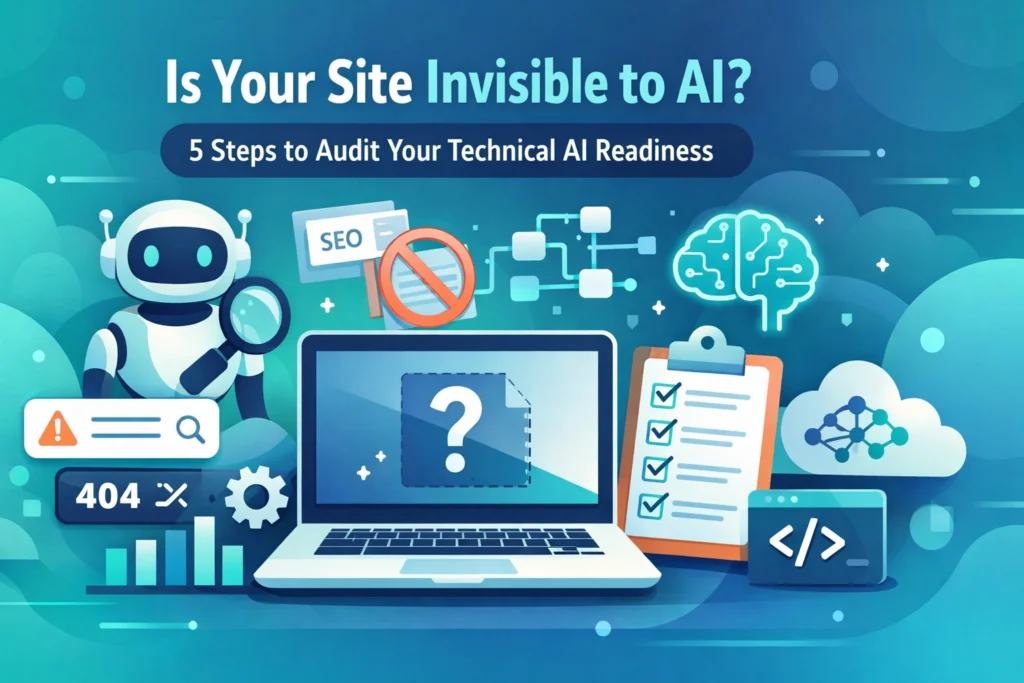
Here are five steps to audit your site’s technical AI readiness and ensure you’re not getting left behind in the age of generative engine optimization.
1. Audit Your AI Crawler Permissions (The "Front Door" Check)
The first step is the most basic, yet it’s where most brands fail. Traditional search engines use Googlebot and Bingbot. AI models use a completely different set of crawlers like GPTBot (OpenAI), OAI-SearchBot, and CCBot (Common Crawl).
Many legacy robots.txt files actually block these crawlers by mistake. Some older security configurations see the high-frequency crawling of an LLM and flag it as a DDoS attack, sitting behind a Cloudflare wall that the AI can't climb.
The llms.txt File
There is a new emerging standard you need to know about: llms.txt. Similar to robots.txt, this file lives in your root directory and provides specific instructions for LLMs. It’s designed to give models a "map" of your most important data in a way they can actually digest.
What to check:
- Review your
robots.txtto ensure you aren't accidentally blockingGPTBotorPerplexityBot. - Check your server logs. Are you seeing "403 Forbidden" errors from AI user agents?
- Implement a
llms.txtfile to proactively guide AI models to your high-value content.
At Citemetrix, we’ve integrated AI Crawler Monitoring into our platform. This allows you to see exactly which AI bots are hitting your site, how often, and: most importantly: which pages they are ignoring. If the AI isn't crawling your high-margin product pages, you won't get the citation.

Caption: A dashboard view of AI crawler activity, showing which models are visiting your site.
2. Optimize for "Content Chunking" and Semantic Structure
LLMs don’t read pages the way humans do. They "chunk" information into smaller segments to process them. If your content is buried in massive, 3,000-word blocks of text without clear breaks, the AI might miss the context or fail to associate your brand with a specific solution.
Technical AI readiness requires a shift toward semantic HTML structure.
How to Audit Your Structure:
- H-Tag Hierarchy: Are your H2s and H3s descriptive? Instead of a header that says "Benefits," use "Benefits of Using [Brand Name] for [Specific Problem]." This gives the AI a clear anchor for its "chunk."
- Bullet Points and Tables: AI models love structured lists and tables. They are easy to parse and often end up as the direct source for "comparison" queries in ChatGPT.
- Contextual Proximity: Keep related information close together. If you mention a feature, the benefit and the price should be in the same "chunk" of text, not separated by three generic images and a sidebar.
If your site is built on a heavy JavaScript framework that requires multiple clicks to reveal content (like accordions that don't load in the DOM), the AI might never see it. Always aim for a "text-first" accessibility approach.
3. Leverage Advanced Metadata and Schema for LLMs
Schema markup used to be about getting a "star rating" in Google search results. In the AI era, Schema is the primary way you tell a machine exactly what your data means without any ambiguity.
When an AI model looks at a page, it’s trying to identify entities. If you have clear Product, Organization, and FAQ Schema, you are essentially hand-feeding the model the facts.
Key Schema to Implement for AI Search Optimization:
- Product Schema: Include price, availability, and specific features. If ChatGPT is asked for the "cheapest high-end camera," it will look for structured data to confirm the price.
- Organization Schema: Clearly define your brand, your founders, and your niche. This builds the "identity" the AI associates with your site.
- FAQ Schema: This is gold for AI search. It provides a direct question-and-answer format that LLMs can easily lift and use as a citation.
Check out the ultimate checklist for AI search visibility in 2026 for a deeper dive into which Schema types move the needle most for your ModelScore™.
4. Fix Your JavaScript Rendering Issues
This is a classic technical SEO problem that has become a massive hurdle for ai search optimization.
While Google has gotten very good at rendering JavaScript, many AI crawlers are still catching up. If your content is hidden behind client-side rendering (CSR) and doesn't appear until after a heavy script runs, the AI crawler might see a blank page or a loading spinner.
The Rendering Audit:
- View Source: Use a "Disable JavaScript" extension in your browser. If your core content disappears, the AI might not see it.
- Server-Side Rendering (SSR): If you are using React, Vue, or Angular, ensure you are utilizing SSR or Static Site Generation (SSG). This ensures the HTML is present the moment the crawler hits the URL.
- Speed Matters: AI crawlers have "patience" levels just like Googlebot. If your page takes 8 seconds to render, the bot may move on before the content even exists.
Monitoring your technical foundation is a huge part of your ModelScore™. If the technical foundation is weak, your authority won't matter because the models simply can't find the proof.

Caption: A technical audit checklist comparing traditional SEO needs vs. AI readiness needs.
5. Audit Your E-E-A-T Signals (For Machines)
Experience, Expertise, Authoritativeness, and Trustworthiness (E-E-A-T) are no longer just "quality rater guidelines" for humans. They are data points that LLMs use to determine which sources are "hallucination-prone" and which are "authoritative."
AI models are trained to prioritize consensus. If your site doesn't have technical signals of authority, the model may find your content but choose not to cite it because it doesn't "trust" the source.
Technical E-E-A-T Signals:
- Author Profiles: Every blog post should have a linked author profile with
Personschema. This helps the AI connect the content to a known entity. - Secure Connection (HTTPS): A non-negotiable. Many AI crawlers will simply skip non-secure sites to avoid spreading potentially malicious content.
- Citations and Outbound Links: Showing your work helps the AI understand your place in the "knowledge graph." If you cite reputable sources, the AI perceives your site as part of a high-quality neighborhood.
Why You Need AI Crawler Monitoring
The biggest mistake you can make right now is assuming that because you have high rankings in Google, you have high visibility in AI.
Traditional SEO tools are blind to the "dark traffic" of AI search. You might be getting 10,000 visits from Google, while a competitor is getting 5,000 visits from Google plus being recommended 50,000 times a day in ChatGPT.
You need to know:
- Is the AI crawling my site?
- Which pages is it ignoring?
- Why is it citing my competitor instead of me?
This is why we built Citemetrix. We bridge the gap between technical SEO and the new world of LLMs. From tracking your AI reputation score to monitoring specific crawler behavior, we give you the data you need to stay visible.
Conclusion: Don't Wait Until You're Invisible
The shift to AI-powered search is happening faster than the shift to mobile did a decade ago. If you wait until your organic traffic drops to zero to start thinking about technical AI readiness, it will be too late.
Audit your site today. Check your permissions, clean up your structure, and make sure the bots can actually "read" what you're selling.
Ready to see if the machines can find you?
See what AI says about your brand → citemetrix.com