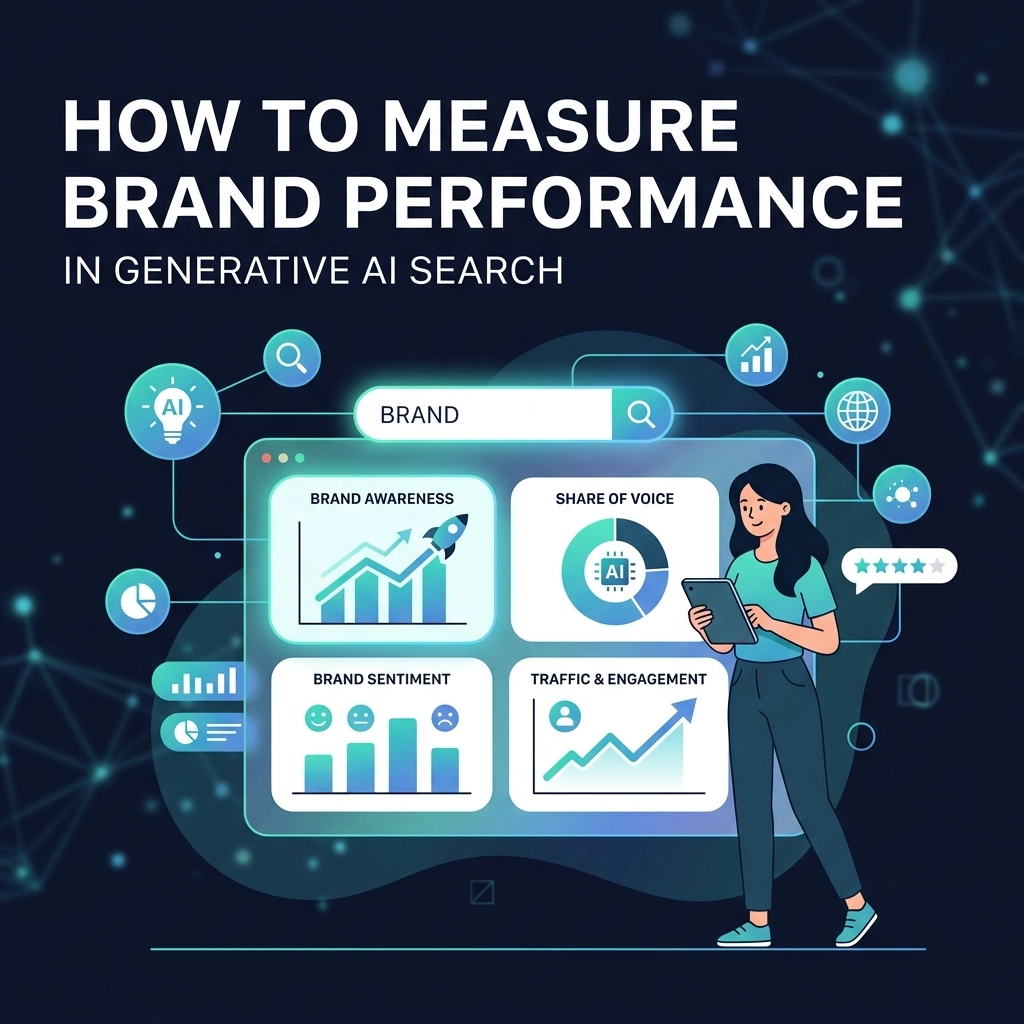
Most executives start their AI visibility assessment the same way: they open ChatGPT and type their company name. Within seconds, they discover whether their brand exists in the AI's knowledge base.
It feels good to see your name in lights: or in this case, in a glowing text box. But this manual approach, while essential as a starting point, only scratches the surface of what you actually need to know to drive revenue. If you aren't measuring the right data, you’re essentially flying blind in the biggest shift to search since the 90s.
Testing Brand Visibility: The "Vibe Check" vs. Reality
When you test queries like "[your company name] features" or "alternatives to [competitor]" across ChatGPT, Perplexity, Google Gemini, Claude, and Microsoft Copilot, you're conducting a fundamental brand visibility audit.
In this initial "vibe check," you’re looking for three critical elements:
- Existence: Does your brand appear at all?
- Connectivity: Are mentions accompanied by working links?
- Context: What is the tone and narrative surrounding your brand name?
Here's what most people miss: appearing once doesn't signal success. At Citemetrix, we recently analyzed a health and wellness resort that showed strong branded visibility. AI platforms knew exactly who they were. However, they registered zero unbranded citations across 1,200 AI platform checks.
They were essentially invisible in the queries where prospective guests actually discover wellness destinations (e.g., "best luxury spa retreats in the Northeast"). If you only show up when people already know your name, you aren't winning new business: you're just maintaining the status quo.
Metrics That Actually Predict Revenue Impact
Traditional SEO metrics tell you how pages rank, but they don't tell you how brands perform in generative responses. AI visibility requires fundamentally different success indicators. To understand your performance, you need to track metrics that align with how decision-makers evaluate solutions today.
1. Citation Rate
This measures the frequency and accuracy of your brand across AI engines. Unlike traditional rankings, this metric captures whether your brand appears in relevant answer sets and whether the information presented is factually correct. A 2025 iPullRank study found that citation rate correlates more strongly with qualified lead generation than traditional organic traffic metrics.
2. Share of Voice (SoV)
SoV quantifies your competitive visibility. This metric reveals what percentage of relevant AI responses mention your brand compared to your competitors. For example, if a user asks for "top marketing analytics tools," and Citemetrix appears in 6 out of 10 responses while a competitor appears in 2, our Share of Voice is significantly higher.
3. The CiteMetrix ModelScore™
At Citemetrix, we realized that single metrics don't tell the whole story. We developed the ModelScore™ to provide a 0-100 composite metric that gives executives a bird's-eye view of their AI health.

Technical Graphic 1: A clean breakdown of the ModelScore™ components: Mention Score (45%), Brand Demand (20%), Authority Transfer (20%), and Technical Readiness (15%).
Why this matters more than traditional SEO: AI platforms don't provide click-through rates or impression data for every generative response. You often can't track performance until users actually click through to your site. By then, the AI has already influenced their perception and consideration set. The ModelScore™ lets you see that influence before the click happens.
Why Citation Sentiment Determines Brand Trust
AI amplifies sentiment in ways traditional search never could. A single negative mention in an AI summary reaches more decision-makers than a buried negative review because users trust AI responses as authoritative and comprehensive.
We use weighted multipliers based on placement to score sentiment:
- Top Summaries: 3x weight (The opening paragraph is where opinions are formed).
- Mid-Answer References: 2x weight.
- Buried Citations: 1x weight.
A negative mention in ChatGPT's opening paragraph carries more reputational risk than multiple positive mentions lower in the response.

Technical Graphic 2: A 'Sentiment Radar' chart showing how a brand is perceived (Innovative, Leader, Trusted vs. Negative traits).
Beyond simple positive/negative labels, you need to monitor Contextual Sentiment. Does your brand appear in innovation discussions or maintenance conversations? Are you positioned as a leader or a follower? Context shapes prospect expectations before they ever speak with your sales team.
Controlling Your Brand Story Through Narrative Consistency
AI platforms synthesize information from multiple sources to create brand narratives. Without active management, your messaging gets filtered through the AI's interpretation rather than your strategic positioning.
Narrative consistency testing compares AI-generated brand descriptions against your official messaging framework. At Citemetrix, we’ve found that brands with consistent narrative scores above 80% show measurably higher conversion rates from AI-referred traffic.
If you want to check how the world’s most popular models see you, see what AI says about your brand → citemetrix.com.
Preventing Narrative Hijacking
Competitors can influence your brand narrative through strategic content publication. When their content gets cited more frequently than yours, their framing of your solution becomes the AI's default interpretation. Regular auditing identifies these shifts before they solidify into persistent AI "knowledge."
Automation Tools That Scale Executive Oversight
Manual testing provides initial insights but can't deliver the consistent monitoring that AI visibility requires. You need specialized tools that fit into an executive workflow.
- HubSpot AI Search Grader: Great for a quick presence check, but requires manual interpretation.
- Yext Scout: Excellent at detecting citation drops, though it often requires separate tools for remediation.
- Semrush Position Tracking: Useful for correlating AI citation changes with traditional organic search performance.
- Meltwater: Strong on sentiment, but limited in competitive benchmarking specific to AI.
- CiteMetrix: The only platform designed for the full monitor-to-fix workflow: monitoring, detection, and remediation across 8 AI platforms + Google AI Overview from a single dashboard.
Competitive Intelligence That Drives Strategic Decisions
Understanding why competitors dominate AI citations reveals actionable opportunities. If a competitor appears in 73% of relevant AI responses, it’s usually because they’ve optimized for the specific content formats AI platforms prefer to cite.
Entity co-occurrence analysis is a fancy way of seeing which brands the AI groups together. When your solution consistently appears alongside market leaders like Salesforce or HubSpot, that association validates your positioning. If you're grouped with "budget alternatives," it suggests a messaging or authority issue that needs addressing.
Strategic Approaches to Increase AI Citations
A 2025 Yext study found that 86% of sources cited by AI platforms are brand-managed content: websites, help articles, and official documentation. This is great news: it means you have control.
Optimization Tactics:
- Structured Data: Use Schema markup (Organization, Product, FAQ) to give AI platforms machine-readable context.
- The llms.txt File: This is the new robots.txt. It allows direct communication with AI platforms about your brand's key facts and preferred messaging.
- FAQ Optimization: Target "How," "What," and "Why" questions. These are the primary triggers for AI citations.
- Content Freshness: AI models prioritize current information. Regular updates to your core documentation are non-negotiable.
The Bottom Line
As AI platforms become the primary discovery channels for B2B and B2C buyers alike, your visibility in generative responses determines your market position. You can't manage what you don't measure.
The brands that invest in systematic AI visibility measurement now will dominate consideration sets in an AI-first environment. Don't let your brand narrative be written by an algorithm you aren't monitoring.
Ready to see your AI visibility? Get your ModelScore → citemetrix.com