If you’re auditing healthcare, pharma, or any content-heavy site for SEO, GEO, or AIEO in 2026, you’ve likely hit a wall when it comes to images. Specifically, the “metadata” wall.
Every few weeks, a version of the same question lands in our inbox at CiteMetrix. It comes from clients, agencies, and even seasoned practitioners. It usually sounds like this:
“We’ve been told we should be embedding more EXIF data in our images to help our SEO rankings. Should we be doing that for AI search and LLMs too?”
It’s a reasonable question. Unfortunately, it’s usually backed by a 2014 answer that just won’t die. In the world of Generative Engine Optimization (GEO), sticking to decade-old folklore is a quick way to waste your budget.
Here is the ground truth in 2026, covering traditional image SEO, AI search visibility, and the new standard that is quietly moving the goalposts for everyone.
First, Let’s Clear Up the Definitions
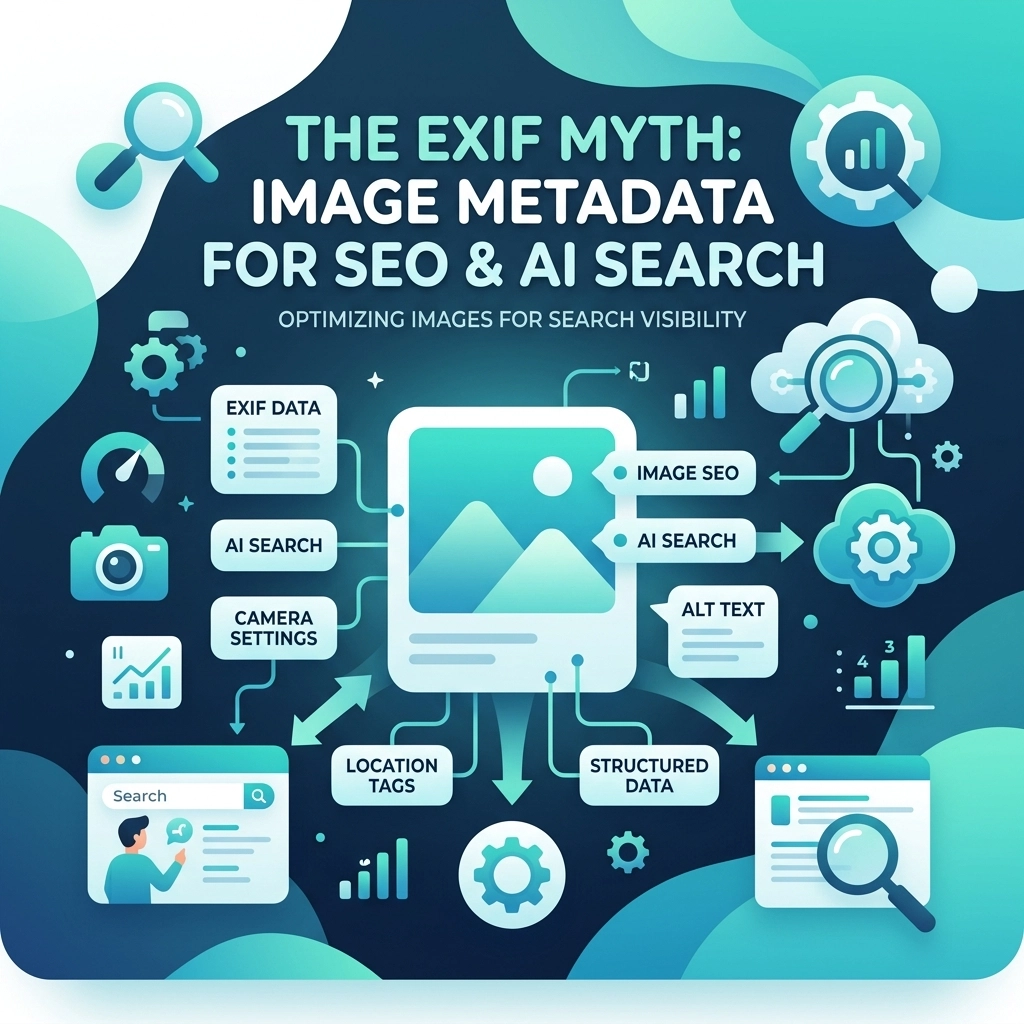
In the SEO world, “EXIF” has become a catch-all term for any data hidden inside a photo. But if you want to optimize correctly, you need to know the three different standards that people constantly confuse.
- EXIF (Exchangeable Image File Format): This is technical capture data. It tells you the camera model, lens settings, ISO, shutter speed, and often GPS coordinates. It’s generated automatically by the device.
- IPTC (International Press Telecommunications Council): This is descriptive data. It’s where you find the creator’s name, credit lines, copyright info, and keywords. This is usually authored manually by a human.
- XMP (Extensible Metadata Platform): Think of this as Adobe’s digital wrapper. It’s a modern format that can hold both EXIF and IPTC data together.
When most “how-to” SEO articles say “Optimize your EXIF,” they actually mean a messy mix of all three. This confusion is where the myth starts.

Visual: A dark-mode diagram showing an image file with three layers: EXIF (Technical), IPTC (Descriptive), and XMP (The Wrapper). Teal and cyan accents highlight the different data points.
Traditional Image SEO: The Answer is “Barely”
The idea that EXIF is a ranking factor traces back to a 2014 video from Matt Cutts, who was then the head of web spam at Google. He famously said Google “reserved the right” to use EXIF in ranking.
In the SEO community, “reserved the right” was immediately translated to “Google uses this to rank you.” They aren’t the same thing.
Fast forward to late 2024 and throughout 2025: Google’s Martin Splitt and John Mueller have been as definitive as they ever get. EXIF is not used for ranking. Google even strips EXIF data from most of its own platforms, including Google Business Profile uploads.
There is also a huge practical reason to avoid heavy EXIF data: File Weight.
Metadata can easily add 15% or more to a JPEG’s file size. In an era where Core Web Vitals and page speed are actual, confirmed ranking factors, keeping that extra “junk” in your trunk is actively hurting you.
The one exception? IPTC Rights Fields.
Since 2018, Google Images has displayed creator and copyright notices next to certain photos. This doesn’t help you rank higher, but it does help with brand visibility and rights enforcement.
The 2026 Playbook for Traditional SEO:
- Strip technical EXIF data on upload.
- Populate IPTC rights/copyright fields.
- Manage file weight aggressively.
AI Search: No, and It Likely Won’t Change
If you are trying to optimize for AI search, you might think ChatGPT or Perplexity are digging into your image files to find keywords.
They aren’t.
ChatGPT, Perplexity, Google Gemini, and Claude do not read embedded image metadata. The architecture of how these models “see” images doesn’t involve reading text strings inside a file header.
Instead, they use Vision-Language Models (VLMs). These models process the actual pixels of an image and turn them into a textual semantic representation. They then combine that “visual understanding” with the text physically surrounding the image on your page:
- Alt text
- Captions
- Schema markup (especially
ImageObject) - The surrounding paragraph text
Recent research into Generative Search Engine Optimization (GEO) confirms this. Multimodal AI search works by mapping visual content into a textual space. If you want an AI to “know” what is in your image, you don’t put it in the EXIF; you put it in the Alt Text and the Caption.

Visual: A minimal vector art graphic showing an AI “eye” scanning an image. On one side, “Embedded Metadata” is blocked by a red X. On the other side, “Pixels + Alt Text + Schema” flows into a teal “Semantic Understanding” brain.
The Real Shift: C2PA and Content Credentials
While EXIF is a dead end for SEO, a new type of metadata is becoming essential for AI brand monitoring.
C2PA (Coalition for Content Provenance and Authenticity) is an open standard for “Content Credentials.” This is cryptographically signed metadata that proves where an image came from, whether AI was used to create it, and what edits were made.
This isn’t about “ranking”; it’s about Trust and Provenance.
Adoption in 2026 is moving at light speed:
- Google is integrating C2PA into its ad systems and search results to flag AI-generated content.
- OpenAI now embeds C2PA metadata in every image generated by ChatGPT and DALL-E.
- Adobe has made Content Credentials a default in Photoshop and Lightroom.
- CISA (Cybersecurity & Infrastructure Security Agency) has endorsed it as a way to fight misinformation.
The question for your brand isn’t “Will this help me rank?” It’s “Will AI engines eventually stop citing images that don’t have verifiable provenance?”
In high-stakes industries like healthcare and finance, the answer is almost certainly yes.

Visual: A data visualization showing the growth of C2PA adoption among major tech platforms (Google, OpenAI, Adobe) from 2024 to 2026. Design is dark mode with teal gradients.
What This Means for Healthcare and Pharma Marketing
If you’re working in pharma, you already know that “authenticity” and “compliance” are your north stars. The metadata conversation here is different.
- Most Pharma DAMs already strip EXIF. Platforms like Veeva Vault or Aprimo usually wipe capture metadata automatically for security and compliance. If you’re worrying about EXIF on your live site, you’re likely fighting a battle your DAM has already won.
- IPTC is for Attribution. Use IPTC fields to manage rights and ensure your brand gets credit when medical illustrations are shared, but don’t expect a ranking boost.
- C2PA is your new E-E-A-T signal. For medical illustrations or AI-assisted MOA (Mechanism of Action) videos, having verifiable Content Credentials will soon be a major trust signal for both human users and AI crawlers.
- Verification is coming. As search engines get better at identifying AI-generated content, being able to prove a clinical photo is authentic (and not AI-generated) will be a massive competitive advantage.

Visual: A “Trust Score” mockup for a medical image. It shows a teal “Verified” badge and a list of provenance steps (Created: Human Photographer -> Edited: Photoshop -> Signed: Brand X).
Bottom Line: The Clean Metadata Strategy
The “EXIF for SEO” question finally has a clear, no-nonsense answer. If you are building an audit framework today, image metadata should be a small bullet point in your technical hygiene pillar, not a massive workstream.
Your Action Plan:
- Strip it: Remove technical EXIF on upload to save file weight and improve Core Web Vitals.
- IPTC: Use it for copyright and creator credit only.
- GEO Focus: Put your effort into Alt Text, Schema Markup, and surrounding context. That is what AI engines actually read.
- Future-Proof: Start looking into C2PA Content Credentials for any AI-generated brand assets.
The interesting work isn’t happening in the camera settings of 2014; it’s happening in the trust-and-provenance layer of 2026.

Visual: A final checklist for 2026 Image Optimization. 1. Fast (Low weight). 2. Semantic (Alt Text/Schema). 3. Trusted (C2PA). Teal checkmarks on a dark navy background.
See what AI says about your brand → citemetrix.com
Get your ModelScore → citemetrix.com