How seven AI platforms changed the rules of brand visibility — and what marketers need to do about it
A research report by CiteMetrix | Published May 2026 | Updated quarterly
Quick reference
For readers in a hurry, the seven findings that define AI search in 2026:
- AI platforms now intercept up to 30% of Google searches before users see organic results, with appearance rates rising rapidly through 2025-2026.
- Only 11% of cited domains overlap between ChatGPT and Perplexity — the two leading AI search platforms agree on almost nothing.
- Reddit accounts for 46.7% of Perplexity’s top citation share, but only 5% of Gemini’s — same source, 9x different weight across platforms.
- Pages with 19+ statistical data points earn 2-3x more AI citations than text-only content.
- Earned media placements outperform owned content by 325% for AI citation rates.
- Citation patterns shift by up to 50% in a single algorithm change — annual SEO audits are now obsolete.
- Perplexity referral traffic converts at roughly 11x the rate of organic search — quality beats quantity per platform.
The implications run through every section that follows.
What “AI search” actually means in 2026
A definition worth making concrete: AI search refers to the practice of asking a large language model (ChatGPT, Claude, Perplexity, Google’s Gemini and AI Overviews, Microsoft Copilot, Grok, and others) a question and receiving a synthesized answer rather than a list of links.
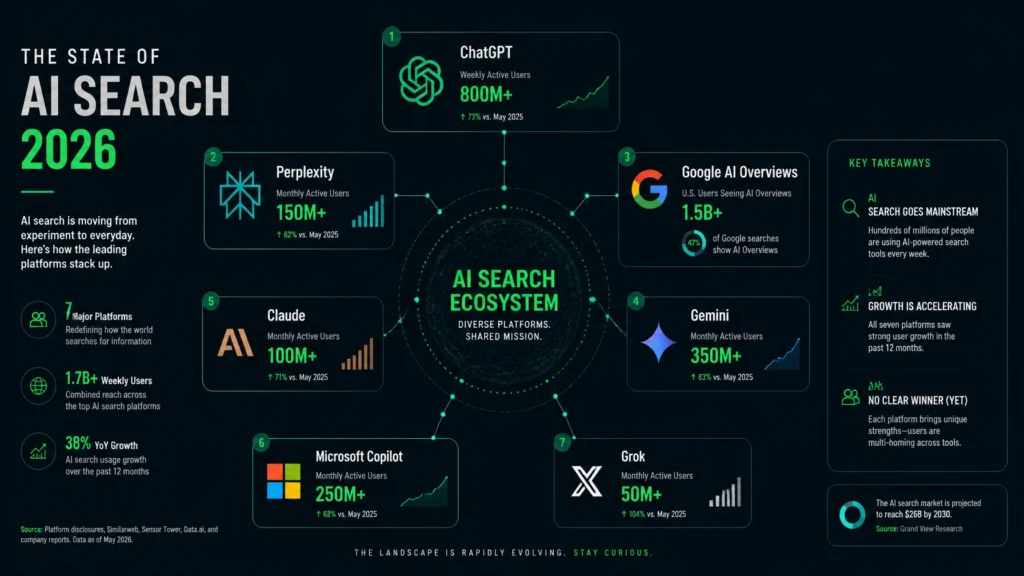
This is not a marginal behavior. ChatGPT now reports over 200 million weekly active users. Google AI Overviews now appears on roughly a quarter to a third of US desktop searches and continues to expand rapidly. Perplexity, while smaller in raw traffic, has become the preferred research tool for analysts, journalists, and considered-purchase buyers — its users convert on referrals at roughly 11x the rate of traditional organic search traffic.
For the past 25 years, brand visibility online has been defined primarily by ranking in Google. The job of an SEO program was to win that single algorithm. That job has fractured. The AI search era replaces one consequential algorithm with seven, each with different mechanics, different content preferences, and different rates of change.
This report covers the state of all seven major platforms as of mid-2026: what they do, how they differ, what brands should know, and how the landscape is changing. We’ll publish a refreshed edition every quarter because, as you’ll see, the data drifts fast enough that a single static snapshot would be misleading by August.
The seven platforms that matter (and the two that don’t yet)
ChatGPT (OpenAI)
The largest AI search platform by usage. Operates in two modes: a “base” mode that answers from training data without citations, and a “search” mode that activates for time-sensitive queries (dates, comparisons, prices, current events) and retrieves live results from Bing.
Citation behavior:
- Cites sources 87% of the time when search activates
- Mentions brands in only 20.7% of answers — among the lowest brand-mention rates of any platform
- Functions like an academic paper with footnotes: precise citations attached to specific claims
- Average 3-5 citations per response
Top cited sources: Wikipedia (47.9% of top-10 citation share), Reddit, Forbes, Business Insider, Amazon, and a rising LinkedIn — which climbed from rank #11 to #5 between November 2025 and February 2026.
The trust cliff: Sites with 32,000+ referring domains are 3.5x more likely to be cited than sites with fewer than 200. ChatGPT is risk-averse — it cites sources it can confidently attribute.
Perplexity
The platform built from scratch as an “answer engine” rather than a search engine. Almost entirely live retrieval. Uses a proprietary index supplemented with Bing.
Citation behavior:
- Average 21.87 citations per response — by far the highest of any major platform
- Visible inline citations are core to the product experience
- Real-time retrieval — Reddit comments appear in Perplexity answers within 24 hours of posting
- 82% citation rate for 30-day-old content
Top cited sources: Reddit dominates (46.7% of top-10 citation share, 24% of all citations), followed by LinkedIn, NIH and other .gov scientific sources, and G2-class review sites.
Perplexity’s hidden advantage: Its visitors convert at roughly 11x the rate of traditional organic search referrals. The traffic volume is smaller than ChatGPT, but per-visitor value is dramatically higher because Perplexity users skew toward researchers, analysts, and high-intent buyers.
Google AI Overviews
The synthesized answer block that now appears on a growing share of Google searches — roughly a quarter to a third of US desktop queries as of late 2025, climbing fast. Uses a “query fan-out” architecture — splits the original query into 5-15 related sub-queries and synthesizes answers across them.
Citation behavior:
- Appears in 25-30% of US desktop Google searches as of late 2025, with appearance rates climbing rapidly (up from ~13% in early 2025)
- Cites sources 84.9% of the time, mentions brands in 61% of answers
- Only 38% of citations come from pages ranking in Google’s top 10 — down from 76% a year earlier
- Pages ranking for the underlying fan-out queries see 161% higher citation odds
Top cited sources: Reddit (21% of top citations), YouTube (18.8% — Google ownership likely a structural advantage), Wikipedia, Quora, and Forbes. More distributed than ChatGPT or Perplexity — no single source dominates as heavily.
The CTR paradox: AI Overviews drop organic click-through on the page by 34-61%. But pages cited inside the AI Overview earn 35% more organic clicks than non-cited competitors on the same SERP. Being cited is the new “position zero.”
Google Gemini
The standalone conversational AI from Google. Same parent search index as AI Overviews but completely different citation algorithm — Gemini builds a knowledge graph of user preferences and conversation history.
Citation behavior — the surprising one:
- Mentions brands in 83.7% of responses (the highest of any platform)
- Generates a citation link in only 21.4% of responses (the lowest of any platform)
- Cites Reddit in only 5% of responses (vs. 44% for Google AI Overviews — a 9x gap between products from the same company)
Top cited sources: Wikipedia, YouTube (Google properties), and traditional SEO winners. Gemini converts traditional Google SEO most directly of any platform.
An important implication: A brand could appear constantly in Gemini conversations and have no visibility through citation-tracking tools — Gemini mentions the brand without linking to a source. This makes brand-mention monitoring (separate from citation monitoring) essential for understanding true Gemini exposure.
Claude (Anthropic)
Anthropic’s AI assistant. Searches via Brave Search index when its reasoning warrants. Conservative citation behavior — cites only what it can verify.
Citation behavior:
- Average 5.67 citations per response — middle of the pack
- Cites less frequently than ChatGPT or Perplexity overall
- Strong preference for editorial authority and conservative attribution
Top cited sources: Legacy journalism is disproportionately represented — The New York Times, The Atlantic, The New Yorker, The Economist. Only 36% of Claude’s journalism citations come from the past year, compared with 56% for ChatGPT. Claude has a longer memory and weights established editorial reputation more heavily.
The audience profile worth knowing: Claude users skew technical, professional, and high-net-worth. For B2B SaaS and considered-purchase categories, Claude citations may convert at higher rates than ChatGPT citations despite being less numerous — the audience quality is higher.
Microsoft Copilot
Bing-based with a GPT layer. Tied closely into Microsoft’s ecosystem — Office, LinkedIn, Edge.
Citation behavior:
- Average 6.89 citations per response
- Differs from all other platforms by prioritizing LinkedIn — which accounts for 43.8% of Copilot’s social citations
- Heavy ecosystem bias toward Microsoft-owned and Microsoft-adjacent content
Top cited sources: LinkedIn, Microsoft documentation and properties, business publications (Forbes, Business Insider, WSJ). Less Reddit-heavy than ChatGPT or Perplexity. Cites YouTube in only 0.5% of responses.
The Copilot user is the enterprise user. B2B-focused content, founder-led LinkedIn thought leadership, and Microsoft documentation references perform disproportionately well here.
Grok (xAI)
The AI assistant integrated into X (Twitter). The only major LLM with native, privileged access to a social platform’s full real-time feed.
Citation behavior:
- Mentions brands at the highest rate of any platform (27% in some studies, vs. 0.59% for ChatGPT)
- Often quotes X posts directly but paraphrases website content
- Live tied to X conversations and trending topics
Top cited sources: X posts (the unique source advantage), real-time news, trending discussions, web sources for factual queries.
A caveat worth flagging: Grok citation share is rising fastest of any platform among power users, but the platform has reputational volatility (multiple 2025-2026 controversies around content moderation). Some brands deliberately limit Grok visibility for risk-management reasons. Whether to invest in Grok-specific tactics is a values question, not just a tactical one.
DeepSeek, Mistral, and Meta AI — for completeness
DeepSeek and Mistral are technically excellent open-source-leaning models with growing usage, but their citation patterns don’t yet differ materially from the dominant platforms. DeepSeek’s behavior most closely resembles ChatGPT (Bing-backed when search activates). Mistral’s French origin and European training data weighting suggest it may favor European-language and regional sources, though comprehensive third-party citation analysis for Mistral is still limited. Both are “monitor but don’t optimize specifically for yet” platforms in 2026.
Meta AI is integrated into Facebook, Instagram, and WhatsApp. Citation transparency is poor, source attribution is limited, and the platform draws heavily from Meta’s own content network. Becoming meaningful for B2C consumer brands; not yet a primary channel for B2B contexts.
The most important finding: platform overlap is nearly zero
If you read one statistic from this report, read this one.
Across 680 million tracked AI citations, only 11% of domains were cited by both ChatGPT and Perplexity.
Even within Google’s own products, AI Overviews and AI Mode share only 13.7% of their cited URLs.
This is the fact that breaks all traditional SEO advice. There is no longer a single recommendation engine you can optimize for. There are seven recommendation engines, each with different evaluation logic, and the strategies that win citations on one frequently do nothing on another.
The practical implication: a brand serious about AI search visibility needs portfolio thinking, not channel thinking. The question is no longer “how do we rank?” It’s “given our budget, which platforms do our buyers actually use, and where should we invest to win on those?”
Platform-specific tactics matrix
This matrix shows which tactics drive citations on which platforms. It’s the most-referenced single artifact from this research.
How to read this matrix:
- ✓✓✓ = Critical lever. One of the dominant ways to gain visibility on this platform. Skip it and you’re leaving most of the value on the table.
- ✓✓ = Meaningful impact. Worth real investment. Won’t single-handedly win the platform but contributes substantially.
- ✓ = Minor positive. Table stakes or marginal benefit. Worth doing because it’s easy, not because it’s transformative.
- — = No meaningful effect. This tactic doesn’t move the needle on this platform.
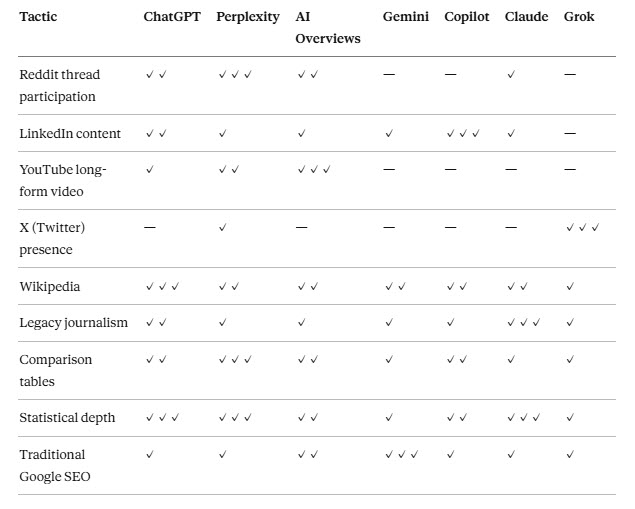
The upper rows of the matrix (Wikipedia, statistical depth, comparison tables, legacy journalism) are the tactics that work across multiple platforms. They are the universal investments. The lower rows are platform-specific — high leverage on one or two platforms, irrelevant on others.
What works across every platform (the universals)
Despite the variation, six tactics improve AI citation visibility across all platforms:
1. Earned media outperforms owned content by 325%. A press placement in a trusted publication is worth more to AI visibility than three blog posts on your own domain. This is the single largest leverage point in GEO.
2. Wikipedia presence is structural infrastructure. Wikipedia is in the top 5 cited sources on every major platform. If your brand qualifies for a Wikipedia entry, ensuring it is accurate, current, and well-sourced is one of the highest-leverage activities available.
3. Statistical density beats narrative content. Pages with 19+ statistical data points average 5.4 citations vs. 2.8 for pages with minimal data. AI platforms favor content they can extract as discrete factual claims.
4. Structured content beats prose. Clear H2/H3 hierarchy, FAQ schema, comparison tables, and direct-answer paragraphs in the first 40-60 words of each section help on every platform. Retrieval systems parse structured content more reliably.
5. Freshness matters everywhere — at different cadences. Perplexity rewards within-24-hours freshness. ChatGPT prefers within-six-months. Claude tolerates older sources if editorial authority is high. The universal floor: dated content (2023 timestamps in a 2026 page) is a negative signal on every platform.
6. Author signals and E-E-A-T. Named authors with verifiable credentials outperform anonymous content across every platform.
The volatility problem
A point that deserves its own section.
Citation patterns are unstable on timescales of weeks, not years.
Documented shifts from 2025-2026:
- ChatGPT’s Reddit citation share dropped from roughly 60% to roughly 10% in a two-week window in September 2025
- LinkedIn rose from rank #11 to #5 on ChatGPT in three months
- AI Overviews citation overlap with Google’s top-10 rankings fell from 76% to 38% in a single year
- Industry analyses have documented 50% citation-share swings in under a month from a single algorithm tweak
The strategic implication is uncomfortable for anyone running an annual SEO program: any GEO strategy that relies on static playbooks built quarterly or annually is structurally behind. The only way to operate in this market is with continuous monitoring and the ability to reallocate budget within days of detecting a shift.
This is why we publish this report quarterly rather than annually. By August, the May 2026 numbers will already be partially stale.
What this means for marketing teams in 2026
Three principles that fall out of the data:
Principle 1: Stop thinking about “AI search visibility” as one thing.
It’s at least seven things, each with different mechanics. Set up tracking and reporting per-platform. Don’t average across platforms; the average hides the signal.
Principle 2: Invest in the platforms your buyers actually use.
For most B2B operations: ChatGPT (broadest audience), Perplexity (highest-converting), Google AI Overviews (broadest reach via Google search). Microsoft Copilot is meaningful in enterprise and heavily-Microsoft-Office industries. Claude is high-quality for technical and considered-purchase contexts.
For consumer brands: add Google Gemini (especially given Pixel and Android distribution) and Meta AI (for social-discovery audiences).
Skip Grok unless you have specific reason to engage. Skip DeepSeek and Mistral until your tracking shows meaningful audience usage.
Principle 3: Build a content portfolio, not a content stream.
A brand that publishes only on its own domain will lose on AI search. The earned-media advantage is 3-4x. The Reddit advantage on Perplexity is structural. The Wikipedia presence is foundational. The LinkedIn founder-content advantage on Copilot is real. The YouTube long-form advantage on AI Overviews is significant.
A modern AI visibility strategy is a media portfolio, not a content marketing program.
Frequently asked questions
How is AI search different from traditional SEO?
Traditional SEO optimizes content for a single algorithm (Google) that decides which links to show in response to a query. AI search platforms synthesize answers from multiple sources and cite their work inline. Optimization shifts from “ranking” to “being cited” — and there are now seven distinct platforms doing this differently from one another. The traditional SEO foundation (technical accessibility, schema markup, content quality) still matters, but it is no longer sufficient.
Do AI Overviews kill Google SEO?
Not exactly. AI Overviews appear above organic results and reduce organic click-through by 34-61% on the queries where they show. But pages cited inside the AI Overview earn 35% more clicks than non-cited competitors on the same SERP. The winning strategy is not abandoning Google SEO but evolving it: optimize for inclusion in the AI Overview, not just for ranking below it.
Which platform should we prioritize first?
For most B2B brands, ChatGPT, Perplexity, and Google AI Overviews are the three with the largest audience-to-effort ratio. ChatGPT for raw reach, Perplexity for conversion quality, AI Overviews because they show up on Google searches your buyers already perform. The platform tactics matrix above shows which content investments serve multiple platforms simultaneously — focus there before specializing.
How do we track AI search visibility?
You need a tool that monitors citations across all major platforms, tracks share of voice against competitors, detects hallucinations and factual errors in AI responses about your brand, and alerts on significant shifts. Manual monitoring is not viable at scale — there are too many platforms, too many queries, and patterns shift too quickly. Disclosure: CiteMetrix is one such tool; we built it for this purpose.
What about Wikipedia — is it really that important?
Yes. Wikipedia is the #1 cited source on ChatGPT (47.9% of top-10 citation share), top-5 on every other major platform, and structural infrastructure across the AI search ecosystem. If your brand qualifies under Wikipedia’s notability criteria, ensuring an accurate, well-sourced entry is among the highest-leverage activities you can undertake.
How often does citation behavior change?
Often enough that quarterly review is the floor, monthly is appropriate for serious operators, and continuous monitoring is what tooling exists to provide. Documented examples: ChatGPT’s Reddit share moved 50 points in two weeks; LinkedIn moved six rank positions on ChatGPT in three months; AI Overviews’ overlap with Google’s top-10 results fell roughly in half within a year.
Should we invest in Reddit?
For Perplexity visibility, almost certainly yes — Reddit is structurally 46.7% of Perplexity’s top citations. For Google AI Overviews, also yes — 21% of top citations. For Gemini and Copilot, less critical. The right approach is supporting authentic community presence (engaging substantively with relevant subreddits, responding to brand mentions, supporting customer-led conversations) rather than corporate Reddit marketing, which is reliably detected and punished by Reddit communities.
Sources and methodology
This report synthesizes findings from multiple independent research datasets:
- Profound (analysis of 680 million AI citations, 2024-2025)
- Ahrefs (multiple AI citation studies, 2025-2026)
- Authoritas (citation pattern reports, 2025)
- AirOps (548,000-page content study, 2025)
- Tinuiti (Q1 2026 AI Citations Trends Report)
- Semrush (AI & SEO Report, 2026)
- 5W (Citation Source Audit, Q1 2026)
- OtterlyAI (YouTube Citation Study, 2026)
- Qwairy (AI Citation Analysis, 118,000 responses, January-March 2026)
- Aggarwal, Murahari, Rajpurohit, Kalyan, Narasimhan, and Deshpande (Princeton, Allen Institute for AI, and IIT Delhi), “GEO: Generative Engine Optimization” (arXiv 2311.09735, November 2023)
- SE Ranking (216,000-page analysis, 2025-2026)
Citation patterns evolve rapidly. This report represents a snapshot as of mid-May 2026. The next edition will be published in August 2026, with updated data through July.
About CiteMetrix
CiteMetrix is the AI search visibility platform built for the era when buyers research products by asking ChatGPT, Claude, and Perplexity instead of Google.
We track how brands are cited across ChatGPT, Claude, Perplexity, Google AI Overviews, Google Gemini, Microsoft Copilot, Grok, DeepSeek, Mistral. Our customers use CiteMetrix to monitor citation share, detect hallucinations in AI responses about their brands, analyze competitor positioning, and execute full remediation when AI platforms get something wrong.
If your team is responsible for how your brand shows up in AI search, we’d like to show you what’s currently happening with your brand. The free Score Check at citemetrix.com takes about 60 seconds and requires no signup.
Author: Eric Richmond, Founder, CiteMetrix Contact: eric@citemetrix.com | (860) 682-9104 Published: May 2026 | Next edition: August 2026
This report is published under a Creative Commons Attribution 4.0 license. You are welcome to quote, cite, and share its findings with attribution to CiteMetrix and a link to citemetrix.com. If you republish substantial portions, a link to the original source helps us track which platforms are citing our work — fittingly, given the topic.