Most analytics products ask you to trust a number without showing you how it’s made. In the world of traditional SEO, we’ve spent two decades moving away from "black box" metrics toward the transparency of Google Search Console and GA4.
But as we enter the era of AI search visibility, we’re seeing a step backward. Many tools are popping up that give you a "visibility score" or a "sentiment grade" without ever showing you the raw data, the prompt, or the logic used to calculate it.
I’ve decided to build CiteMetrix the opposite way. This isn't just a marketing choice; it’s the result of a specific engineering decision that changed how I view our responsibility to our users.
It started on my own API bill
During our beta, every scan ran on keys I controlled. Our beta testers weren’t using their own API keys: they were running on mine. I want to be exact about that because the rest of this story involves a cost bug: no customer was ever overcharged, because no customer's keys were ever in use. The only account ever exposed was mine.
Our original scan engine lived inside the web application, coordinated by background jobs. Under the right timing: parallel workers, a slow scan, a window where two workers each thought the same query still needed running: a single query could be sent to the same AI platform twice.
Each send was a real, paid API call. You wouldn't see it in the dashboard. You'd see it on the API bill.
I saw it on the API bill. And because it was my bill in my beta, the lesson cost me money instead of a customer's trust.
The fix wasn't a patch. It was a rebuild.
What bothered me wasn't the bug: it was that the architecture allowed the bug. Running a job coordinator inside a web application that was never designed to be one makes that whole class of failure possible. I could patch symptoms forever, or I could rebuild so the failure couldn't exist.
I rebuilt. The new pipeline runs on one principle: a scan should cost exactly one paid API call per query-and-platform pair, and the system should make any other outcome impossible: not just unlikely.

The mechanism is deliberately boring. Each scan is split into individual work units, one per (query × platform) pair. Every unit carries a unique key, and a database constraint enforces uniqueness on it. If the same unit is ever delivered twice: normal in any distributed queue: the second attempt simply cannot create a second paid call. The database refuses it.
That's the difference between "we're careful" and "it can't happen." I'd rather ship the second one.
Capturing the "Raw" Truth
There's a second design choice I'm proud of: the engine captures the full raw AI response first, then interprets it in a separate stage.
In AI brand monitoring, context is everything. If you only save the "score," you lose the "why." By capturing the raw response from ChatGPT, Perplexity, or Gemini, we create a permanent record of exactly what was said about your brand at that moment.
This architecture offers two massive benefits for our users:
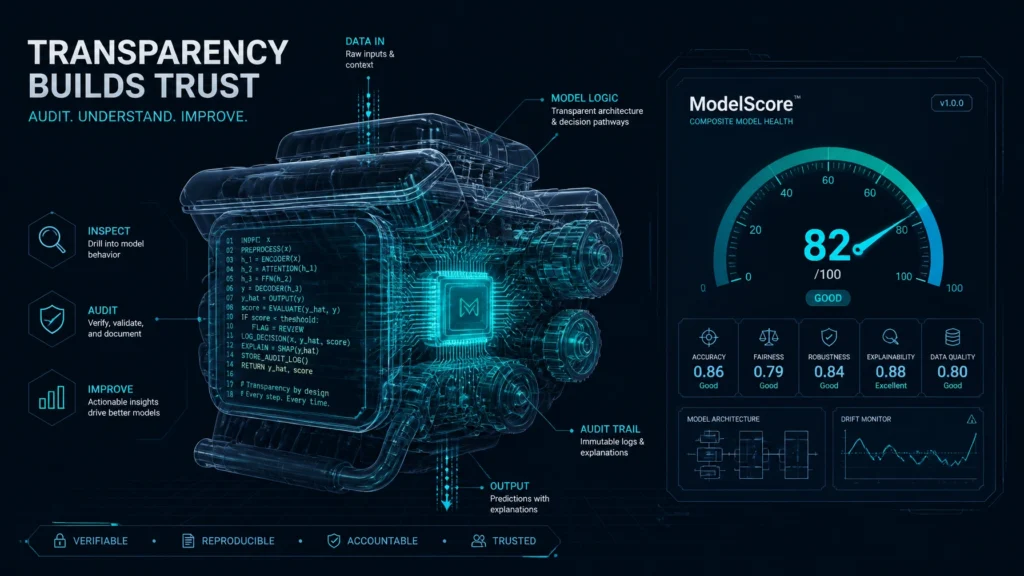
- Auditability: If you see a dip in your ModelScore™, you can look at the raw response to see if the AI hallucinated or if a competitor actually took your spot.
- Future-Proofing: When we improve our analysis algorithms or add new sentiment dimensions, we can re-run that analysis against responses we already paid for. You get better answers from old data without spending a cent more on API credits.
Why I'm telling you instead of just showing you a score
A visibility score is only as trustworthy as the method behind it. If I ask you to trust a number, I owe you the ability to check how it’s produced.
Most SEO professionals are used to the "vibe check" of AI results: manually typing queries into ChatGPT to see if they show up. CiteMetrix automates this, but we don't want to hide the work.

So we published our full technical methodology: the components of our score, the exact weights, the data source behind each, and the limitations. We state what the tool measures and what it doesn't. We say plainly that our accuracy engine is an AI evaluating AI, with human review. We say which security work is documented versus formally audited.
Transparency as a Feature
That last part is the real test. Anyone publishes the flattering parts. The signal of an honest tool is whether it publishes the unflattering parts too: the boundaries, the dependencies, the roadmap gaps. We do, on purpose.
When we track AI search visibility, we are looking at four main pillars:
- Citation Rate: Is your site being linked?
- Brand Demand: How often is the brand being searched in an AI context?
- Authority Transfer: Is the AI recommending you as a primary or secondary source?
- Technical Readiness: Can the AI crawlers actually read your content?
Each of these has a weight. Each has a margin of error. By being open about these weights, we allow our users to correlate their CiteMetrix data with their Google Search Console and GA4 data more accurately.

The Question You Should Ask Every AI Tool Vendor
If you're evaluating any AI-visibility tool: ours or anyone else's: put this question at the top:
"Will you show you how the number is made, including where it's weak?"
If the answer is a shrug or a "it's our proprietary secret sauce," then it's a marketing asset, not a measurement tool. You can't build a 2027 marketing strategy on a number you aren't allowed to audit.
We'll show you ours. You can read the full technical methodology, data collection rules, and architecture details right here: CiteMetrix Technical Methodology.
The era of the "black box" score is over. It’s time for data we can actually trust.
Eric Richmond is the founder of CiteMetrix. Technical questions welcome: eric@citemetrix.com.
Ready to see your AI visibility? Join the beta (free) → citemetrix.com