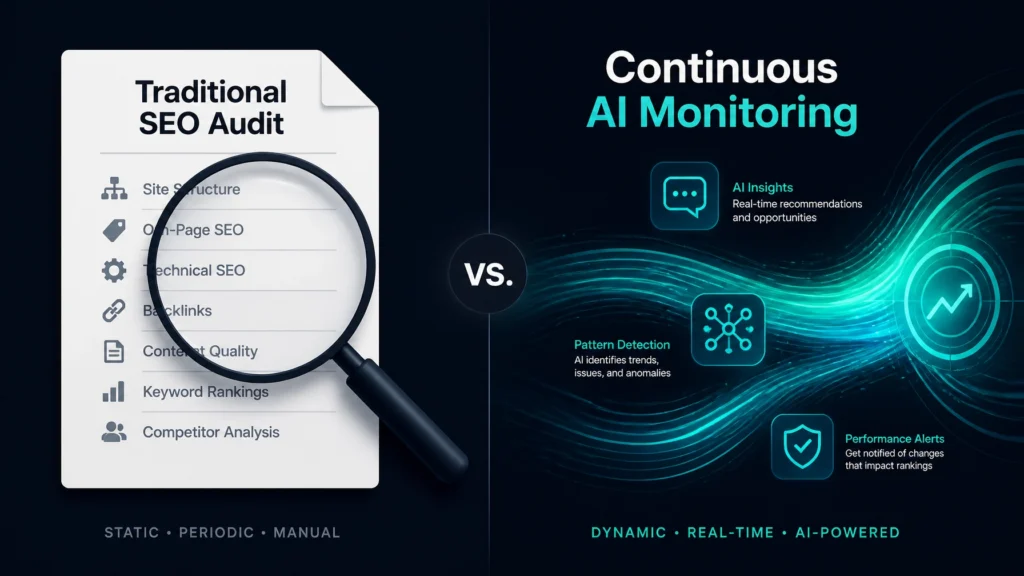
For two decades, the "SEO Audit" has been the cornerstone of digital marketing. Agencies bundle it into every proposal, promising a deep-dive snapshot of exactly where a brand stands today. It’s a comfortable, predictable deliverable: one time-bounded report, one set of recommendations, and a clear "before and after."
But as search shifts toward AI assistants like ChatGPT, Perplexity, and Gemini, this snapshot model isn’t just outdated: it’s structurally broken.
When an agency scopes AI search visibility as a one-time audit, they aren't just giving a less-detailed version of the truth. They are providing a different measurement of a different thing entirely. They are trying to treat a probabilistic system like a deterministic one.
At CiteMetrix, we believe that if you want to understand how AI sees your brand, you have to stop looking at snapshots and start looking at the stream. Here is why.
Traditional SEO: The Stable Ranking Model
In traditional search, a query produces a result set that is relatively stable at any given moment. For a specific query right now, there is a single, ranked list of organic results. Whether you check it at 9:00 a.m. or 3:00 p.m., the SERP remains largely the same across users.
This stability is what makes the "snapshot" model defensible. You check where you rank today because there is a definitive "where we rank" to observe. Volatility exists, of course, but it operates on an object: the index: that has a fixed state between updates.
AI Search: Measuring a Probability Distribution
AI search doesn’t retrieve a pre-existing list; it generates a response. When a user asks Perplexity or Google's AI Overviews a question, the system produces an output based on a complex interaction of layers:
- Model Weights: The behavior of the underlying LLM (like GPT-4 or Claude 3.5).
- Retrieval-Augmented Generation (RAG): The specific data pulled from the live web or an index at that exact millisecond.
- Query Rewriting: The system's own "interpretation" of the user's intent.
- Stochasticity: Built-in randomness that ensures the same prompt can yield slightly different results every time.
The implication is massive: for a given query at a given moment, there is no single answer that exists to be measured. There is only a probability distribution of potential answers.

If you take a snapshot of ChatGPT's response to "What is the best CRM for small business?" at 10:00 a.m., you are seeing exactly one draw from that distribution. Your brand might appear in that specific session, but be absent in the next six.
A snapshot report that says "Your brand is cited" is like flipping a coin once, seeing heads, and concluding that the coin always lands on heads. It is a measurement that cannot establish a pattern.
The Snapshot Trap: Why One-Off Audits Mislead
When an agency delivers a one-day AI visibility audit, the client inevitably draws conclusions the data cannot support. This leads to strategic errors like:
- "We need to fix our visibility in ChatGPT" – You might be absent in the snapshot but present in 70% of total sessions. Fixing what isn't broken wastes budget.
- "Our competitor is winning" – They might have won that specific "flip of the coin," while your brand wins the majority of others.
- "We need to address this hallucination" – If an AI engine hallucinates a price or a feature in one session, it’s a non-issue. If it does it in 40% of sessions, it’s a reputation crisis. A snapshot can't tell you which is which.
Without a time-series baseline, you are making decisions based on anecdotes, not data. This is why generative engine optimization (GEO) requires a shift in how we track success.
The Correct Model: Frequency, Not Presence
In the AI era, the metric of record isn't "Rank." It is Frequency of Mention.
Instead of asking "Where do we rank?", we must ask "In what percentage of sessions for this topic does the AI cite our brand?" This requires continuous monitoring: checking queries multiple times a day, every day, and aggregating those responses into a meaningful trend.

When you move to continuous monitoring with a tool like CiteMetrix, your reporting changes from static observations to actionable intelligence:
- Mention Frequency: "The brand appeared in 78% of sessions this month, up from 65%."
- Share of Voice Trends: Seeing how your competitive citation share moves over weeks, not just minutes.
- Hallucination Patterns: Distinguishing a recurring inaccuracy from an isolated artifact.
- Actionable Attribution: Correlating your content updates or technical changes (like implementing
llms.txt) directly to a rise in ModelScore™.
The Commercial Reality for Agencies
For agencies, this shift is as much about business model as it is about methodology. AI brand monitoring is not a project with a completion date; it is a discipline.
Clients buy "AI visibility" because they want assurance that their brand is being recommended accurately and competitively over time. A one-time audit can't deliver that assurance. By framing AI visibility as an ongoing program, agencies align their deliverables with the actual value the client is looking for.
Furthermore, a time-series baseline creates compounding value. The longer you track, the more legible the competitive landscape becomes. You aren't just selling a report; you are selling the ability to prove change.

Closing: Measuring the Future
The agency model for SEO evolved over twenty years to match the structure of what was being measured. We are now in a new era where the underlying object: the generative response: has different properties.
You can't manage what you can't measure, and you can't measure a probabilistic system with a snapshot. The agencies and brands that build AI visibility programs based on continuous monitoring will be the ones that actually move the needle. The others will just be telling stories about a single coin flip.
Ready to see how AI really sees your brand?
Stop guessing and start measuring with CiteMetrix. Track your citations, monitor sentiment, and see your ModelScore™ in real-time.
See your AI visibility now → citemetrix.com