A good AI visibility audit should tell you where your brand appears, where it is missing, and which sources shape the answers people see.
Semrush’s framework is a useful starting point. In “How to conduct an AI visibility audit with Semrush,” published September 23, 2026, Luke Harsel lays out six practical steps: establish a baseline, identify citation-worthy content, find missing topics and prompts, analyze sentiment, examine influential off-site sources, and check site-level access issues.
That is a thoughtful framework. It correctly treats AI visibility as more than a single mention count.
Two observations in particular deserve credit.
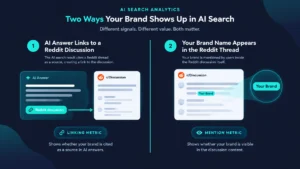
First, Semrush distinguishes between being cited but not mentioned. A page can be used as a source while the brand name never appears in the answer. We call this the ghost-citation problem, and Semrush arrived at the same distinction through its own audit method.
Second, the framework points out that pages driving organic traffic are often not the pages AI cites. Collection and category pages are usually built for browsing. AI systems often prefer pages with concise, self-contained explanations they can extract and reuse.
The next question is what happens after you establish presence.
Presence is the beginning of an audit, not the end. An audit that stops at presence can tell you that you are missing. It cannot tell you that you are wrong.
A complete AI visibility audit checks four things:
| Check | What it proves | What it misses on its own |
|---|---|---|
| Presence | Whether your brand is mentioned or cited in relevant answers | Whether the mention is prominent, accurate, or still accurate after a fix |
| Prominence | Whether you are recommended or merely included | The factual quality of the answer |
| Accuracy | Whether AI describes your brand correctly and completely | Whether a correction changed the answer |
| Verifiability | Whether the issue was fixed and the AI answer actually changed | Nothing essential: the other three checks depend on it |
1. Presence: Were you mentioned or cited?
Presence is the foundational layer. Did an AI platform mention your brand? Did it cite one of your pages? In which answers, prompts, and platforms?
This is where Semrush’s framework is especially useful. A baseline gives you something concrete to evaluate instead of relying on occasional manual searches.
But presence has more than one state:
- Mentioned and cited
- Mentioned but not cited
- Cited but not mentioned
- Neither mentioned nor cited
The third state is easy to overlook. A page may influence an answer without your brand receiving visible credit. That is why the “cited but not mentioned” distinction matters. It identifies content that has entered the answer-generation process, but has not transferred attention or attribution to your brand.
In CiteMetrix, Citation Tracking, Citation Gaps, and Source Pages help make this layer specific. Citation Gaps show queries where you should be cited but are not. Source Pages show exactly which pages, yours and competitors’, AI platforms cite.
The output is not simply “your visibility is low.” It is a list of prompts, platforms, and source pages that can be investigated.
2. Prominence: Recommended or mentioned in passing?
A flat mention count treats every appearance as equal.
It cannot distinguish between:
“Brand A is the best option for this use case.”
and:
“Other options include Brand A, Brand B, and several alternatives.”
Both may count as mentions. They do not have the same commercial meaning.
Prominence asks where and how the brand appears in the answer:
- Are you the primary recommendation?
- Are you listed as one option among many?
- Are you mentioned only in a comparison or qualification?
- Are you associated with the exact use case you want to own?
- Is the answer positive, neutral, or negative?

This is why CiteMetrix’s ModelScore uses a Mention Score weighted by sentiment and prominence rather than raw count. Mention Score represents 45% of ModelScore and is measured across nine AI engines.
The remaining components are disclosed as well:
- Brand Demand, 20%: branded searches from Google Search Console
- Authority Transfer, 20%: AI-referred traffic from GA4 or Adobe Analytics
- Technical Readiness, 15%: schema, crawlability, and llms.txt
The point of disclosing the components and weights is not to turn ModelScore into an oracle. It is to make the result reasoned and inspectable. You can see whether movement comes from more citations, stronger brand demand, AI-referred traffic, or technical improvements.
That distinction changes the next action. A presence gap may require better content coverage. A prominence problem may require clearer positioning, stronger evidence, or content that answers the recommendation criteria directly.
3. Accuracy: Are the facts right?
This is where the business risk sits.
A brand can appear frequently in AI answers and still be represented incorrectly. An inaccurate description of a product, price, capability, limitation, or customer segment can be repeated across platforms and prompts.
A useful accuracy audit should help you recognize the specific failure:
- Incorrect Fact: AI states something verifiably wrong.
- Outdated Info: The information was once true but is no longer current.
- Fabricated Claim: AI invents a product, result, credential, or capability.
- Misleading Context: A technically true statement is presented in a way that creates a false impression.
- Critical Omission: A missing fact makes the overall answer misleading.

CiteMetrix’s Accuracy & Hallucination Detection monitors these five error types across three severity levels: Minor, Moderate, and Critical. Each finding routes to a contextual fix rather than a generic warning. The feature is included from Starter.
This is brand-specific AI accuracy monitoring, not a general enterprise hallucination solution. It is designed to answer a narrower, operational question:
What is AI saying about our brand, which parts are not supported by verified facts, and what should we fix?
That requires a reliable reference point. CiteMetrix’s Source of Truth turns verified Brand Facts into the baseline for detection. Those facts can also generate llms.txt and schema.org markup deterministically, rather than being written by AI. A verified-only publish gate, restricted to Owners and Admins, helps keep unconfirmed information out of public outputs.
This is the foundation of brand knowledge governance: one verified record of what is true, used consistently across content, technical signals, and monitoring.
Accuracy also includes perception. Brand Perception and Model Sentiment help separate factual errors from the broader narrative AI attaches to your brand.
4. Verifiability: Did the fix actually work?
An audit can identify a problem. A team can make a fix. The answer can remain unchanged.
Without verification, the audit produces a to-do list with no reliable way to close anything out.
This is the part almost nobody does, and it is the part that makes the other three checks worth doing.
CiteMetrix’s Correction Proof reports whether the AI platform actually updated its answer after a correction. For ongoing monitoring, Hallucination Watch automatically rechecks daily until the error stops. Hallucination Watch is available on Professional and above.
That creates a closed loop:
Monitor → Detect → Diagnose → Fix → Verify

The difference is important. “We updated the page” is an activity. “The answer changed and the incorrect claim stopped appearing” is an outcome.
A practical structure for your next audit
A useful audit does not need to be complicated, but it does need a repeatable method.
Start with a stable prompt set
Build a prompt set around:
- Category questions
- Product and service recommendations
- Comparison questions
- Use-case questions
- Brand-specific questions
- Questions involving limitations, pricing, and eligibility
Run the same prompts across more than one platform. Record the date, platform, full answer, mention status, citation status, position, prominence, sentiment, and factual issues.
Evaluate against verified facts
Do not evaluate accuracy only against your own marketing copy. Marketing pages may be incomplete, outdated, or written to persuade rather than define.
Use a verified set of facts about the business: products, pricing, capabilities, limitations, locations, ownership, certifications, and important exclusions. Assign severity before reviewing the AI answers so the audit reflects business impact.
Record the baseline before changing anything
Take the baseline first. Then make the correction.
If you change the page, update schema, publish a clarification, or correct an external source before recording the original answer, you lose the ability to evaluate the fix. A baseline lets you distinguish a real change from an assumption that the change should have worked.
The access layer is deeper than a site-level check
Crawler access is part of the audit, but “AI crawlers are permitted” is only the first question.
You also need to know:
- Which AI crawlers actually reached your site
- When they visited
- How often they returned
- Whether they reached the pages that matter
- Whether important pages are buried, blocked, or absent from the crawl path
This traffic may not appear in your standard web analytics. CiteMetrix’s AI Crawlers monitoring shows which AI crawlers visited, when, and how frequently.
Coverage matters too. Auditing twelve familiar pages is not the same as auditing a 400-page site. CiteMetrix’s Site Crawl runs an automated crawl up to three levels deep, at one request per second, respects robots.txt, and typically completes in 10–20 minutes. Starter supports up to 250 pages; Professional and above support up to 500 pages.
That gives you a baseline for pages that have not been cited yet, not just the pages AI already found.
The platform’s nine core features are AI Coaching, Report Analysis, Source of Truth, Hallucination Detection, Mobile Dashboard, CiteMetrix Analyst, Content Engine, Content Change Tracker, and Site Crawl. Analysis tools such as Citation Gaps, Correction Proof, Brand Perception, and Model Sentiment support specific parts of the audit.
For delivery, Report Analysis lets you open a report, ask the Analyst about the actual numbers, and save the answers into the client PDF. There are more than ten templates, including AI Visibility, Monthly Progress, Competitive Intelligence, Executive Briefing, and Client QBR, with PDF and PowerPoint export, shareable links, and scheduled delivery.
The standard for a real AI visibility audit
A complete audit should answer four questions:
- Presence: Are we appearing in the answers that matter?
- Prominence: Are we being recommended, or merely mentioned?
- Accuracy: Is the information correct, current, and complete?
- Verifiability: Did the fix change what AI says?
The fourth question is the one that closes the loop. Without it, presence, prominence, and accuracy remain observations rather than an operating system for improvement.
CiteMetrix monitors all four layers across nine AI platforms: ChatGPT, Perplexity, Claude, Google AI Overview, Google Gemini, xAI Grok, Mistral, DeepSeek, and Copilot. Plans start at $79 per month.
Everything Included, Nothing Extra.
Get your ModelScore and start your AI visibility audit → citemetrix.com