Find the Gap. Write the Answer.
Measure What Changed.
Every AI visibility tool tells you where you’re invisible. None of them do anything about it. Content Engine turns a measured citation gap into a publication-ready article, then into companion pieces for eight other platforms — and closes the loop by measuring whether your citation rate actually moved.
The Remediation Layer No Competitor Has
The dashboard is not the fix
Every tool in this category stops at the diagnosis. They show you a dashboard, tell you a competitor owns the answer to a question your customers are asking, and leave the next move to you. The dashboard is the product, and “so what do I do about it” is your problem.
Content Engine starts where they stop. Every piece it writes begins with something measured from your own monitoring data — a topic you’ve never been cited for, a question a competitor owns, a claim an AI platform keeps getting wrong. Not a prompt. Not a keyword you guessed at. A gap you can point to, with the AI’s own words attached to it.
Then it writes the answer, puts it where the models look, and tells you what happened. Not sure which gap to act on first? Ask CiteMetrix Analyst™ — it already knows your data and can talk you through the tradeoffs before you generate anything.
A Scenario You’ve Actually Had
It’s Tuesday. Your Citation Gaps view shows a competitor being cited for a question you should own — the one prospects actually ask before they buy. You’ve been cited on it 12% of the time this month. They’re at 70%.
You click the insight card. The topic fills itself in, along with what the AI platforms actually said, the verified facts CiteMetrix already holds about your brand, and live search research on what people are asking right now.
Ninety seconds later you have a brief, a full article, SEO metadata, schema markup and an image script — written against that specific gap, not a generic outline.
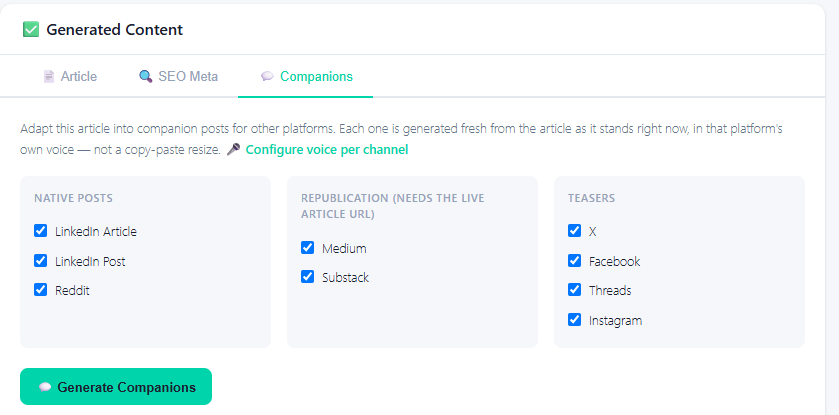
You push it to WordPress as a draft, edit it, publish it. Then you generate companions: a LinkedIn post in your voice, a Reddit draft with the subreddit’s norms flagged, teasers for four more channels, and republication-ready versions for Medium and Substack with the canonical pointing home.
Thirty days later, a card in your dashboard tells you what the citation rate for that topic did.
What It Looks Like
Click image to enlarge
Content Engine lives in your CiteMetrix dashboard under Remediation Tools. A generated package appears as tabs — Brief, Article, SEO Meta, Schema, Image Script, Companions — reviewable before anything leaves the tool. Nothing auto-publishes, ever. CMS connectors create drafts. Companions copy, export, or fire a webhook. You approve everything.
Where the Topics Come From
Gaps you can prove
Topics you’ve never been cited for across any monitored platform, topics cited under 30% of the time, and topics where your rate has dropped ten points or more against the prior month.
Questions a competitor owns
Where a named competitor is being cited and you aren’t — pulled from the same monitoring data, with the platform and the response attached.
Things AI gets wrong about you
Open, unresolved cases where a platform stated something false about your brand. These get handled differently: assert the correct fact, never mention the error. The goal isn’t a public correction. It’s better source material, so the model stops repeating it on its own.
One Article, Nine Places It Needs to Exist
A blog post on your own domain is one source. AI systems weigh corroboration — the same fact, stated on several independently-hosted surfaces, is a far stronger signal than the same fact stated once.
Companions aren’t the same post resized eight ways. Each platform gets its own register, three classes deep.
Republication
Medium and Substack get the article itself, with an adapted title and a canonical pointing home. Not a rewrite competing with your original.
Native posts
LinkedIn and Reddit get original short-form making the same argument in that platform’s voice. Written from five to ten of your own best-performing posts, so it sounds like you and not like a press release.
Teasers
X, Facebook, Threads and Instagram get a hook and a link, sized for the channel.
What Makes It Different
Every piece starts from a measurement
Not a keyword tool, not a content calendar, not a prompt. A specific gap in your own citation data, with the AI’s actual response attached.
Grounded in facts you’ve verified
Your Brand Facts repository feeds every generation, so nothing it writes can contradict what CiteMetrix already knows to be true about you.
Companions written in your voice, per platform
Your LinkedIn register isn’t your website’s register. Paste a handful of posts you’re proud of and the engine learns the difference — editable, and it improves every time you correct it.
The loop closes
Record where you published, and CiteMetrix compares the topic’s citation rate before and after. You find out what changed, not just that you shipped something.
No Competitor Does This
| Platform | Hallucination-Specific Remediation |
|---|---|
| Profound | ✗ |
| Otterly | ✗ |
| Peec AI | ✗ |
| Brandlight | ✗ |
| SEMrush AI Toolkit | ✗ |
| Scrunch AI | ✗ |
| CiteMetrix | ✓ Included |
Comparison limited to hallucination-specific remediation, which is independently documented across CiteMetrix’s existing competitor comparison pages. None of the six platforms above offer hallucination detection or remediation tools at any tier. A broader comparison covering content generation, multi-platform companion content, and citation-rate measurement is pending further research and will be added once verified.
Common Questions
Find the Gap. Fix It. Measure It.
Content Engine is included on every CiteMetrix plan — from the first citation gap you find to the companion set that closes it.
See Plans and Pricing