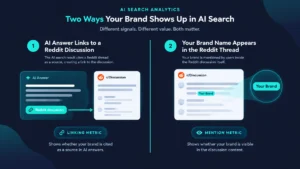
Search Engine Land’s Nikki Lam analyzed roughly 9 million AI-generated answers across nine platforms and more than 400 enterprise brands. The result is a split that looks almost impossible at first:
- Third-party sources account for 82% of citations on commercial-intent queries.
- Owned pages account for about 3%.
- That is roughly a 27x gap in citation volume.
But Lam’s analysis also found that when a brand’s own content is cited, it produces roughly a 5x visibility lift, and owned citations persist 3 to 9 times longer than third-party citations.
Both findings are true.
Third-party sources dominate how often brands enter AI answers. Owned pages matter more when they earn a place, and can continue holding that place for longer.
Lam’s work is an observational, snapshot-based analysis of correlations. It does not establish causation. The figures describe patterns in the dataset, not guaranteed outcomes for every brand.
| Signal | Finding from Lam’s Search Engine Land analysis | Strategic meaning |
|---|---|---|
| Citation volume | 82% third-party; about 3% owned | Other people’s pages create reach |
| Owned-page impact | Roughly 5x visibility lift when cited | Your pages can have disproportionate value |
| Citation persistence | Owned citations last 3 to 9 times longer | Durable citations can compound over time |
Why the 27x gap is not bad news
The first mistake would be treating the 82%/3% split as a reason to abandon your own site.
Third-party presence buys reach. It is how your brand gets into answers you did not write and cannot publish yourself. Reviews, communities, professional profiles, industry pages, and independent coverage give AI systems external context for deciding whether your brand belongs in an answer.
Owned pages buy durability. When your own content is selected, the citation carries a stronger visibility effect and remains useful for longer, according to Lam’s analysis.
These are two different jobs:
- Third-party work expands the surface area around your brand.
- Owned work creates durable, attributable sources.
- Brand knowledge governance keeps the two sides consistent.
- Cross-functional owners are required: marketing, legal, product, PR, and content operations cannot treat AI visibility as an SEO-only task.
A program doing only one of these is running half a strategy. The reach half and the durability half also operate on different timescales. External presence may require ongoing relationship and reputation work. Owned durability depends on creating, maintaining, and verifying pages that AI systems can understand and cite.
The persistence finding is the important one
Volume is easy to celebrate because it is easy to count. Persistence is more important because it changes the value of the citation.
A citation that appears once is a mention. A citation that continues appearing is a position.
Lam found that owned citations persist 3 to 9 times longer than third-party citations. The “9x” in this article’s title represents the upper end of that range, not a universal average for every owned page.
That difference matters because durable content keeps working without requiring the same level of additional spend. A page that remains citable can support repeated answers, reinforce the same facts, and give other sources something stable to reference.
This is the durability theme we have written about before: citation is not simply a channel you enter. It is a position you hold, or lose.

The sentiment finding breaks a common assumption
Many teams still assume that positive sentiment should naturally lead to more citations.
Lam’s analysis complicates that assumption. On several major platforms (including ChatGPT, AI Mode, Gemini, Copilot, and Grok) higher negative sentiment correlated with more citations.
That does not mean negativity causes citations. This is a correlation in an observational dataset, not a causal finding. One plausible explanation is that contested or notable brands attract more discussion and coverage, creating more material for AI systems to retrieve and cite.
The practical conclusion is more important than the explanation:
Sentiment and visibility are different metrics.
They should not be averaged together or treated as one score. A brand can be highly visible and poorly described at the same time. A blended number can hide that distinction precisely when the marketing team needs to see it.
You need to know:
- Is the brand present in the answer?
- Is the brand explicitly named?
- Which source page supports the answer?
- How does the model describe the brand?
- Is the description accurate, incomplete, or negative?

This is also where ghost citations matter. AI may use a source without naming the brand in the answer. Being present in the evidence is not the same as being mentioned in the narrative.
The platform question is really a content-format question
Lam found that YouTube produced the strongest AI-citation lift at about 2.8x, followed by LinkedIn, Reddit, G2, and Gartner.
That ranking should not be read as a simple instruction to “invest in YouTube.” It is better understood as a content-format answer.
These platforms are places where named expertise, third-party corroboration, customer experience, and professional context can accumulate. That is consistent with the broader shift toward AI systems assembling answers from distributed evidence rather than relying only on a brand’s domain.
The counterweight is the ghost citation problem. A brand can be represented in the source set without receiving a visible brand mention.
So track presence and mention separately:
- Presence: Did an AI answer use a page, profile, or source connected to the brand?
- Mention: Did the answer explicitly name the brand?
- Prominence: How central was the brand to the answer?
- Sentiment: How did the model characterize it?
A related AI Mode development
Search Engine Watch reported on September 30, 2026, that AI Mode had begun showing more blog carousels inside answers. For frequently publishing sites, that creates an additional surface for visibility.
This is a test and a directional signal, not a guaranteed channel. It reinforces the value of publishing consistently, but it does not replace measurement across the wider AI search ecosystem.
Volatility is a brand property, not a platform one
Lam’s analysis found that brand-level factors drive more AI-visibility volatility than platform-level factors.
In practical terms, the same brand may be stable on one engine and erratic on another. Another brand may behave in the opposite way. The platform is part of the explanation, but the brand’s own content footprint, external coverage, entity consistency, and market context appear to matter more.
That changes how benchmarking should work.
Comparing your score with a competitor’s score once tells you less than tracking your own stability over time. A one-off read can show what happened in one sample. Repeated sampling can show whether the pattern is durable.
Use:
- A stable prompt set.
- Repeated sampling.
- Per-platform breakdowns.
- Source-page tracking.
- Sentiment tracked separately.
- Change records for your own content.
A 9-million-answer study can describe the market. It cannot tell you exactly what happened to your brand this week.
The practical read
The strategy that follows from Lam’s findings is balanced:
- Do the third-party work for reach. Build presence in the places where customers, experts, reviewers, and professional communities already discuss your category.
- Do the owned work for durability. Create pages that state verified facts clearly and remain useful as reference material.
- Track presence and mention separately. Ghost citations make brand-name monitoring incomplete.
- Keep sentiment as its own metric. Visibility is not reputation.
- Sample repeatedly rather than once. Volatility is part of the signal.
- Connect content changes to citation movement. Otherwise, you cannot tell what actually helped.
Where CiteMetrix fits
CiteMetrix is built for the measurement and remediation loop around this problem, not as a replacement for your broader marketing program.
Its nine core features are:
- AI Coaching
- Report Analysis
- Source of Truth
- Hallucination Detection
- Mobile Dashboard
- CiteMetrix Analyst
- Content Engine
- Content Change Tracker
- Site Crawl
For the 82%/3% question, Source Pages shows exactly which pages, yours and your competitors’, AI cites. That separates owned citations from third-party citations instead of combining them into one total.
Competitor Share of Voice provides a head-to-head view against named competitors on every monitored platform and over time. That is the reach side of the strategy.
ModelScore™ provides the broader measurement framework across nine engines:
- Mention Score: 45%. How often AI names your brand, weighted by sentiment and prominence rather than raw count.
- Brand Demand: 20%, branded searches from Google Search Console.
- Authority Transfer: 20%, AI-referred traffic from GA4 or Adobe Analytics.
- Technical Readiness: 15%, schema, crawlability, and
llms.txt.
Because sentiment is a weighting input rather than an additive score, a high-volume, negatively framed presence is visibly different from a smaller, favourable one. That is the structural answer to Lam’s sentiment finding: the measurement should not hide the difference.
Per-platform breakdowns cover ChatGPT, Perplexity, Claude, Google AI Overview, Google Gemini, xAI Grok, Mistral, DeepSeek, and Copilot. This helps detect brand-level volatility instead of averaging it away.
Citation Gaps identify queries where your brand should be cited but is not. Brand Perception and Model Sentiment track the qualitative language AI uses about your brand separately from presence.
The Content Engine addresses the durability half. It turns a measured citation gap into a publication-ready article and companion pieces for nine other platforms: Medium and Substack republications with canonical links pointing home, native LinkedIn and Reddit posts based on five to ten of the brand’s own best-performing posts, and teasers for X, Facebook, Threads, and Instagram.
Content is grounded in verified Brand Facts. CMS connectors create drafts; they never auto-publish. A Companion Impact card compares citation rate before and after 30 days.
Content Change Tracker creates structured page snapshots on every scan, so a citation movement can be connected to a specific content change in the same window.
Hallucination Detection monitors brand-specific AI accuracy using five error types and three severity levels, with each issue routed to a contextual fix. It is an accuracy-monitoring feature for your brand, not a general enterprise hallucination solution.
For communicating findings, Report Analysis includes 10+ templates, PDF and PowerPoint export, shareable links, and scheduled delivery. The Mobile Dashboard, CiteMetrix Analyst, and Site Crawl keep the measurement loop accessible and actionable.
The operating model is simple:
Monitor → detect → diagnose → fix → verify.
Everything is included at $79/month. No add-ons. Everything Included, Nothing Extra.
Measure the position you can verify
Lam’s analysis gives marketers a useful market-level correction: third-party sources may dominate citation volume, while owned pages can deliver more durable value when they are selected.
The answer is not to choose between reach and durability. It is to measure both, and to make sure the way you measure visibility does not erase sentiment, ghost citations, source ownership, or volatility.
That is the role of verifiability in AI search. Know which page was cited, whether the brand was named, how the model described it, and what changed before the result moved.
Get your ModelScore and see what AI says about your brand →
Sources: Nikki Lam, “What 9 million AI answers reveal about search visibility,” Search Engine Land, September 30, 2026. Related AI Mode development attributed to Search Engine Watch reporting dated September 30, 2026. The Search Engine Land analysis is observational and snapshot-based; its correlations do not establish causation.