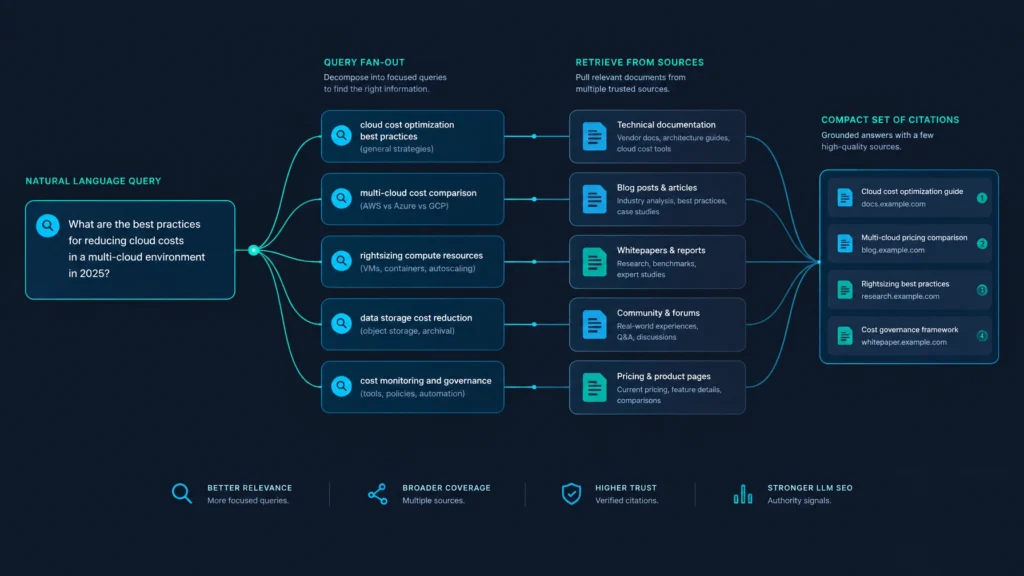
A person asks ChatGPT one question. The answer may depend on several smaller searches behind the scenes: one for an official product page, another for pricing, and another for reviews or comparisons. That process, often called query fan-out, is a useful new lens for LLM SEO.
For practitioners, the takeaway isn’t simply “write more content.” It’s to understand the distinct questions an AI assistant may need to answer, make your brand’s most reliable information easy to retrieve, and check whether your visibility changes across platforms and over time.
What query fan-out means for LLM SEO
In an October 2026 study, Ahrefs analyzed 66.6 million free, logged-out ChatGPT responses from August and September, along with about 15 million fan-out queries. Its findings add important nuance to the idea that every prompt triggers a bundle of searches:
- 14.4% of the responses triggered a web search.
- When ChatGPT searched, it generated about 1.6 fan-out queries per response on average.
- In the study’s sample of roughly 160 most-searched sites, 75.9% of
site:searches targeted brand-owned websites.
These numbers describe a specific model and access state over a specific period. They’re not a universal rate for every ChatGPT user or other AI platform. Still, they point to a practical opportunity: when an AI system searches for specific facts, it may look for the organization that owns those facts.
That matters for LLM SEO because a single broad prompt can touch several content needs. “Which project management tool is right for a distributed team?” might involve feature details, pricing, security, integrations, and independent reviews. A page that directly and accurately covers one of those needs may be more useful to retrieval than a broad article that only mentions the topic in passing.

Map the sub-questions before you publish
You don’t need access to ChatGPT’s internal retrieval process to build a useful content plan. Start with the questions your audience asks, then break each one into likely information needs.
For a software vendor, a prompt such as “What’s the best analytics platform for a mid-market team?” could lead to questions like:
- What does the product do, and who is it for?
- What does it cost, and what’s included?
- How does it compare with common alternatives?
- Does it meet security or compliance requirements?
- What do customers or independent reviewers say?
Treat these as hypotheses to investigate, not a claim about the exact hidden searches any model will run. Use sales and support questions, search-query data, customer interviews, and recurring prompts from your AI visibility monitoring to find the subtopics that matter in your market.
Then check whether your site has a clear, current source for each important fact. If pricing is hard to find, features are described differently across pages, or your product name varies from one document to another, you’ve found a content operations issue as well as an SEO opportunity.
Structure content so useful details stand on their own
A page can be comprehensive and still be difficult to extract information from. Make each important answer easy to identify, verify, and quote.
Put the direct answer near the relevant heading
Use descriptive headings that reflect the question, followed by a concise answer. Then add the explanation, context, and evidence. Readers benefit from this structure, and it gives retrieval systems a clear path to the relevant passage.
Make facts specific and easy to verify
State product names, dates, units, prices, limitations, and eligibility clearly. Include links to primary sources where appropriate. Avoid relying on vague phrases like “flexible pricing” when the reader needs to know which plans exist or how pricing works.
Publish information only your organization can supply
Original research, documented testing, product specifications, implementation guidance, and first-party data give your content a distinct source role. A generic summary of common advice may be helpful, but if it adds no original evidence or expertise, another source may be more useful to cite.
Keep brand facts consistent across teams
This is where brand knowledge governance becomes practical. Marketing, legal, product, and content operations should agree on canonical names, current product descriptions, approved claims, and where authoritative information lives.
A useful starting point is a shared source of truth for the facts AI systems and customers are likely to need. Review it whenever pricing, product capabilities, leadership, or policies change. CiteMetrix’s guide to brand facts explains how to document verified company information and its source URLs.

Don’t optimize only for your own website
A brand’s official pages are important sources for facts it controls. They won’t necessarily answer every comparison, review, or recommendation question.
For those prompts, AI systems may draw on third-party coverage, professional reviews, customer feedback, or other credible sources. Build a balanced visibility plan:
- Make your official product and support information clear and current.
- Identify comparison and review questions where your audience looks for independent perspectives.
- Support media, analyst, and partner coverage with accurate, consistent information.
- Avoid treating self-authored “best of” content as a substitute for independent evidence.
The goal isn’t to force one source type into every answer. It’s to make sure accurate information about your brand is available wherever relevant questions are being answered.
Track citation variance across AI engines
A citation is not a fixed property of a page. Results can differ by platform, prompt wording, time, and other conditions. A brand may appear in a ChatGPT answer but not in a Perplexity response, or be named in an answer without a link to its site.
To monitor those differences, establish a repeatable test:
- Create a stable prompt set. Include informational, comparison, and recommendation prompts that reflect real customer questions.
- Run the same prompts across engines. Keep wording and relevant settings consistent where possible.
- Record what happened. Track whether the brand is mentioned, which URLs are cited, the context of the mention, and whether the description is accurate.
- Compare by platform and date. Look for recurring differences, not just a one-time change.
- Investigate gaps. If one engine cites a competitor or third-party source, check what information that source provides and whether your own content answers the same question more clearly.

CiteMetrix citation scans let teams monitor brand mentions and cited URLs across supported platforms, including ChatGPT, Perplexity, Claude, Gemini, Meta AI, and Copilot. The scans capture responses to configured prompts; they don’t reveal every hidden fan-out query an AI platform may have used. That distinction matters: citation monitoring shows what appeared in the answer, while query-fan-out research can offer clues about the retrieval process.
See how CiteMetrix citation scans work, and explore our guide to LLM SEO and the shift from keywords to citations.
Turn query fan-out into a useful content workflow
Query fan-out is not a checklist of guaranteed ranking factors. It’s a way to think more carefully about how a broad question can involve several specific information needs, and whether your organization has reliable sources for them.
Start with a handful of customer prompts. Map the likely subtopics. Improve the pages that own your essential facts, and identify where original evidence or third-party coverage is missing. Then measure citations repeatedly across the platforms your audience uses.
For the technical side, check whether AI crawlers can access important pages and whether your site presents its content clearly. CiteMetrix’s technical readiness guide covers crawler access, structured data, and content structure.
The durable work is not chasing every possible hidden query. It’s making your brand’s information accurate, consistent, useful, and easy to verify, then tracking how AI systems represent it.
See what AI says about your brand → citemetrix.com