There’s an emerging standard called EntityMap that’s trying to solve a real problem in how AI systems understand websites. Whether it succeeds is an open question — but the problem it’s addressing is worth understanding regardless.
The Problem Is Real
When you ask ChatGPT a question about an industry, it doesn’t visit a website and read it top to bottom. It pulls chunks of text from a retrieval database, finds the most relevant passages, and stitches together an answer. That process routinely loses three things that matter to brands.
First, your name. The publisher identity often doesn’t survive the chunking and retrieval process. Your content gets used. You don’t get credited.
Second, the connections. Your product improves a specific outcome. Your service addresses a specific regulation. Your methodology builds on a specific framework. Those relationships are obvious to anyone reading your site — but they’re buried in prose, and a retrieval system has to guess at them.
Third, consistency. If you describe the same concept three different ways across your site — which most brands do — a retrieval system treats those as three separate signals instead of recognizing them as one entity.
“Consider a company that describes the same metric as “ModelScore,” “our visibility score,” and “the composite score.” A human reader understands those are one thing. A retrieval system may treat them as three.”
What EntityMap Proposes
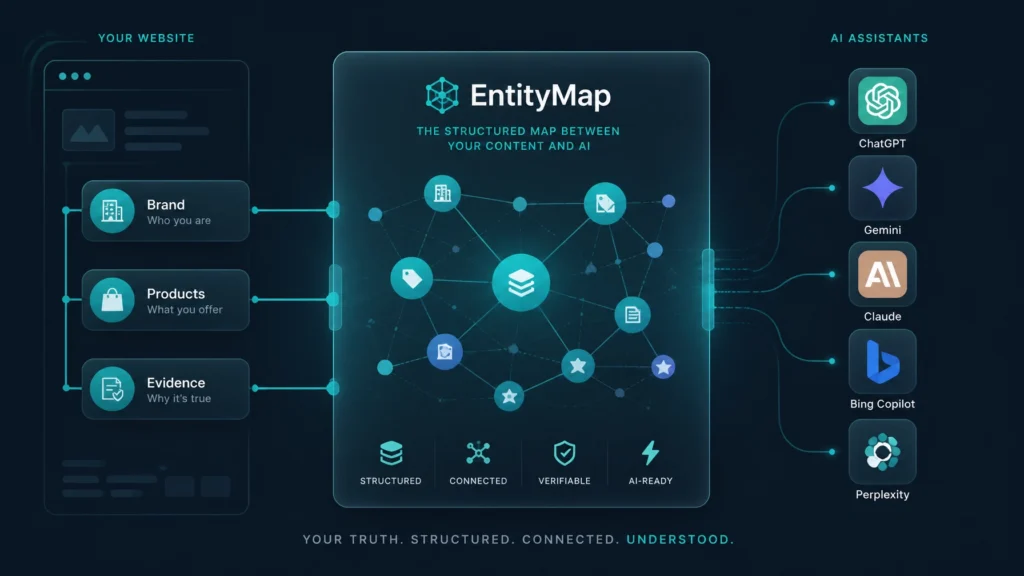
EntityMap (entitymap.org) is a structured file format — a JSON file and an HTML companion — that lets publishers explicitly declare their entities, the relationships between them, and the evidence supporting each one. Think of it as moving from “here are my pages” (sitemap.xml) to “here is what my organization actually knows.”
In practice you publish two files at your domain root, in the same place robots.txt lives: entitymap.json for machines and entitymap.html as a crawler- and human-readable companion. The sitemap analogy is deliberate and holds up. Sitemap.xml tells crawlers where your content lives. EntityMap tries to tell AI systems what your content means.
The design detail worth noticing is attribution. Every evidence chunk carries publisher identity that, by design, is meant to survive extraction and aggregation — which is the specific failure the format is trying to fix.
The spec reached v1.0 in April 2026 and formally launched July 1 after a public consultation. It was created by Fred Laurent with Dixon Jones (co-founder of InLinks and Waikay), and it’s been endorsed by R.V. Guha, one of the people who created schema.org.
A minimal EntityMap requires three things: a publisher identity, at least one entity with a name and description, and at least one evidence chunk per entity linking back to a source URL on your site. Everything beyond that — relationships between entities, audience types, verification status — is optional enrichment.
The Evidence: Encouraging but Thin
Waikay, which operates the reference implementation, deployed an EntityMap on its own site in April 2026 and tracked what happened. On one topic where the brand had room to improve, their AI visibility score jumped 26 points within 48 hours. The EntityMap HTML file was cited two to three times more often than the site’s About page on Gemini and Perplexity.
On topics where the brand was already scoring in the 90s, nothing changed — which is actually what makes the positive results more credible. If the intervention only shows improvement where there’s room for it, that’s a real signal, not noise.
But the results came exclusively from Google-indexed surfaces. The file wasn’t submitted to Bing, so ChatGPT, Copilot, and Claude never saw it. That’s a significant gap in the evidence.
And that’s one site. One deployment. One measurement window.
The Skeptic’s Case
The most useful thing anyone has written about EntityMap came from Suganthan, an early adopter who installed it on his own site and published the results:
“The number of AI systems reading it is zero. That includes ChatGPT, Claude, Perplexity, and Google. The GitHub repo has 11 stars. Measured today, the file does nothing.”
He shipped it anyway because it cost him half a day. But his observation highlights the core tension: EntityMap is a publisher-side standard that requires consumer-side adoption to deliver value, and that adoption hasn’t happened yet.
No major AI lab has announced support. The robots.txt discovery convention is a proposal, not a commitment. The certification registry in the spec isn’t operational.
“The spec’s consumer conformance guidance is explicitly labelled non-normative.”
Every value proposition depends on future events that may or may not materialize.
“The example is worth copying. He implemented it anyway — half a day of work, credible people behind the standard, and asymmetric upside if adoption materialises. Then he said plainly that it did nothing yet.”
These are not minor caveats. They’re the central question.
The Precedent Argument
The counterargument is historical, and it’s a fair one.
GoodRelations was an independently published vocabulary for e-commerce structured data. It launched in 2008 with no mandate from any search engine. Nobody was consuming the files when the first publishers started implementing them. By 2012, schema.org had absorbed its core concepts, and the early implementers had a running start.
“The creator, Martin Hepp, built it because the logic was sound and the implementation cost was low — the same reasoning an EntityMap implementer is using today.”
EntityMap is making the same bet: demonstrate value through implementation, build a community of publishers, and wait for the retrieval ecosystem to catch up. Whether it follows the GoodRelations path depends on whether the standard delivers enough value to attract a critical mass of adopters, and whether AI platforms see enough publisher adoption to justify building consumer support.
Both of those are open questions.
A Practical Framework for Deciding
If you are evaluating EntityMap for your organisation, here is how I would think about it.
Implement if you already have your brand facts, entity relationships, and evidence organised. The marginal cost of generating an EntityMap from existing data is a few hours of work. The downside if adoption never materialises is negligible. The upside if it does is being positioned before your competitors.
Wait if implementing would require a significant entity mapping exercise you have not done for other reasons. The standard is months old and unproven at scale. Do not start a major content audit for the sake of a file format. Start it because entity-level organisation has value in its own right, and generate the EntityMap as a byproduct.
Track honestly. If you implement, measure what happens across multiple AI platforms over a meaningful time window, and publish what you find whether it is positive or negative. The standard needs honest data more than it needs cheerleaders.
The question is not really whether EntityMap becomes the winning standard. It is whether the exercise of organising your brand’s entities, relationships and evidence into a structured format has value regardless of which format wins. I think it does. That is infrastructure you will need however AI retrieval evolves.
One thing I would not do is sell it to stakeholders as a proven technique. It is not one yet, and overselling it is how a reasonable, low-cost experiment becomes an expensive internal argument.
My Take
I think the honest answer is: we don’t know if EntityMap will become a meaningful standard, and anyone who tells you otherwise is selling something (or bought something and is rationalizing).
What I do think is true:
The problem EntityMap addresses is real. AI retrieval systems do lose attribution, disambiguation, and relationship context when they chunk and embed web pages. That’s not a theoretical concern — it’s measurable today.
The cost of implementing is genuinely low for brands that already have their entity data organized. If you’ve done the work of defining your brand facts, your product relationships, and your competitive landscape, generating an EntityMap is an afternoon project.
The exercise of organizing your entities into a structured format has value regardless of whether this specific standard achieves adoption. AI retrieval is moving toward entity-level understanding — whatever mechanism delivers that, the brands with organized entity data will be better positioned.
And the risk of being early is minimal. Two static files on your web server. If they work, you’re ahead. If they don’t, you’ve lost a few hours.
How I’d decide
Implement if you already have your brand facts, entity relationships, and evidence organised. The marginal cost of generating an EntityMap from existing data is a few hours, and the downside if adoption never materialises is negligible.
Wait if implementing would require a significant entity-mapping exercise you haven’t done for other reasons. The standard is months old and unproven at scale. Don’t start a content audit for the sake of a file format — start it because entity-level organisation has value in its own right, and generate the EntityMap as a byproduct.
Track honestly. If you implement, measure across multiple AI platforms over a meaningful window, and publish what you find — positive or negative. The standard needs honest data more than it needs cheerleaders.
The direction feels right. The evidence is early. The cost of finding out is low.
I’d implement. I’d track the results honestly. And I’d resist the temptation to tell anyone it’s a proven technique — because it isn’t, not yet.
For what it’s worth, we deployed one on our own site. We will publish what happens to our visibility scores, good or bad.
— Eric Richmond is the founder of CiteMetrix, an AI visibility platform that monitors how brands appear across nine major AI platforms. We ship an Entity Map generator that builds from the brand facts customers have already verified.
LinkedIn version
Being early to a standard is cheap. Being late to infrastructure is not.
There’s a new file format competing for space on your web server. EntityMap wants to be the sitemap.xml of AI search — a structured file that tells ChatGPT, Perplexity and Gemini what your brand knows, not just which pages you have.
The idea is elegant. When an AI answers a question about your industry, it doesn’t read your site like a person would. It chunks your HTML into passages, embeds them, and retrieves the relevant ones. In that process three things routinely get lost: your brand name (attribution), the connections between your concepts (relationships), and the fact that “ModelScore,” “our visibility metric” and “the composite score” are all the same thing (disambiguation).
EntityMap lets publishers declare their entities, relationships and evidence in two files at the domain root — entitymap.json for machines, entitymap.html as a companion. Same spot as robots.txt.
The evidence so far. One deployment reported a 26-point AI visibility gain on a single topic within 48 hours, and the EntityMap file was cited two to three times more often than that site’s own About page on Gemini and Perplexity. But the results only showed on Google-indexed surfaces — the Bing-dependent stack never saw the file. One site, one window, incomplete coverage. Encouraging, not conclusive.
The honest skeptic’s view. No major AI lab has committed to consuming the file. The discovery conventions are proposed, not adopted. One early adopter put it plainly: “Measured today, the file does nothing.” He shipped it anyway, because it cost him half a day.
The precedent. GoodRelations published in 2008 with no search engine mandate. Schema.org absorbed its core concepts by 2012. The brands that implemented early had a head start.
My take: the cost of being early is low, and the exercise of organising your entities has value regardless of which format wins. What I would not do is sell it to stakeholders as a proven technique — it isn’t one yet.
We deployed one on our own site. We’ll publish what happens to our visibility scores, good or bad.
#AIVisibility #GEO #EntityMap
{“@type”:”BlogPosting”,”image”:”https://cdn.marblism.com/9c83tZVAKHK.webp”,”author”:{“name”:”Eric Richmond”,”@type”:”Person”},”@context”:”https://schema.org”,”headline”:”Entity Maps: What They Are, What the Evidence Says, and Whether You Should Care”,”publisher”:{“logo”:{“url”:”https://citemetrix.com/logo.png”,”@type”:”ImageObject”},”name”:”CiteMetrix”,”@type”:”Organization”},”articleBody”:”There’s an emerging standard called EntityMap that’s trying to solve a real problem in how AI systems understand websites. Whether it succeeds is an open question — but the problem it’s addressing is worth understanding regardless. The Problem Is Real. When you ask ChatGPT a question about an industry, it doesn’t visit a website and read it top to bottom…”,”description”:”An exploration of EntityMap, a new standard for helping AI systems understand brand entities and relationships.”,”datePublished”:”2026-07-24″}