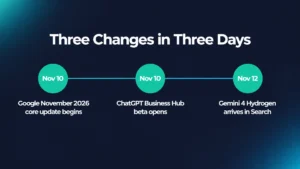
Google flipped the default model in AI Mode to Gemini 4 Hydrogen, and it’s calling this the biggest model upgrade to Search since AI Overviews launched.
That’s not a minor version bump buried in a changelog — it’s the retrieval and reasoning engine behind the answers hundreds of millions of searchers see every day, swapped out worldwide, with Google specifically pointing to improved query fan-out and sourcing as the headline changes. If you work in brand visibility, SEO, or content strategy, this is the kind of event that quietly rewrites who gets cited and who gets dropped, long before anyone writes a postmortem about it.
Here’s what most people miss when a shift like this hits: the model change itself is less important than what it does to the mechanics of how answers get assembled. That’s where citation share actually moves.
What Query Fan-Out Changes About Who Gets Cited
Query fan-out is the process where a single search gets broken into multiple sub-queries behind the scenes, each one pulling from different sources before the model synthesizes a final answer. A better fan-out engine doesn’t just mean more sources get considered — it means the mix of sources changes. A brand that ranked well for the literal query but never showed up in the adjacent, unbranded phrasing a fan-out system now generates can lose visibility overnight, even though nothing about that brand’s content changed.
This is precisely the gap we see most often when we run new client scans. In one scan for a major US health and wellness resort brand, CiteMetrix found zero unbranded citations across 1,200 AI platform checks. The brand’s branded visibility was strong — AI platforms clearly knew who they were when asked directly — but when a prospective guest asked something more exploratory, like where to go for a weeklong wellness reset, the brand never appeared. That’s exactly the kind of query fan-out would surface, or fail to surface, at scale. An upgrade like Gemini 4 Hydrogen, with Google specifically citing better fan-out, is the kind of change that can expose that gap in a single rollout.
Takeaway: if your visibility tracking only checks branded queries, you’re measuring the wrong half of the problem right now. Fan-out improvements reward brands that already show up for the unbranded, intent-level version of the question.
Sourcing Changes Mean Your Technical Setup Gets Graded Differently
Google also pointed to improved sourcing as part of this release. In practice, that typically means the model is better at identifying which passages on a page actually answer the question, and more selective about which domains it trusts enough to cite. A site that was getting cited because it happened to rank well in traditional search can lose that citation if the new model is pickier about structural signals — clean schema, clear entity definitions, content that answers a question in a single self-contained passage rather than three paragraphs in.
This is the layer most brands have never audited, because until recently there wasn’t a reliable way to see it. It’s also why the four components behind CiteMetrix’s ModelScore exist as separate, weighted metrics rather than one blended number: Mention Score (45%, sentiment-adjusted mention frequency across nine AI platforms), Brand Demand (20%, branded search volume), Authority Transfer (20%, AI-referred traffic), and Technical Readiness (15%, how well your site is structured for AI crawlers to actually extract and cite). A sourcing change at the model level hits Technical Readiness and Mention Score first — long before it shows up in your traffic numbers.
The Honest Caveat Here
We don’t yet have a verified, platform-level breakdown of exactly how much citation share shifted for specific named brands in the first days after the Gemini 4 Hydrogen rollout — and anyone publishing precise percentage swings this early should be treated with skepticism unless they show the methodology. What we can say, based on how CiteMetrix’s monitoring works, is that a change of this scope is exactly the type of event that produces measurable, trackable shifts in Mention Score and citation presence across Google Gemini and Google AI Overviews — the two surfaces in our nine-platform coverage where an AI Mode default change would be expected to show up. Quantifying the actual before-and-after for any given brand requires a scan taken before the rollout and one taken after it, compared directly.
How to Actually Measure the Before-and-After
This is the part that gets skipped. Most teams notice a visibility change weeks later, when someone finally asks why organic-adjacent traffic dipped, and by then there’s no clean baseline to compare against. The only way to isolate the effect of a model default change is to have scans running continuously across the platforms in question, so you can diff the data on either side of the release date.
We went through a version of this ourselves. CiteMetrix monitors its own brand using the CiteMetrix platform, and after we corrected a logic bug in how we calculated recommendation status back in August 2026, our tracked recommendation rate settled at 22.1% across 9,382 citations analyzed as of that November. The number itself isn’t the point — the point is that we could only identify the before-and-after effect, and confirm the fix actually worked, because the monitoring never stopped running. That same discipline is what separates a useful reaction to a model rollout from a guess.
- Pull a baseline immediately. If you haven’t scanned branded and unbranded queries across Google Gemini and Google AI Overviews in the last two weeks, you no longer have a clean pre-rollout reference point.
- Separate branded from unbranded in your query set. Fan-out improvements disproportionately affect unbranded, exploratory phrasing — track both, not just your company name.
- Watch sentiment, not just mention count. A model that sources more aggressively can also surface more outdated or third-party commentary about your brand, for better or worse.
- Re-check weekly for the first month. Google’s own rollouts don’t always behave uniformly across regions and query types on day one.
Why This Is Also a Compliance Problem, Not Just a Visibility One
A sourcing change at the model layer doesn’t just reshuffle who gets cited — it changes what gets said. For regulated categories, that matters more than ranking position. In pharma and healthcare specifically, CiteMetrix’s Brand Facts Accuracy Engine is built to flag when an AI platform generates a statement about dosing, indications, or safety that diverges from verified product labeling, which creates a documented record of AI-generated claims that never passed through MLR review. A model swap this large is exactly the kind of event that can introduce new hallucinated claims simply because the model is pulling from a different mix of sources than it did last week. Hallucination Watch then re-checks flagged claims daily and auto-resolves them once a fix is confirmed — closing the loop instead of leaving you with a one-time alert and no way to verify the fix stuck.
What to Actually Do in the Next 30 Days
Don’t wait for a quarterly report to tell you something changed. Set up tracking across at minimum Google Gemini and Google AI Overviews — Claude and Perplexity are mandatory in CiteMetrix because they power core scoring, so you’ll have those as a stable cross-platform reference point regardless of what Google does. Compare your Mention Score and Technical Readiness trend lines against the Gemini 4 Hydrogen rollout date specifically. If you see a drop in unbranded citations but branded citations hold steady, that’s the fan-out signature described above, and the fix is almost always content-structure work — self-contained passages, cleaner schema, better entity definition — not a full content rewrite.
One more practical point: this kind of tracking doesn’t require enterprise budget or a sales call. CiteMetrix’s Solo tier runs $79 a month and covers all nine platforms using your own API keys, so you pay the AI providers directly with no markup. Compare that to Profound, where full multi-platform coverage sits in enterprise pricing territory north of $2,000 a month. When a default model changes overnight for every searcher on earth, the teams that come out ahead aren’t the ones with the biggest budget — they’re the ones who already had the baseline running before the rollout hit.