By Eric Richmond, CiteMetrix
Semrush’s September 8, 2026 study of the manufacturing vertical found that only two domains appeared in both its top-mentioned and top-cited lists. That finding is more important than it may look.
If the brands AI talks about most are not the same domains it uses as sources, then AI visibility is not one measurement.
It is a set of related outcomes. At minimum, you need to separate three:
- Being mentioned
- Being cited
- Being recommended
These outcomes overlap, but they do not mean the same thing. They have different causes, different business implications, and different fixes.
The three layers of AI visibility
1. Mentioned: your brand appears in the answer
A brand is mentioned when its name appears in an AI-generated response.
For example, someone asks:
“What are the leading suppliers of industrial automation equipment?”
If the answer includes your brand name, you have earned a mention.
A mention can signal that AI systems recognize your brand as relevant to the topic. But a mention alone does not tell you:
- Whether the statement is positive or negative
- Whether your brand is prominent or buried in a long list
- Whether the answer recommends you
- Whether the AI platform used your website as a source
- Whether the answer is accurate
A passing reference and a strong endorsement can both count as mentions, even though they have very different value.
2. Cited: your URL appears as a source
A brand is cited when an AI platform links to one of its pages as a source for the answer.
This is a source-authority signal. It means the platform has selected a page from your site to support, explain, or substantiate something in its response.
But a citation does not necessarily mean the platform recommends your company.
An AI answer might cite your technical documentation to explain how a product category works without positioning your company as the best option. It might also cite a product page while recommending a competitor.
That is why citation tracking needs to capture the specific source page, not only the domain.
3. Recommended: your brand is positioned as a good choice
A brand is recommended when an AI platform positions it as a suitable choice for a specific need.
Recommendation is contextual. It depends on the prompt, the buyer’s requirements, and the alternatives being considered.
A brand can be mentioned without being recommended. It can be cited without being recommended. It can be both mentioned and cited but still appear as only one option among many.
The strongest outcome is usually the combination:
- Your brand is named
- Your site is used as a source
- Your brand is presented as a good fit for the user’s need

Why the three states diverge
Each state points to a different underlying problem.
Mentioned but not cited: an attribution problem
AI knows your name, but it is not using your website as a source.
Possible causes include:
- Your brand is discussed widely on third-party sites
- Your own pages do not clearly answer the relevant questions
- Your content is difficult for AI systems to retrieve or interpret
- Your site is not being connected to the facts associated with your brand
This is a brand knowledge governance problem. Marketing, content operations, product, and legal teams may all have a role in making sure your brand, products, claims, and terminology are represented consistently across the web.
Cited but not recommended: a source-authority problem
AI uses your page as evidence, but does not position your company as the best choice.
This can happen when your content is useful as a reference but does not make your value proposition clear. It can also happen when your page explains a category while a competitor owns the stronger product positioning.
The fix may involve improving:
- Product and service pages
- Comparison content
- Use-case explanations
- Proof points and customer evidence
- Internal links between educational content and commercial pages
Mentioned and cited but not recommended: a positioning problem
This is a more specific issue. AI recognizes your brand and trusts at least one of your pages, but the answer still does not connect your brand to the buyer’s decision.
The question is no longer “Does AI know us?” It is:
“Does AI understand when we are the right choice?”
That requires examining the exact prompts, competitors, qualifications, and language used in the answer.
What the manufacturing data does, and does not, show
Semrush’s findings are useful because they separate visibility from traffic. But they apply to the manufacturing and industrial vertical, not to every market.
In that manufacturing study, Semrush reported that AI Overviews appeared on 57% of tracked manufacturing search volume, up from 38% in the study period. Semrush also reported that AI search generated only 0.48% of sessions to manufacturing sites.
That session share is small. It should be treated honestly.
It does not prove that AI visibility is already a major traffic channel for every company. It does show that sessions are not a complete measure of AI’s influence.
Channel measurement versus influence measurement
A channel measurement asks:
“Did a visit arrive directly from an AI platform?”
An influence measurement asks:
“Did an AI answer affect what the buyer searched for, remembered, shortlisted, or visited later?”
Those are different questions.
A buyer may ask an AI assistant for vendor recommendations, see your brand, and then:
- Search for your brand in Google
- Visit your site directly
- Ask a colleague about you
- Return through a bookmarked page
- Contact sales without a clearly attributable AI referral
Traditional analytics may record the later visit as direct, organic, or unassigned. That does not prove AI caused the visit. But it also means an AI referral report alone cannot capture the full path.
The right response is not to ignore sessions. It is to measure them alongside brand demand, direct traffic, branded search, conversion activity, and visibility movement.
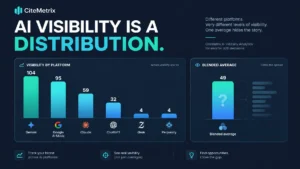
A single-platform read is a sample of one
Semrush also found that different AI platforms cited substantially different sources in its manufacturing analysis.
A source that performs well in ChatGPT may not appear among the leading sources in Google’s AI surfaces. The same applies across other platforms. Each system has its own retrieval methods, index relationships, answer formats, and citation behavior.

This makes single-platform reporting risky.
If you only check ChatGPT, you are not measuring “AI visibility.” You are measuring your visibility in ChatGPT under a particular set of prompts and conditions.
A more reliable program needs:
- Per-platform visibility
- Consistent query monitoring
- Competitor comparison
- Source-page analysis
- Sentiment and prominence
- Accuracy checks
- Trends over time
A practical diagnostic table
Use this framework to decide what your current data is telling you.
| What you observe | What it suggests | Primary lever to pull |
|---|---|---|
| Mentioned when users name your brand, absent for category queries | Brand recognition exists, but category relevance is weak | Run the unbranded category query test; strengthen topical authority and use-case content |
| Mentioned frequently, but with neutral or negative language | Awareness exists, but perception may be limiting recommendations | Review Brand Perception and Model Sentiment; address inaccurate or outdated narratives |
| Mentioned, but rarely cited | Attribution or source-access problem | Improve source clarity, structured content, technical readiness, and crawl access |
| Cited often, but not recommended | Your content is useful evidence, but positioning is weak | Improve product pages, comparisons, proof points, and buyer-specific messaging |
| Cited on one platform but not others | Platform-specific source divergence | Compare per-platform results before changing sitewide strategy |
| Recommended but rarely cited | Strong brand association, weak owned-source connection | Identify the pages competitors are earning citations from and close the Citation Gaps |
| Frequently visible but inaccurate | Brand knowledge governance failure | Verify facts, prioritize hallucinations, and route fixes across content, product, legal, and marketing teams |
| High visibility with little measurable AI referral traffic | Influence may be occurring outside referral analytics, or visibility may not be commercially relevant | Connect visibility to business outcomes, not sessions alone |
Run the unbranded category query test
The most important diagnostic is simple:
- Query AI platforms using your brand name.
- Query the same platforms without your brand name.
- Compare whether your brand appears.
- Record whether it is mentioned, cited, and recommended.
- Compare the result with named competitors.
A brand can be fully visible when a user asks about it directly and completely absent when the user asks for the category.
That is not a contradiction. It means the platform knows the brand but does not yet associate it strongly enough with the category or use case.
How CiteMetrix separates the layers
CiteMetrix is built to show the difference between a blended visibility score and the signals underneath it.
ModelScore and Mention Score
ModelScore provides a composite view of AI visibility. Its Mention Score accounts for 45% of ModelScore and uses data from nine AI engines.
The Mention Score weights both sentiment and prominence. Prominence is important because it helps separate a passing mention from a meaningful recommendation. Being listed fifth in a long answer is not equivalent to being identified as the best fit for a specific need.
You can learn more about the calculation in Understanding Your ModelScore.
Citation Gaps
CiteMetrix’s Citation Gaps identify queries where you should be cited but are not.
This moves the analysis from “we are missing citations” to:
- Which query is affected?
- Which competitor is being cited?
- What type of page is winning?
- What source or content gap needs attention?
Source Pages
Source Pages show exactly which pages, yours and your competitors’, AI platforms cite.
That is where you can see mention and citation divergence in your own data. A competitor may be mentioned because of brand familiarity but cited because of a specific technical guide, comparison page, or product detail page.
Platforms, Share of Voice, and perception
CiteMetrix provides per-platform breakdowns across all nine engines because platform behavior differs. Share of Voice shows how you compare head-to-head with named competitors on every platform.
Brand Perception and Model Sentiment add the qualitative layer:
- How does AI describe your company?
- Is the language positive, neutral, or negative?
- Are important strengths missing?
- Are outdated or incorrect claims appearing?
CiteMetrix also includes Accuracy & Hallucination Detection across five error types:
- Incorrect Fact
- Outdated Info
- Fabricated Claim
- Misleading Context
- Critical Omission
Each error is assigned one of three severity levels, with contextual remediation based on the error type.

Measure influence without abandoning traffic
The conclusion is not that traffic no longer matters. Traffic, conversions, pipeline, and revenue remain essential.
The measurement argument is that AI visibility sits earlier in the journey than a session. It can affect discovery and consideration before an attributable visit occurs.
That means your reporting should separate:
- Visibility: Are we mentioned, cited, and recommended?
- Quality: Is the description accurate and favorable?
- Competitive position: Are we earning more visibility than named competitors?
- Source authority: Which pages are AI platforms using?
- Business impact: Does visibility movement align with branded demand, direct activity, qualified leads, or revenue?
CiteMetrix’s Impact analysis connects visibility movement to business outcomes rather than treating sessions as the only measure of value.
At CiteMetrix, we believe this work belongs to brand knowledge governance: the ongoing, cross-functional discipline of keeping the facts, positioning, and sources associated with your brand accurate and discoverable across AI systems.
CiteMetrix brings these nine analysis capabilities together in one platform. Business plans start at $79 per month, with all nine AI platforms included and no separate add-ons for the core visibility analysis.
See CiteMetrix plans and pricing or explore the full analysis suite.
Being mentioned is a start. Being cited is evidence. Being recommended is the outcome to measure.