If your team already has a working SEO program, you are not starting from zero with GEO marketing.
You already understand crawlability, content quality, technical hygiene, search intent, authority, and measurement. Those fundamentals still matter because AI assistants draw from the open web. Strong SEO gives AI systems more useful, accessible, and authoritative information to retrieve.
What changes is the destination.
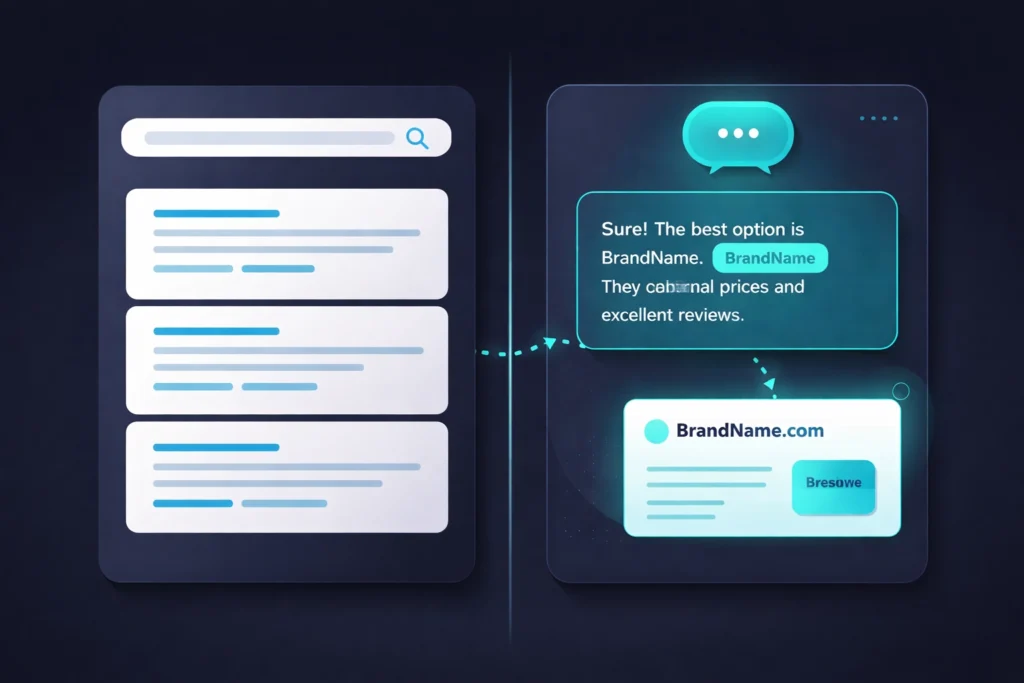
Traditional SEO is largely about earning visibility in a search results page. GEO marketing, also called generative engine optimization, is about helping AI systems retrieve, understand, synthesize, and cite your brand in an answer.
GEO is not a replacement for SEO. It is the second half of the same search visibility program.
Why SEO teams are well-positioned for GEO marketing
Teams with established SEO practices already have several advantages.
Authority carries over
AI systems need sources they can use to construct answers. A site with high-quality content, relevant backlinks, expert contributions, and a clear topical focus is better positioned than a site with thin or disconnected content.
Your existing authority-building work is not wasted. GEO marketing gives that work another outcome to optimize for: being included and represented accurately in AI-generated answers.
Crawlability still matters
AI search systems cannot reliably retrieve content they cannot access.
Robots.txt rules, server responses, redirects, JavaScript rendering, internal links, XML sitemaps, and page structure remain important. The technical foundation of SEO still supports AI search optimization.
The difference is that your technical audit should now include AI crawler access. CiteMetrix checks whether important AI crawlers can access your site, including crawlers associated with ChatGPT, Claude, Perplexity, Gemini, and other platforms.
Entity clarity carries over
Search engines and AI systems both need to understand who your organization is, what it offers, who it serves, and how its products relate to one another.
Consistent naming is especially important in AI search. If your brand name, product names, descriptions, founding information, and category definitions vary from page to page, AI systems have more opportunities to confuse or misrepresent you.
This is why GEO should be treated as part of brand knowledge governance: the cross-functional discipline of keeping your brand’s facts, entities, and relationships accurate across owned and third-party channels.
What genuinely changes in AI search
The key shift is from ranking and clicking to retrieval and synthesis.
A traditional search engine typically returns a set of links. An AI assistant may retrieve information from several sources, synthesize a response, mention specific brands, and sometimes provide citations.
That changes the questions your team needs to ask:
- Are we included when customers ask relevant questions?
- Which sources are AI systems using to describe us?
- Is our brand mentioned accurately?
- Are competitors appearing more often in the answer?
- Does the AI present us as a primary recommendation or a passing reference?
In traditional SEO, click volume is a central outcome. In GEO marketing, clicks are still useful, but they do not tell the whole story. A brand can influence a buyer’s perception before the buyer ever visits a website.
The four things GEO marketing actually moves
A practical GEO program should focus on four observable outcomes.
1. Mentions
A mention tells you whether an AI platform includes your brand in a response to a relevant prompt.
Track mentions across the questions your customers actually ask, such as:
- “What are the best tools for…?”
- “Which providers serve…?”
- “What should a company consider when…?”
- “How does [category] compare with…?”
Mention volume alone is not enough. A brand can be mentioned rarely, frequently, or only for a narrow set of queries.
2. Citations
A citation shows that an AI response connects its answer to a source or page. Citation tracking helps you understand whether your content is being used as evidence, not merely whether your name appears.
Review:
- Which pages are cited
- Which questions trigger citations
- Which platforms cite your content
- Whether citations point to current, relevant pages
- Whether third-party sources corroborate your claims
This is the practical center of AI citation tracking.
3. Sentiment
AI platforms do not simply decide whether to mention a brand. They also characterize it.
A response may describe your company as reliable, expensive, specialized, difficult to use, innovative, or something else entirely. Sentiment analysis helps you identify whether the current representation matches your intended positioning.
Accuracy matters as much as positivity. An inaccurate positive description can still create problems if it sets the wrong expectation.
4. Share of voice
Share of voice measures how often your brand appears compared with competitors across a defined set of AI prompts.
The goal is not to attack or name competitors negatively. The goal is to understand the category landscape:
- Which brands are consistently included?
- Which brands own comparison answers?
- Which topics produce gaps in your visibility?
- Are competitors associated with use cases you also serve?
This gives SEO teams a familiar competitive lens for an environment where rankings may not provide the complete picture.

A practical GEO marketing playbook
1. Create entity consistency across every touchpoint
Start with a basic brand knowledge audit.
Compare how your organization is described across:
- Homepage and About page
- Product and service pages
- Documentation
- Author bios
- LinkedIn profiles
- Partner pages
- Review sites
- Press coverage
- Industry directories
Standardize your company name, product names, category language, customer segments, locations, leadership information, and key differentiators.
Bring marketing, legal, product, PR, and content operations into this process. GEO is not only a content task. It is a cross-functional effort to keep important facts accurate wherever AI systems may find them.
2. Use answer-first content structure
Do not make an AI system search through six paragraphs to find the answer.
For important questions:
- Use the customer’s question as a heading.
- Give a direct answer in the first paragraph.
- Add supporting detail, examples, and qualifications below it.
- Link to the most authoritative page for the topic.
Use clear H2 and H3 headings, short paragraphs, bullets, tables, definitions, and concise summaries. This improves readability for people and makes key passages easier for retrieval and synthesis.
3. Map headings to real customer questions
Your keyword research should now include question mapping.
Review:
- Search Console queries
- Sales and support questions
- Site search data
- Comparison and alternative queries
- Prompts that produce competitor mentions
- Questions asked by different customer segments
Then map those questions to pages. If a valuable question has no clear answer on your site, create or update the most appropriate page.
This is a better starting point than publishing generic “AI-friendly” content without a defined customer need.
4. Prefer third-party corroboration over self-claims
Your website can explain what your brand says about itself. But independent sources help establish how the wider information ecosystem understands your brand.
Look for opportunities to earn accurate mentions through:
- Industry publications
- Partner websites
- Expert interviews
- Customer case studies
- Analyst and review platforms
- Association profiles
- Original research with transparent methodology
Do not manufacture authority signals. Make your claims specific, support them with evidence, and keep important third-party profiles current.
5. Check AI crawler access
Technical readiness is easy to overlook because a site can perform well in traditional search while still limiting access for AI crawlers.
Review:
robots.txt- AI-specific user agents
- Server and firewall rules
- Content hidden behind scripts or login walls
- Canonical tags and redirects
- Sitemap references
- Important pages that return errors
You can also evaluate whether an llms.txt file makes sense for your site. It is an emerging convention, not a replacement for crawlability or quality content.
CiteMetrix’s Technical Readiness documentation explains how crawler access, structured data, llms.txt, and heading structure contribute to technical visibility.
6. Add structured data, but do not treat it as a silver bullet
Structured data helps express entities and relationships in machine-readable form. Depending on your site, useful types may include Organization, WebSite, Article, Product, and FAQPage.
Validate the implementation and ensure the markup matches the visible page content.
Schema cannot compensate for:
- Missing or contradictory facts
- Weak content
- Blocked crawlers
- Poor site architecture
- A lack of external corroboration
- An unclear brand entity
Think of schema as a label system. It helps machines interpret your content, but it does not create authority by itself.
How to measure GEO marketing
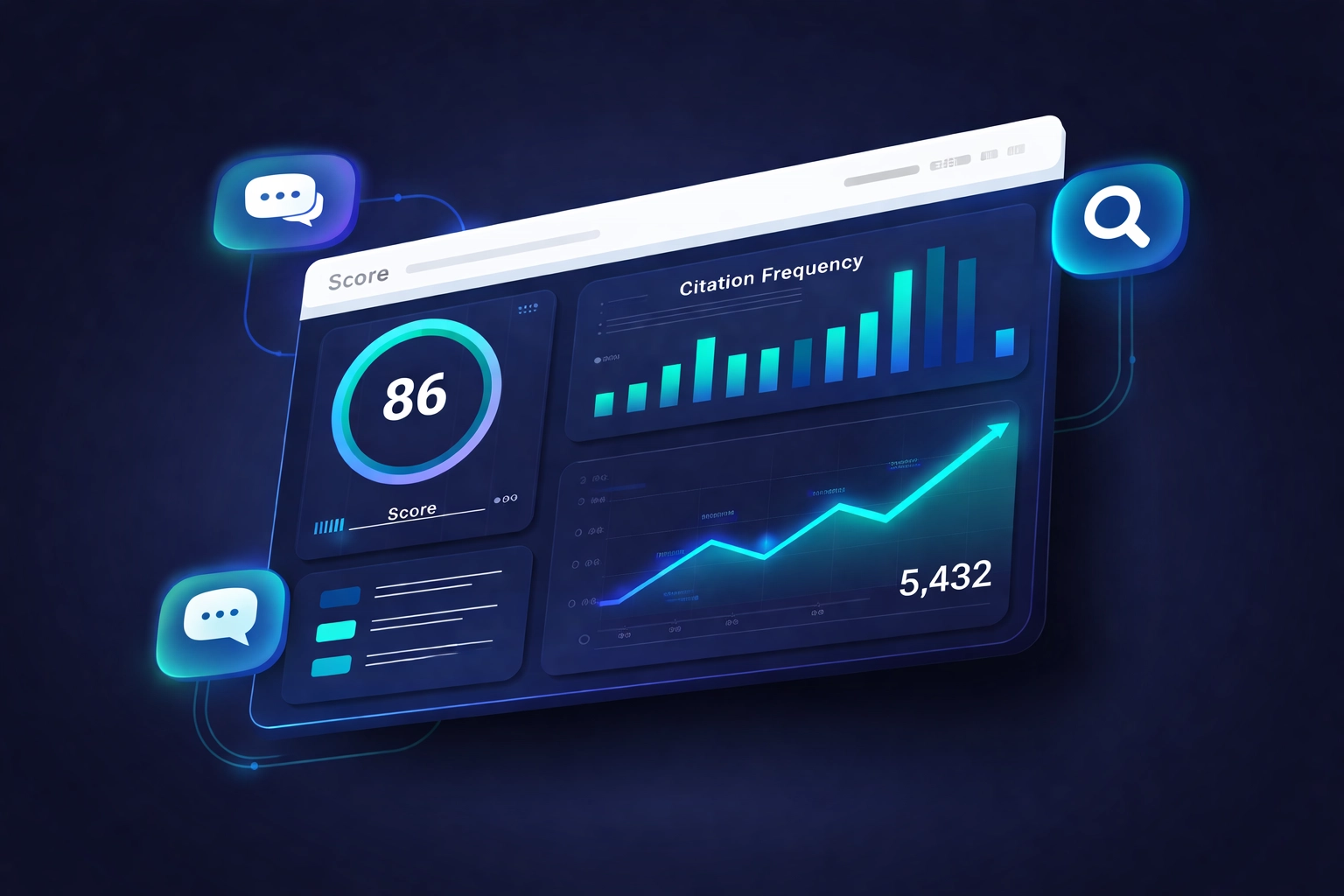
A useful measurement program combines direct AI visibility signals with familiar marketing and search data.
Track:
- Citation rate: How often your brand or content is cited for relevant prompts
- Answer ownership: How often your brand is the primary or leading answer rather than a passing mention
- Share of voice: Your visibility compared with selected competitors
- Sentiment accuracy: Whether AI’s description matches verified brand facts and positioning
- Branded search volume: Whether more people are searching for your brand by name
- AI-referred traffic: Visits attributed to AI platforms in your analytics system
CiteMetrix combines these signals through ModelScore, a composite measure of AI visibility:
- Mention Score: 45%
- Brand Demand: 20%
- Authority Transfer: 20%
- Technical Readiness: 15%
The score is useful as a directional health metric, but the components are what help your team decide what to do next. A low Technical Readiness score suggests a technical fix. Weak share of voice suggests a content or authority gap. Inaccurate sentiment suggests a brand knowledge governance problem.
Read the full ModelScore explanation for the calculation and component details.
CiteMetrix monitors nine AI platforms: ChatGPT, Perplexity, Claude, Google Gemini, Grok, Google AI Overviews, Microsoft Copilot, DeepSeek, and Mistral AI.
Build a closed loop: Monitor → Detect → Diagnose → Fix → Verify
GEO marketing should not be a one-time audit.
Use a repeatable operating loop:
- Monitor relevant prompts across AI platforms.
- Detect missing citations, weak visibility, sentiment issues, and inaccurate claims.
- Diagnose the likely cause: content gap, entity inconsistency, third-party misinformation, or technical barrier.
- Fix the source, page, schema, profile, or crawler access issue.
- Verify the result through continued monitoring.
CiteMetrix’s Hallucination Watch supports this workflow by identifying incorrect or outdated claims about your brand, providing remediation recommendations, and re-checking daily until the issue is resolved. The goal is not to assume every AI response is wrong. It is to identify material inaccuracies and manage them systematically.
Common GEO marketing mistakes
Treating GEO as a separate project
Creating a disconnected “GEO team” can produce duplicate content, conflicting brand language, and unclear ownership.
Add GEO requirements to existing SEO, editorial, PR, product marketing, and technical workflows.
Chasing schema as the main strategy
Schema is useful, but it is only one layer. Clear answers, consistent entities, authoritative sources, and accessible content matter too.
Ignoring technical readiness
A strong page cannot be retrieved if the relevant crawler cannot access it. Check robots.txt, server rules, rendering, redirects, and structured content before assuming the problem is editorial.
The next step for an SEO team
You do not need to rebuild your SEO program to optimize for AI search.
Start by selecting a set of important customer questions. Run them across the AI platforms your audience uses. Record whether your brand appears, how it is described, which sources are cited, and how competitors compare.
Then use the findings to prioritize one content fix, one entity consistency fix, and one technical readiness check.
That is GEO marketing in practice: extend the SEO program you already have so it measures what happens after the search query becomes an AI-generated answer.
Get your free Score Check at CiteMetrix → citemetrix.com