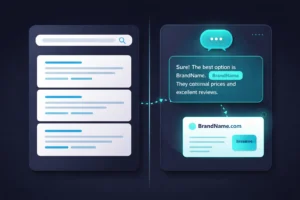
For over two decades, SEO was a game of blue links. We obsessed over rankings, backlinks, and click-through rates. But in 2026, the landscape has shifted. When a user asks ChatGPT, "What's the best enterprise CRM for a mid-market manufacturing firm?" they don't get a list of ten links. They get a definitive answer: a synthesized recommendation that often cites just one or two sources.
If your brand isn’t in that answer, you aren't just "lower on the page." You’re invisible.
This shift has given birth to a new gold standard in digital marketing: Citation Authority. It’s no longer just about being indexed; it’s about being selected by an LLM (Large Language Model) as the single source of truth.
In this guide, we’ll break down why citation authority is the new PageRank, how the mechanics of source selection actually work for ChatGPT and Perplexity, and the actionable steps you can take to ensure your brand is the one being quoted.
Why Citation Authority is the New PageRank
In the old era of search, PageRank used links as a proxy for authority. The more high-quality sites that linked to you, the higher you ranked.
In the AI era, LLMs use Citation Authority. This is a measure of how often an AI model trusts your content enough to include it in its synthesized response. This matters because of Authority Transfer. When ChatGPT or Perplexity cites your brand, it isn't just giving you a link; it’s giving you a testimonial. It is telling the user, "I trust this source to provide the answer you need."
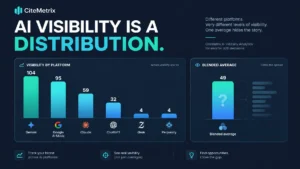
At CiteMetrix, we measure this through our proprietary ModelScore™. It’s a 0-100 composite score that looks at your citation rate, brand demand, and technical readiness across platforms like ChatGPT, Perplexity, Claude, Gemini, and Copilot. Understanding your ModelScore is the first step toward dominating the AI search era.
The Mechanics: How LLMs Select Their Sources
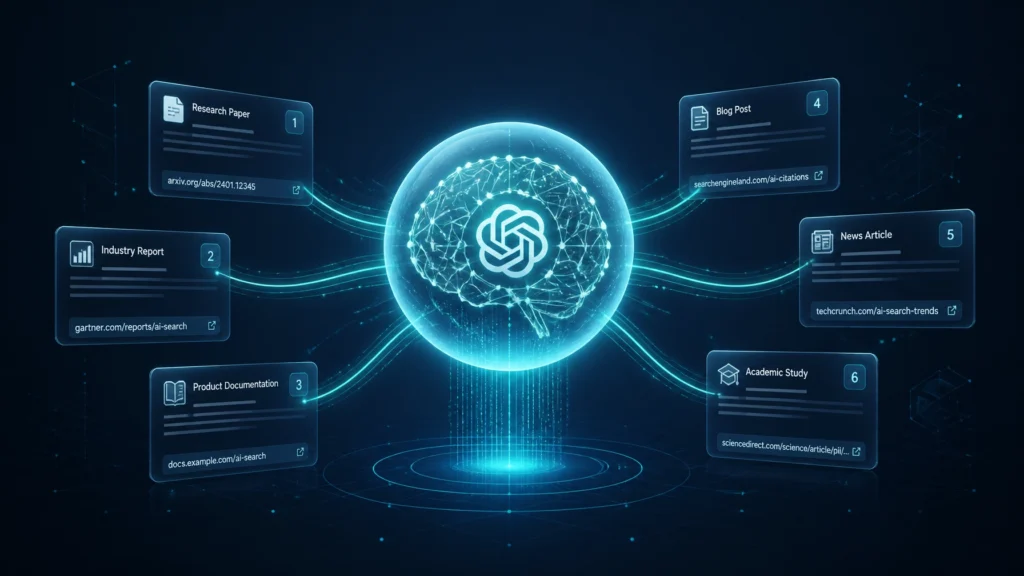
To get cited, you first have to understand the "audition" process. While every model is slightly different, they generally follow a retrieval-augmented generation (RAG) process.

ChatGPT: The Trust-Heavy Retriever
ChatGPT Search (OpenAI) doesn't just rely on its training data. It sends 3–5 sub-queries to Bing, pulls dozens of candidate pages, and then whittles them down. Recent research shows that ChatGPT is "risk-averse." It favors high-authority, clearly attributable sources. If your content is buried or lacks clear authorship, it won't make the cut. Interestingly, about 44% of ChatGPT citations come from the first third of a page. If your answer isn't front-loaded, it’s ignored.
Perplexity: The Freshness Engine
Perplexity is a live answer engine. It runs multiple real-time searches for every prompt. Unlike ChatGPT, which leans on a mix of training data and retrieval, Perplexity is pure RAG. It has a massive preference for freshness and community signals. In 2026, Perplexity cites Reddit in nearly 47% of its top results for product-related queries. It wants to see what people are saying right now.
3 Ways to Improve Your Likelihood of Being Cited
If you want to move the needle on your AI citation tracking, you need to optimize for these three pillars of "citability."
1. Structure for Extraction (The "Answer-First" Layout)
AI models don't read your blog post for fun; they scan it for specific facts they can "lift" into an answer.
- Answer-First Structure: Provide a concise 2-3 sentence summary at the very top of your article.
- Question-Based Headings: Use H2s and H3s that mirror actual user prompts (e.g., "How does [Product] compare to [Competitor]?").
- Standalone List Items: Ensure every bullet point in a list makes sense on its own. LLMs often extract individual list items without the surrounding context.
2. Implement "Deep" Schema Markup
If content is the body, Schema is the skeleton. LLMs use structured data to verify the entities (brands, people, products) in your content.
- Article & FAQ Schema: Pages with FAQ schema see a 40% higher citation weighting in ChatGPT Search.
- Author Schema: Verify your E-E-A-T by clearly defining who wrote the piece and their credentials.
- Table Schema: For comparison data, use Table schema. It makes it exponentially easier for an AI to parse your data into a comparison response.
3. Maintain Aggressive Content Freshness
This is the biggest lever for Perplexity and Gemini. Content updated within the last 30 days receives a staggering 3.2x more citations than older material.

Don't just write and forget. Establish a quarterly cadence to refresh your core "money" pages with new stats, updated examples, and a fresh "last updated" date.
How CiteMetrix Helps You Win the Citation War
You can't manage what you don't measure. Traditional SEO tools like SEMrush or Ahrefs are great for Google rankings, but they are blind to the "black box" of AI responses.
CiteMetrix fills this gap with specialized AI Citation Tracking. Our platform monitors 6 major AI platforms in real-time to show you:
- Share of Voice: How often you are cited compared to your top 5 competitors.
- Sentiment Analysis: Is the AI characterizing your brand as "the budget option" or "the premium leader"?
- Citation Sentiment: We track if the AI is quoting you correctly or hallucinating your features.
- AI Crawler Monitoring: We check if your site is actually accessible to the bots that matter (like OAI-SearchBot or PerplexityBot).

By connecting your Google Search Console (GSC) and GA4 to CiteMetrix, you can finally see the correlation between your AI visibility and your actual bottom-line traffic.
The Bottom Line
Becoming the top source for ChatGPT and Perplexity isn't about "gaming" a system. It's about providing the most authoritative, best-structured, and freshest answer to a user's question.
As we move deeper into the era of Generative Engine Optimization (GEO), the brands that prioritize Citation Authority today will be the ones that own the market tomorrow.
Ready to see how AI sees your brand?
See what AI says about your brand → citemetrix.com
Want to check your AI visibility for free?
Get your ModelScore → citemetrix.com