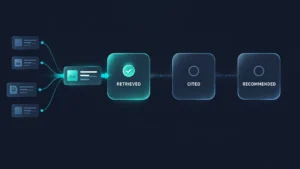
Nearly every AI visibility test in the wild follows the same pattern: ask one question, record the answer, and check whether the brand appeared.
That tells you something about the opening answer. It tells you almost nothing about the decision.
A buyer rarely asks one question and immediately takes action. They clarify the problem, add constraints, compare options, validate the risks, and then decide what to do next.
Search Engine Land’s Louisa Frahm made this point in “The follow-up query: Rethinking SEO for conversational search,” published September 15, 2026. The article frames modern search as a sequence of questions rather than a single interaction.
That framing matters because a brand can appear in the opening answer and vanish from the conversation five minutes later.
The follow-up query is where consideration is actually decided.
Search is now a chain, not a prompt
A useful buyer conversation usually moves through five stages:
- Clarify: What is the problem?
- Constrain: What requirements must the solution meet?
- Compare, Which options belong on the shortlist?
- Validate: Can the buyer trust the recommendation?
- Act: What should the buyer do next?
Each stage asks something different of your brand. Showing up at the first stage does not guarantee that you will survive the next four.

The five-stage conversation framework
1. Clarify: Do you appear at all?
The opening question is usually broad.
A buyer may ask:
“What are the best AI visibility tools for an SEO team?”
At this stage, the buyer is describing a problem loosely. They may not know the right terminology, the relevant features, or the differences between vendors.
Your job is to be discoverable and understandable.
The assistant needs enough information to associate your brand with the category and explain what you do. Clear positioning, consistent entity naming, and self-contained definitions matter here.
If your website describes the product as an AI visibility platform on one page, a generative search tool on another, and a citation tracker somewhere else, you create ambiguity at the first step.
This is why brand knowledge governance matters. Marketing, product, legal, and content operations need to agree on the facts and language that define the brand.
2. Constrain: Can you meet the buyer’s requirements?
The next question adds a filter:
“Which of those tools support an in-house SEO team with competitor tracking and a budget under $100 per month?”
This is where many brands disappear.
The constraint may involve:
- Pricing
- Team size
- Industry
- Geography
- Compliance requirements
- Integrations
- Availability
- Implementation time
- Technical compatibility
If the answer to one of those questions is not stated clearly anywhere machine-readable, the assistant has little to work with.
A pricing page hidden behind a form creates uncertainty. A differentiator buried in a long paragraph is easy to miss. A product capability described differently across multiple pages may not be connected to the right entity.
The constraint stage is not just a tracking problem. It is a fact problem.
3. Compare: Are you named or replaced?
Once the buyer has narrowed the field, they usually ask for a comparison:
“How does CiteMetrix compare with the other AI visibility platforms?”
At this point, the assistant may name competitors, build a shortlist, or recommend one option over another.
You need to know:
- Are you still present?
- Are you named alongside the alternatives?
- Are your differentiators accurate?
- Is your brand being positioned for the right use case?
- Is a competitor being substituted for you?
A single citation in the opening answer can create a false sense of security. If your brand disappears when competitors enter the conversation, your actual share of consideration is lower than your initial visibility suggests.
CiteMetrix’s Platforms and Share of Voice views help make this measurable. You can examine visibility by platform and compare your presence head-to-head with competitors instead of relying on one blended number.
4. Validate: Can the buyer trust the answer?
Validation questions are often more commercially important than the opening question:
“What does it cost?”
“What are the limitations?”
“Is the data accurate?”
“How often does it update?”
“What happens if the AI gets something wrong?”
This is where sentiment, factual accuracy, and context decide the outcome.
A brand may be mentioned positively but still lose the buyer because the price is outdated, a feature is described incorrectly, or an important limitation is omitted.
CiteMetrix’s Hallucination Detection checks AI responses against verified Brand Facts and categorizes five types of error:
- Incorrect Fact
- Outdated Info
- Fabricated Claim
- Misleading Context
- Critical Omission
Each issue receives a severity level: Minor, Moderate, or Critical. Contextual remediation routes the problem toward the right fix rather than treating every error the same way.
With Hallucination Watch, available on Professional and above, the platform rechecks an issue automatically every day until it is resolved. Correction Proof then reports whether the AI platform actually changed its answer after the correction.
That last step matters. Updating your website is not the same as proving that the answer changed.
5. Act: Can the buyer take the next step?
The final question moves from evaluation to action:
“How do I get started?”
“Does it integrate with my workflow?”
“What plan should I choose?”
“How do I connect my data?”
At this point, availability and onboarding details must be verifiable.
A buyer who cannot confirm the next step may return to the conversation and ask for another recommendation. If your brand is absent from that answer, you may lose the conversion even after winning the earlier stages.
The action stage depends on operational facts being easy to retrieve:
- Current plans and pricing
- Product availability
- Setup requirements
- Supported integrations
- Clear onboarding steps
- A direct path to sign up or request help
Why this is a content problem, not only a measurement problem
You cannot measure your way out of missing or inconsistent information.
If your pricing is hidden, your differentiators live only in prose, and your product positioning changes from page to page, AI platforms will have difficulty representing you consistently.
The solution is not to add more generic content. It is to make important facts:
- Verified
- Specific
- Consistent
- Machine-readable
- Available in the context where buyers need them
CiteMetrix’s Source of Truth is designed for this purpose. Your team states a fact once, verifies it, and uses it as the baseline for monitoring.
Verified facts can be used to generate:
llms.txt- Deterministic
schema.orgmarkup - Detection checks for AI responses
The verified-only publish gate means only an Owner or Admin can approve facts for publication. Internal and live drift detection can also identify when a generated file was not uploaded or when the live version has fallen behind the verified repository.
That gives your team one controlled baseline for the constraint and validation stages.
How to build a chain-based prompt set
Do not begin with hundreds of isolated prompts. Start with one important buyer journey.
Step 1: Pick a category and decision
Choose a real commercial question, such as:
“What is the best AI visibility platform for an in-house SEO team?”
Define the buyer, the decision they are making, and the risk they are trying to avoid.
Step 2: Write the opening question
Keep the opening query natural and broad. It should represent how a real buyer might begin the conversation, not how an SEO tool labels a keyword.
Step 3: Add four to six follow-ups
Write the questions a real buyer would ask next.
For example:
- Which options are best for a mid-market company?
- Which support competitor share of voice?
- How does CiteMetrix compare with other platforms?
- What does it cost, and what is included?
- How does it detect inaccurate AI answers?
- How do I get started?
The exact sequence will vary by category. The important point is to preserve the conversational context rather than testing every question as a separate interaction.
Step 4: Run the chain, not just the prompts
Use the same conversation thread where possible. Record the result at each stage:
- Brand present or absent
- Position in the answer
- Sentiment
- Competitors mentioned
- Claims made about the brand
- Sources and citations used
- Any incorrect, outdated, or missing information
CiteMetrix’s citation scans capture the prompt, response, brand mentions, citation sentences, sentiment, cited URLs, and competitor presence. That gives you the underlying evidence for each stage rather than only a summary score.
Step 5: Identify the first meaningful drop
The most useful question is not simply, “Were we cited?”
It is:
“At which stage did we stop being useful to the buyer?”
Citation Gaps are built for this diagnosis. They show queries where your brand should be cited but is not, helping you connect the gap to a specific point in the conversation.
You may find that:
- You appear during clarification but disappear when price is introduced.
- You survive the constraint but lose the comparison.
- You are recommended but described with an outdated feature set.
- You are present throughout evaluation but absent when the buyer asks how to start.
Each pattern requires a different fix.
What to fix first
Start with verified, machine-readable facts about:
- Pricing
- Availability
- Positioning
- Key differentiators
- Limitations
- Integrations and onboarding
Then improve the passages that explain those facts.
CiteMetrix’s Answer Position Estimator helps assess where a passage may appear in an AI-generated answer. The Self-Contained Passage Analyzer checks whether an individual passage can stand alone when it is lifted into a follow-up response.
That matters because the assistant may not retrieve your entire page. It may retrieve one paragraph, table row, or FAQ answer. Each important passage should make sense without requiring the model to reconstruct the missing context.
The FAQ Generator can help turn the actual follow-up questions in your chain into clear question-and-answer pairs.
Once a measured gap is confirmed, the Content Engine can turn it into a publication-ready article and companion content for nine other platforms. It uses verified Brand Facts, creates CMS drafts rather than auto-publishing, and includes a Companion Impact card comparing citation rate before and after 30 days.
The workflow is:
Monitor → detect → diagnose → fix → verify

Measure the conversation, not the opening answer
A single-prompt visibility score is incomplete.
It may tell you whether a model associates your brand with a category. It does not tell you whether the brand survives the questions that determine fit, trust, and action.
That is why conversational measurement should include:
- Presence at every stage
- Citation gaps by follow-up type
- Competitor share of voice
- Sentiment and factual accuracy
- Pricing and availability accuracy
- Correction outcomes
- Platform-by-platform differences
CiteMetrix supports this work across nine AI platforms on every plan. The business track starts at $79 per month, with the monitoring, analysis, and remediation workflow in one platform.
The goal is not to win one prompt.
The goal is to remain useful throughout the conversation.
See what AI says about your brand → citemetrix.com