By Eric Richmond, Founder of CiteMetrix
Zero-click marketing works. That is also what makes it difficult to defend in a channel-level report.
A buyer may see your brand in an AI answer, a LinkedIn post, a search summary, or another platform-native format. They may find the answer useful, remember your name, and return weeks later through a branded search or direct visit.
Your analytics report may show none of that.
Instead, the report says the campaign generated impressions but few clicks. Impressions do not prove influence. Referral traffic proves a visit, but it misses the value created before the visit ever happens.
This is the measurement problem behind zero-click marketing: when the audience consumes the value without clicking, you need a visibility metric built for influence rather than sessions.
The click-based model breaks down in AI
Traditional digital reporting assumes a relatively linear path:
- A person sees content.
- They click.
- They visit your site.
- They convert.
AI search disrupts that path. The user asks a question, receives a synthesized answer, and may never see a conventional search result or a reason to click.
Your brand can still be part of that answer. It can be cited as a source, mentioned as a recommendation, or described in a way that influences the buyer’s shortlist. But the interaction may end inside the AI platform.
The buyer might search for your brand later. They might type your URL directly. They might return through an email, an organic result, a sales conversation, or a referral from someone else.
The influence is real. The original attribution path is broken.
In its September 11, 2026 article, Semrush describes zero-click marketing as publishing content that delivers standalone value where the audience already is. Semrush also recommends looking beyond referral clicks toward signals such as branded search, engagement, and AI visibility.
That framing is useful. But it creates a follow-up question:
Which visibility signals should an executive team actually track?
A six-signal framework for zero-click measurement
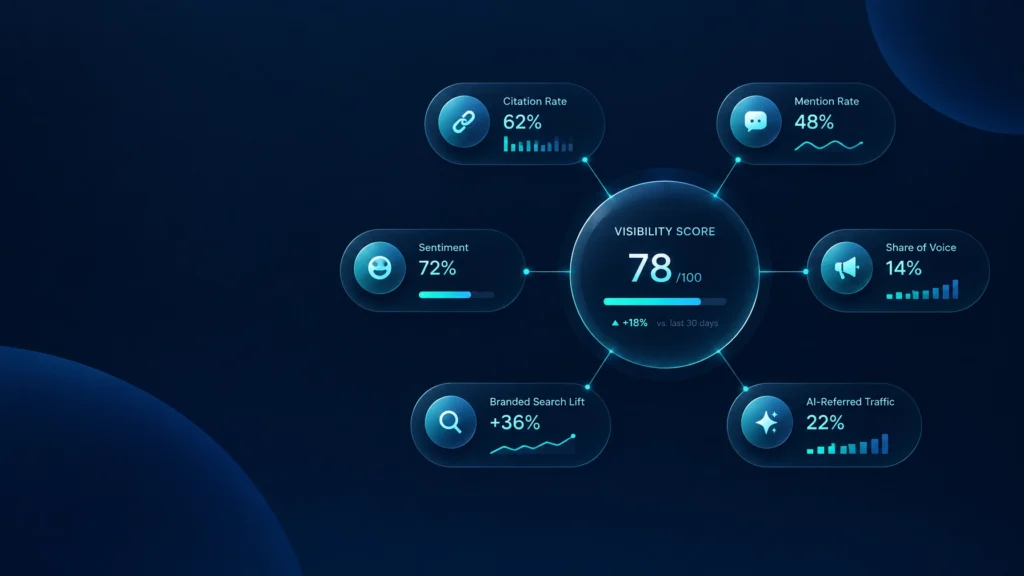
No single metric can prove that an AI answer caused a pipeline event. The practical approach is to track a group of signals that describe different stages of influence.
| Signal | What it proves | What it misses |
|---|---|---|
| Citation rate | Your content or domain is being used as a source for relevant AI answers. | It does not prove the user read the citation, trusted it, or converted. |
| Mention rate | AI platforms recognize and discuss your brand, even when they do not provide a link. | A mention may be brief, generic, outdated, or inaccurate. |
| Sentiment | Whether AI platforms describe your brand positively, neutrally, or negatively. | Sentiment alone does not show reach, prominence, or commercial impact. |
| Share of voice | How often your brand appears compared with named competitors across platforms and queries. | It does not explain why a competitor is winning or whether the audience is the right audience. |
| Branded search lift | More people are searching for your brand, product, or distinctive terms by name. | It cannot identify which exposure created the demand or separate your campaign from other activity. |
| AI-referred traffic | Users clicked from an AI platform to your site and can be measured in analytics. | It captures only the observable traffic slice and understates total AI influence. |
The last signal is important because it is easy to overvalue.
AI-referred traffic is the smallest and most observable part of the picture. It is useful because the session can be recorded in GA4, Adobe Analytics, or another analytics platform. But it represents only the people who both saw the answer and clicked through.
It does not include the buyer who saw your brand in an answer, remembered it, and returned later through another channel.
That is why AI-referred traffic should be treated as evidence of direct response, not as a complete measure of AI visibility.
What each signal adds to the executive story
Citation rate: Are you part of the answer?
Citation rate measures whether AI platforms use your content as supporting evidence.
This is stronger than simply being mentioned. A citation means your content has been selected to support a claim, recommendation, comparison, or explanation.
Still, citation rate has limits. A citation may appear below the fold, support a minor point, or sit beside a response that does not accurately represent your brand. Citation tracking should therefore be paired with source-page analysis and accuracy review.
CiteMetrix provides Source Pages and Citation Gaps to show which pages AI platforms cite, and where your brand should be cited but is not.
Mention rate: Does AI know you exist?
Mention rate captures brand presence beyond linked citations.
This matters because some AI platforms discuss brands without consistently attaching source links. A brand may appear in an answer, recommendation, or comparison without generating measurable referral traffic.
Mention rate is a visibility signal, not a quality guarantee. You still need to examine prominence, context, and factual accuracy.
That is where Model Sentiment and Brand Perception become useful. They show how AI describes your company, including whether the description is positive, neutral, negative, incomplete, or outdated.
Share of voice: Are competitors taking the recommendation?
Visibility is relative. A brand can increase its own mentions and still lose ground if competitors are appearing more often in the same answers.
CiteMetrix Share of Voice provides head-to-head comparisons against named competitors across monitored platforms. Competitor Intelligence extends that view by showing share of voice per platform and per query over time.
This helps answer more useful questions:
- Are we losing “best” queries to one competitor?
- Does our visibility differ between ChatGPT and Perplexity?
- Are competitors being cited from pages we do not have?
- Did our share change after a content or brand campaign?
Branded search lift: Did visibility create demand?
Branded search is the bridge between passive exposure and active interest.
If more people search for your company or product by name, that suggests increased demand. It does not prove that AI caused the lift, but it can show that the market is responding to a broader visibility program.
CiteMetrix connects to Google Search Console to monitor this signal through the Brand Demand component of ModelScore.
Treat branded search as directional evidence. Compare it with campaign timing, AI visibility movement, PR, social activity, and sales feedback rather than assigning the entire lift to one channel.
AI-referred traffic: Did anyone click?
AI-referred traffic is the most familiar signal because it fits the existing analytics model.
CiteMetrix connects to GA4 and Adobe Analytics through Authority Transfer, helping teams see whether AI platforms are sending measurable visitors to the site.
This data is valuable for understanding direct traffic quality and downstream behavior. It is not a substitute for the other five signals.
A low volume of AI-referred sessions can coexist with meaningful AI influence. The answer may have done its job before the click opportunity existed.
ModelScore connects the signals
CiteMetrix’s ModelScore™ is designed for this zero-click gap. It does not rely on clicks alone. It connects citation presence to demand, traffic, and technical access.
The composite includes four disclosed components:
- Mention Score, 45%: Coverage across nine AI engines, weighted by sentiment and prominence.
- Brand Demand, 20%: Branded searches measured through Google Search Console.
- Authority Transfer, 20%: AI-referred traffic measured through GA4 or Adobe Analytics.
- Technical Readiness, 15%: Schema, crawlability, and
llms.txtreadiness.
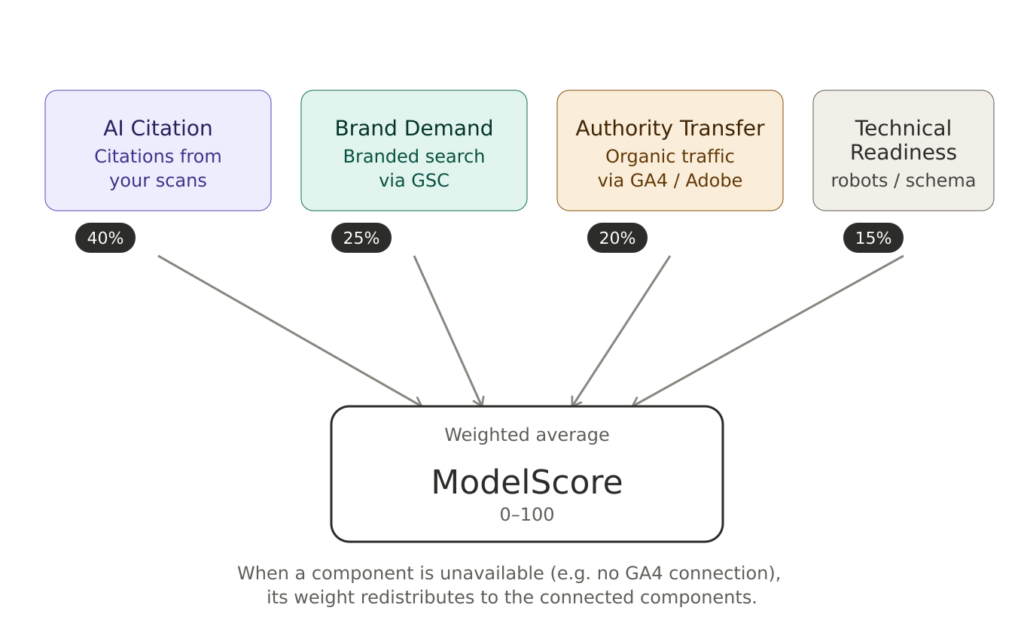
ModelScore is not a revenue metric, and it is not a promise that visibility produces a specific number of leads. It is a composite operating metric: a way to see whether AI visibility is improving across presence, demand, authority transfer, and the conditions that allow AI systems to access your content.
That makes it useful for brand knowledge governance: the cross-functional work of keeping your company accurately represented across marketing, legal, product, content operations, and sales.
Triangulation is the evidence executives can use
No single signal is proof.
A citation can be present without demand. Branded search can rise because of PR. Referral traffic can convert without being representative of total influence. Sentiment can improve while share of voice declines.
The stronger case comes from the pattern.
For example:
- Citation rate increases for priority queries.
- Share of voice improves against named competitors.
- Branded search lift follows the visibility movement.
- AI-referred traffic increases, even if it remains a small portion of total visits.
- Sales conversations begin mentioning the brand in the same category or use case.
That pattern does not create perfect attribution. It creates directional evidence.
A responsible executive report should say exactly that: the data supports a relationship between visibility movement and demand movement, but it does not claim that every pipeline event came from an AI exposure.
CiteMetrix’s Analytics and Impact features help connect visibility movement to business outcomes without hiding those attribution limits.
A practical reporting cadence
A useful reporting program does not ask every metric to answer every question.
Weekly: sentiment and accuracy
Review:
- How AI platforms describe the brand
- New negative or inaccurate claims
- Changes in product, pricing, or category information
- Emerging competitor narratives
This is where Model Sentiment, Brand Perception, and accuracy analysis support fast response.
Monthly: citations and share of voice
Review:
- Citation rate by platform
- Mention rate and prominence
- Share of voice against named competitors
- Citation gaps and source-page changes
- Branded search movement
Monthly reporting is frequent enough to identify directional change without overreacting to every daily fluctuation.
Quarterly: pipeline connection
Review:
- Visibility trends against branded demand
- AI-referred traffic and assisted conversions
- Sales and customer-reported discovery sources
- Pipeline activity in priority categories
- Content and technical changes associated with movement
Use this review to decide where to invest next, not to force a precise return-on-influence number that the data cannot support.
Turn visibility data into a report people can use
Measurement only matters if the team can explain it.
With CiteMetrix Report Analysis, you can open any report on screen and ask the Analyst about your actual numbers. The answers can be saved into the PDF you hand to a client or executive team.
CiteMetrix includes more than 10 report templates, PDF and PowerPoint export, shareable links, and scheduled delivery. The AI Coaching layer adds a first-scan debrief, coaching cards, and a weekly AI consultant briefing so the reporting process leads to action.

The platform brings nine features together across nine AI platforms on every plan. For business customers, plans start at $79 per month, with the core visibility, analysis, reporting, and coaching capabilities included.
The next step
Zero-click marketing does not eliminate measurement. It changes what measurement needs to capture.
Clicks still matter. They are simply no longer the whole story.
Track citations, mentions, sentiment, share of voice, branded search lift, and AI-referred traffic together. Then use the pattern, not one isolated number, to explain how visibility is influencing demand.
Get your ModelScore and see what AI says about your brand → citemetrix.com
Related resources: