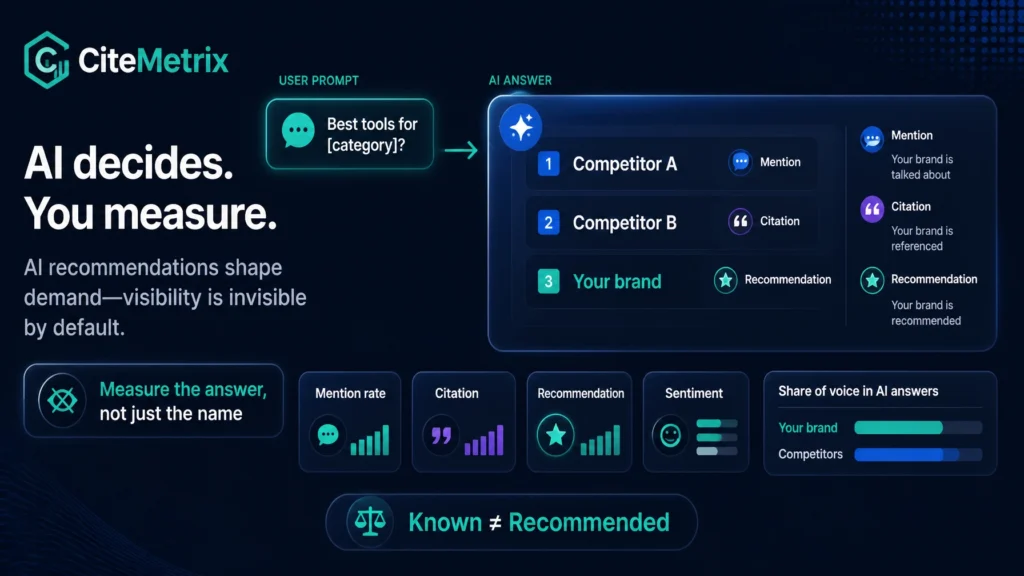
The Visibility Problem Nobody Told You About
Right now, someone is asking ChatGPT, Perplexity, or Google’s AI Mode which tools, services, or brands they should consider in your category. The AI is answering them. It’s naming competitors, framing options, and shaping purchase consideration — and you have no idea whether your brand is in that answer or not.
That’s the actual problem. Not the theoretical future of AI search. The present-tense, revenue-affecting reality that your competitors may already be systematically dominating query categories you thought you owned.
In organic search, a visibility gap is at least visible. You can open a rank tracker, see you’re on page three for a target keyword, and build a plan. The absence registers. In AI-generated answers, there’s no equivalent signal. If ChatGPT consistently recommends three competitors when someone asks for the best software in your category, you won’t see a notification. You won’t see anything. The queries happen, the answers are delivered, and your brand isn’t in them.
This is why AI brand monitoring is a fundamentally different problem from SEO monitoring — not a variant of it. The failure mode is invisible by default.
What AI Recommendation Actually Means (It’s Not One Thing)
Before you can measure whether AI recommends your brand, you need to be precise about what “recommendation” actually means in this context. Most teams conflate three distinct signals, which leads to sloppy measurement and worse strategy.
Being mentioned means the AI names your brand somewhere in its response — possibly in passing, possibly in a list of ten options, possibly while discussing something else entirely. Presence, but no endorsement.
Being cited via URL means the AI’s response links to your domain as a source, typically in platforms like Perplexity or Google AI Overviews that surface citations alongside answers. This indicates your content is being used to construct the answer, which has different implications for your content strategy than a bare mention.
Being actively recommended or endorsed is the signal that actually drives purchase behavior: your brand is named in a top-three list, framed positively, and positioned as a strong solution for the searcher’s specific need.
These three signals call for different measurement approaches and different responses. A brand showing up in citations but rarely in recommendations has a content authority problem. A brand mentioned frequently but in neutral or negative framing has a sentiment problem. A brand absent entirely has a signal-strength problem. You can’t diagnose the right issue if you’re treating “AI visibility” as a single binary.
Why Failing to Monitor This Is Different From Ignoring SEO Rankings
When a brand loses organic search rankings, the loss is bounded. A keyword drops from position two to position seven. Traffic to that page falls. The analytics register the change. You have a defined target to recover.
AI visibility loss doesn’t work this way. There’s no position to recover because there’s no position being tracked. The AI assistant simply answers the user’s query from its synthesis of training data and live web signals, and either names your brand or doesn’t. If it doesn’t, the user receives a complete, confident-sounding answer that doesn’t include you — and has no particular reason to go looking for what was omitted.
The compounding effect matters here. A buyer-intent query like “best project management tools for agencies” might be asked hundreds of thousands of times across AI platforms each month. If your brand appears in zero percent of those answers and a competitor appears in forty percent, that’s not a ranking disadvantage. That’s a structural exclusion from a discovery channel. The user never reaches a search results page where they might notice your brand in position eight. The conversation ends before you enter it.
The consequence of not monitoring is that you have no way to quantify what you’re losing, which means you have no business case for fixing it and no way to measure improvement even if you try.
How to Test Whether AI Recommends Your Brand Right Now
Start with buyer-intent queries — not branded searches. Asking “tell me about [Your Brand]” tests whether the model knows your brand exists, which research shows it does in 94–100% of first-run tests when you name yourself explicitly. That tells you almost nothing useful. The question that matters is whether AI surfaces your brand when someone asks a category-level question with no brand name in it.
Open ChatGPT, Perplexity, Gemini, Claude, and Microsoft Copilot. Run queries like “what are the best tools for [your category]” or “which [service type] should I use for [specific use case].” For each platform, record three things: whether your brand is mentioned, where it appears in the answer, and how it’s framed relative to competitors.
Here’s what most people miss: a single run of this test is nearly useless. AI assistant responses vary by run, by prompt phrasing, and by platform. Two runs of the same query on the same platform can return materially different answers. To get a statistically reliable picture of your AI visibility, you need at least 20 to 50 commercially relevant prompts run across multiple platforms, with results tracked systematically over time. Running three prompts in ChatGPT on a Tuesday afternoon and concluding you have an AI visibility problem — or that you don’t — is the equivalent of checking your stock price once and declaring a trend.
The variability itself is diagnostic. It tells you your brand’s presence in AI answers is unstable, which is a different problem than being consistently absent.
The Metrics That Actually Tell You Something
AI visibility breaks into four measurable components: mentions, citations, sentiment, and share of voice against rivals. Leading frameworks in 2026 define AI search visibility precisely this way, which is useful because it gives you a vocabulary for building actual KPIs rather than impressionistic assessments.
Mention rate is the foundational metric: the number of times your brand appears in AI responses divided by the total number of answers generated, multiplied by 100. If you run 50 prompts across five platforms (250 total answers) and your brand appears in 40 of them, your mention rate is 16%. Simple formula, but it requires systematic prompt execution to generate reliable inputs.
Share of voice tells you how your mention rate compares to specific competitors across the same prompt set. If you have a 16% mention rate and your primary competitor has 34%, the gap is measurable and actionable. Without this comparison, you’re flying with a partial instrument panel.
Sentiment and position add qualitative depth. Being listed fifth in a neutral enumeration is different from being named first with specific positive framing. Tools now score both the confidence of the AI’s claims and the tonality of how your brand is described — not just whether you appear.
Consistency across engines is an often-overlooked signal. A brand that appears reliably in Perplexity but rarely in Gemini or AI Overviews has a signal distribution problem worth investigating.
Why Your Competitors Show Up and You Don’t
The instinctive explanation when a brand is absent from AI answers is that the model doesn’t know about the brand. This is almost never the correct diagnosis. AI models index enormous amounts of web content. The more accurate explanation is relative signal strength — your competitors have stronger, more distributed signals in the training data and current web ecosystem that correlate with AI recommendation behavior.
Recent correlation research puts specific numbers on this. YouTube mentions correlate with AI visibility at approximately 0.737 across ChatGPT, AI Mode, and AI Overviews — one of the strongest single signals identified. Branded web mentions from external sources correlate at roughly 0.66 to 0.71. The practical implication: brands that invested in video content and authoritative third-party coverage are appearing in AI answers partly because of those investments, not luck.
This matters for diagnosis. If you’re absent from AI recommendations, the first audit should be comparative: how does your YouTube presence, your branded mention volume from third-party domains, and your authoritative content depth compare to the competitors who are showing up? The gap you find there is the gap to close.
Being Named Is Not the Same as Being Endorsed
A subtler risk that most brand teams don’t think about until it bites them: AI might be mentioning your brand, but not in the way you’d want.
AI platforms can describe your brand inaccurately — wrong pricing, outdated product information, misattributed features. They can list you in a category comparison where your positioning is factually incorrect. They can mention you in a neutral or subtly negative framing that doesn’t rise to the level of disinformation but consistently frames you as the second-tier option. None of these scenarios register as a problem if your only measurement question is “does the AI know my name?”
This is the hallucination and sentiment risk that monitoring frameworks now explicitly account for. The relevant questions are: what exactly is the AI saying about your brand, how confident does it appear when it says it, and is what it says accurate? A mention that frames your brand incorrectly may be doing more damage than an absence would.
When CiteMetrix monitored its own brand across AI platforms, the platform identified that AI engines were describing it in feature language rather than outcome language — accurate, but not optimally framed for how buyers think about the problem. That’s the kind of nuance that only shows up when you’re measuring sentiment and framing, not just presence.
From Manual Checks to a Measurement Framework That Scales
Manual spot-checking has a ceiling. At some point, the number of platforms, prompts, competitors, and query categories you need to track exceeds what any team can manage in spreadsheets. And because AI answers change over time — as models update, as web signals shift, as competitors strengthen their content — a measurement taken six weeks ago is not reliable guidance for decisions made today.
CiteMetrix was built specifically for this transition. The platform monitors brand visibility across 8 AI platforms + Google AI Overview — ChatGPT, Perplexity, Claude, Google Gemini, Grok, Google AI Overviews, Microsoft Copilot, DeepSeek, and Mistral AI — using a BYOK architecture that means scans are unlimited and users pay the AI providers directly with no markup. The proprietary ModelScore synthesizes four weighted components into a 0–100 composite: mention frequency and sentiment (45%), branded search volume (20%), AI-referred traffic (20%), and technical readiness for AI crawlers (15%).
The health and wellness case illustrates what this kind of systematic measurement surfaces. CiteMetrix scanned a major US health and wellness resort brand and identified zero unbranded citations across 1,200 AI platform checks. The brand had strong branded visibility — ask an AI about the brand by name and it knew who they were — but was completely absent from the unbranded queries where prospective guests are actually making discovery decisions. That gap was invisible without systematic measurement and could not have been found with manual spot-checks.
Beyond measurement, CiteMetrix includes a Hallucination Watch system that detects when AI platforms make factually incorrect claims about a brand, flags them with severity ratings, connects them to 14 remediation tools, and automatically re-checks daily until the issue resolves. No manual loop required. Competitors stop at monitoring; this is the full closed loop.
For teams just getting started, a free Score Check at citemetrix.com returns an AI visibility score across ChatGPT, Perplexity, and Google AI in about 15 seconds with no login required. It won’t replace systematic monitoring, but it gives you a starting reference point in under a minute.
Improving Your AI Recommendation Rate Once You Can Measure It
Measurement without action is just reporting. Once you have a baseline — mention rate, share of voice, sentiment scores, consistency gaps — the improvement loop becomes concrete.
Start with content AI actually cites. Authoritative guides, structured comparison pages, and content that directly answers category-level buyer questions are the inputs AI uses to construct recommendations. If competitors’ content is more comprehensive, more structured, and more heavily cited by external sources, that’s a content strategy gap first and a visibility gap second.
Invest in YouTube presence deliberately. The 0.737 correlation with AI visibility is not a coincidence. Video content that generates branded mentions, embeds, and citations across the web feeds the same signals that AI platforms use when constructing answers. This isn’t about gaming algorithms — it’s about building the kind of authoritative presence that AI models treat as a credibility signal.
Audit your robots.txt and AI training opt-in/opt-out configurations. Some brands have inadvertently blocked AI crawlers from content that would otherwise strengthen their recommendations profile. Fixing the technical plumbing is a prerequisite for everything else.
Target queries where competitors are winning. Once CiteMetrix tells you which prompt categories surface competitors instead of you, you have a prioritized content brief. Those are the specific questions your content strategy needs to answer better than what’s currently ranking in AI responses.
Then measure again. The experimental loop — measure via CiteMetrix, address the signal gaps, re-test across platforms — is how brands systematically shift their AI recommendation rates rather than hoping the model catches up on its own.
The brands treating AI visibility as an analytics problem with a measurement framework and improvement cycle are the ones pulling ahead. The brands still doing occasional manual checks are measuring with a ruler that’s only accurate half the time.