By Eric Richmond, CiteMetrix
In a Semrush workflow run across four AI tools, 32 questions produced 693 cited sources, but the brand did not appear in the answers unless it was named in the prompt. That is the structural exclusion problem in one sentence: a brand can be present in the source universe and still be absent from the buyer’s answer.
Semrush reports this finding in its September 18, 2026 article, “What is agentic SEO? 8 workflows run on a live site”. It is a strong illustration, not a market-wide measurement. The workflow used one site and one prompt set.
The larger lesson is more useful than the number:
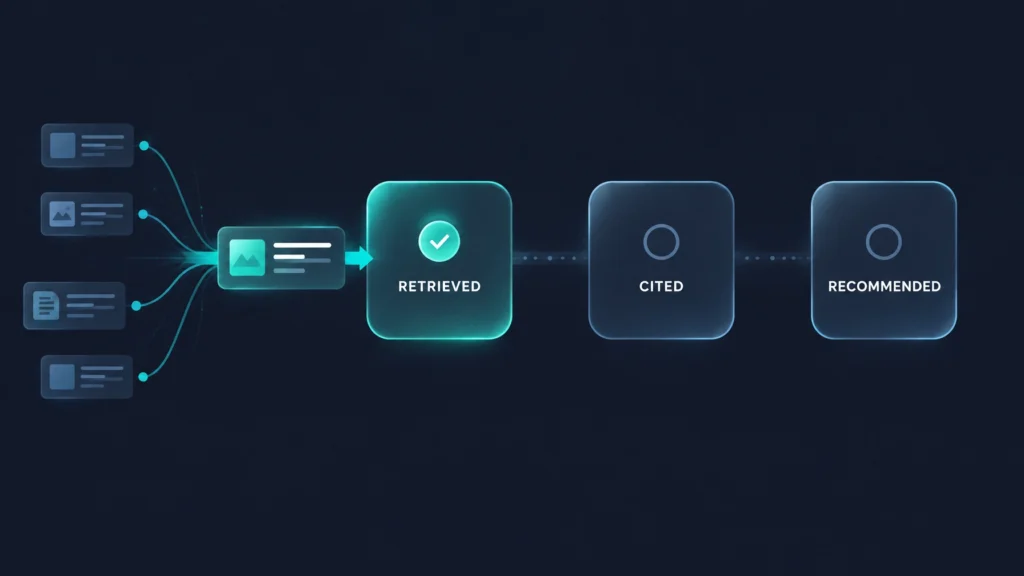
Retrieved is not cited. Cited is not mentioned. Mentioned is not recommended.
If your team collapses all three states into “AI visibility,” you cannot tell which problem you have, or which fix is worth making.
The three states of AI visibility
AI systems typically move through a sequence when producing an answer:
- They retrieve information into a working set.
- They decide which sources support the answer.
- They form an answer that may or may not name a brand as a good choice.
These stages are related, but they fail independently.
| State | What it means | What it does not mean |
|---|---|---|
| Retrieved | A page, document, or source was fetched or considered by the AI system. | The page will be credited or the brand will be named. |
| Cited | Your URL or source was credited in the answer. | Your brand will be mentioned prominently or recommended. |
| Recommended | Your brand was named as a suitable choice for a specific need. | Every supporting page was retrieved or cited. |
There is also an important middle state: mentioned.
A brand may be mentioned in an answer without being recommended. For example, an AI platform might say that a company offers a category of product, then recommend three competitors instead. A mention is visibility. A recommendation is influence.
1. Retrieved: eligible to be considered
Retrieval is the eligibility layer.
An AI crawler, search index, or retrieval system may fetch a page because it appears relevant to a query. The page might contain the right topic, terminology, structured data, or links. It is now available to the model or answer engine as part of the working set.
But retrieval is not a promise of attribution.
A page can be fetched and ignored. It can be considered alongside stronger sources. It can contribute information to an answer without its URL being shown. Or it can fail to make the final response at all.
This is why the retrieval-side signal matters. CiteMetrix’s AI crawler monitoring shows which AI crawlers visited your site, when they visited, and how often. If the crawlers cannot access the content, the page may never reach the next stage.
2. Cited: credited as evidence
Citation is the attribution layer.
A cited source is one the AI system uses and credits, usually by linking to the page or displaying it as a source. This gives you a much stronger signal than simple retrieval. Someone, or something, decided that the page supported the answer.
Citations can still be weak in practical terms. A URL may appear in a source list while the brand itself is barely visible in the answer. A competitor may receive the explanatory sentence while your page is listed as a secondary reference. Or the citation may support a narrow factual point without influencing the buyer’s decision.
CiteMetrix’s Source Pages view is designed for this distinction. It shows exactly which pages, yours and your competitors’, AI platforms cite. That lets you separate “our site was available” from “our page was credited.”
3. Recommended: selected for the need
Recommendation is the decision layer.
A recommendation occurs when the buyer describes a need and the AI names your brand as a good choice for that need. This is the highest-value state because it connects visibility to consideration.
The query might be:
- “What are the best analytics platforms for tracking AI search visibility?”
- “Which tool should an SEO agency use to monitor client citations?”
- “What should an enterprise marketing team use to measure how AI describes its brand?”
A brand can be retrieved without being cited. It can be cited without being mentioned. It can be mentioned without being recommended.
That sequence is not a technicality. It determines the work your team should do next.
What each state tells you to fix
The state you are in is a diagnostic clue.
Retrieved but never cited
This often points to an extractability or credibility problem.
The AI system can access your content, but it does not select your page as evidence. Possible causes include:
- The answer is difficult to extract from the page.
- The page does not state the relevant fact clearly.
- The content is less authoritative than competing sources.
- Important claims are buried in vague marketing language.
- The page lacks supporting evidence, context, or clear ownership.
The fix may be structural: clearer headings, direct answers, stronger source references, better internal linking, or more complete coverage of the question.
Cited but never mentioned
This suggests an attribution or entity-clarity problem.
Your page is being used, but the answer engine may not connect the information to your brand clearly. The source could be cited under a generic description. Your organization name may vary across pages. Product names, categories, and ownership relationships may be inconsistent.
This is where brand knowledge governance matters. Marketing, legal, product, and content operations need to maintain the same verified facts, names, descriptions, and relationships across the website and external sources.
CiteMetrix’s Source of Truth workflow helps keep core facts consistent across expressions such as llms.txt, schema markup, and brand monitoring. The goal is not to publish more claims. It is to make the right claims consistent and verifiable.
Mentioned but never recommended
This is a positioning, sentiment, or product-proof problem.
The model knows your brand exists. It may even describe it accurately. But something prevents it from selecting you for the specific need.
Look for:
- A weak or unclear category position.
- Negative or mixed model sentiment.
- Missing information about an important feature.
- A factual weakness compared with named competitors.
- A mismatch between your product and the query’s requirements.
- A lack of evidence that supports your stated advantage.
A mention is not failure. It is a useful starting point. It tells you the entity is present, while the recommendation gap tells you that the answer is not yet moving in your favor.
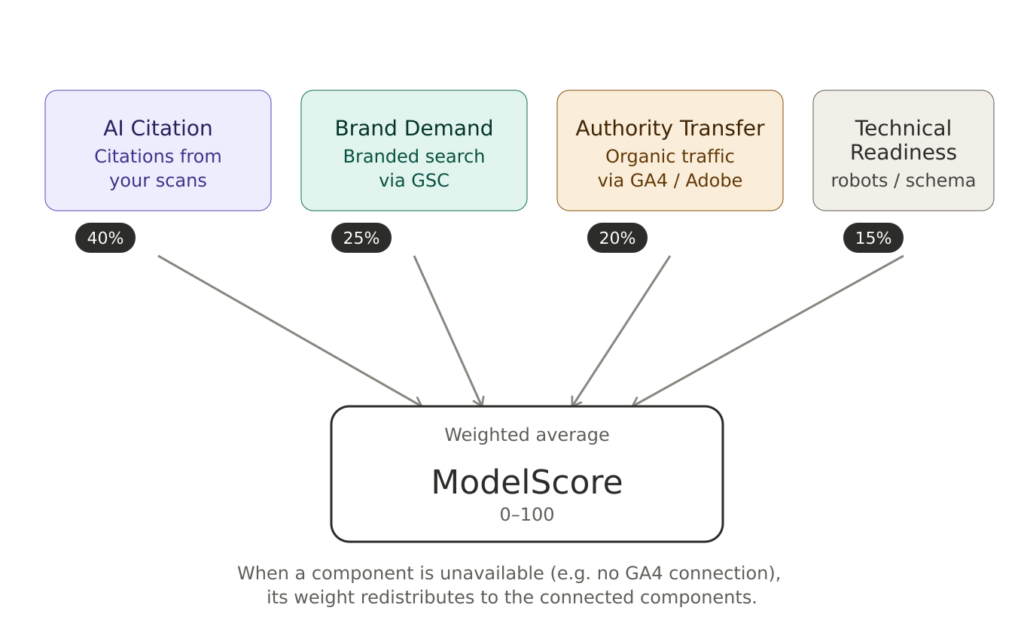
CiteMetrix makes this distinction visible in the ModelScore. Its Mention Score carries 45% of the score, is measured across nine AI engines, and weights both sentiment and prominence. That weighting is important: a buried, neutral mention should not look equivalent to a prominent, positive recommendation.
The highest-stakes case: unbranded queries
Branded prompts are useful for monitoring accuracy.
If someone asks, “What does CiteMetrix do?” the system has already been given the entity. The question is whether the answer is accurate, current, and well-supported.
Unbranded prompts test something more difficult:
“What is the best tool for tracking whether AI platforms cite my brand?”
Here, the buyer describes a problem without naming a provider. The system must identify the category, interpret the requirements, compare entities, and choose which brands deserve attention.
A brand can be thoroughly known when named and entirely absent when the buyer describes their need without naming anyone. That is the gap illustrated by the Semrush workflow.
This is also why branded-query monitoring alone creates false confidence. It measures whether AI can respond about you. It does not measure whether AI brings you into the conversation.
A practical test for your brand
Run a controlled set of prompts across several AI platforms. Keep the prompt set stable long enough to observe patterns, and sample more than once because AI answers vary.
Step 1: Build unbranded category prompts
Write prompts around buyer needs, not your company name:
- Best tools for [category] teams
- Alternatives for [common problem]
- Recommended platforms for [specific use case]
- What should an enterprise buyer look for in [category]?
- Compare the leading options for [job to be done]
Include different industries, company sizes, and buying stages where relevant.
Step 2: Track four outcomes separately
For every response, record:
- Retrieved: Was your page or domain available to the system, where that signal is observable?
- Cited: Was one of your URLs credited as a source?
- Mentioned: Was your brand named anywhere in the answer?
- Recommended: Was your brand presented as a suitable choice?
Do not use a single “visible/not visible” field. The diagnostic value is in the separation.
Step 3: Compare platforms and competitors
AI systems do not behave identically. Use per-platform reporting to see whether the problem is broad or isolated.
CiteMetrix provides platform-level breakdowns across all nine engines. Its Share of Voice view lets you compare your brand head-to-head with named competitors on every platform. Its Brand Perception and Model Sentiment views add context to the raw presence data.
Step 4: Check for factual damage
A recommendation gap may be caused by a true competitive weakness, or by incorrect information.
CiteMetrix’s Accuracy & Hallucination Detection identifies five error types across three severity levels. Each error type receives contextual remediation, and Hallucination Watch automatically rechecks open issues daily until they are resolved.
That matters because an inaccurate model answer can suppress a recommendation even when your underlying product is a fit.
Measure the closed loop, not just the snapshot
The useful question is not simply, “Are we visible in AI?”
Ask instead:
- Are we being retrieved?
- Are our pages being cited?
- Is our brand being mentioned?
- Are we being recommended for the right needs?
- Is the answer accurate and positive?
- Is our position improving relative to competitors?
That creates a practical operating loop:
Monitor → detect → diagnose → fix → verify

CiteMetrix is built around that loop: Source Pages for citation attribution, Citation Tracking and Citation Gaps for queries where you should be cited but are not, crawler monitoring for retrieval eligibility, ModelScore for trend measurement, Share of Voice for competitive context, and accuracy monitoring for what AI gets wrong.
The point is not to chase a single score. It is to know which state you occupy and apply the right fix.
CiteMetrix brings nine features together across nine AI platforms on every plan. Business plans start at $79 per month, with everything included, no extra apps or add-ons.
Ready to see where your brand stands? Get your ModelScore → citemetrix.com