By Eric Richmond, Founder of CiteMetrix
A recent survey of search experts described branded search volume as “the new link.”
That is a useful way to think about the shift, but it is important to be precise about what the evidence does and does not show.
In its Google Ranking Factors Expert Survey 2026, published September 9, 2026, Zyppy Signal, led by Cyrus Shepard, surveyed 131 search professionals. Brand signals were named among the top three factors by 27.0% of respondents. In a companion Google AI Ranking Factors article published September 16, “Brand / Entity in LLM Memory” ranked third among the surveyed AI factors, with an average rating of +2.08 on a scale from -3 to +3.
These are expert opinions, not measured performance data. Zyppy’s contributors also noted the uncertainty around how Google and AI systems work. The survey should not be read as proof that branded search volume is a direct ranking input or that increasing it guarantees more visibility.
But the direction is consistent with a pattern we see in actual AI citation data: recognition often comes before recommendation. Understanding that relationship explains why a brand can be well understood by AI and still be missing from the answers that matter most.
Recognition precedes citation
People rarely begin every buying journey with a blank slate.
They search for brands they already recognize. They ask follow-up questions about companies they have heard of. They compare products whose names have appeared in a podcast, review, customer conversation, publication, or social feed.
That repeated exposure matters because AI systems build their understanding of entities over time. A model’s parametric memory is shaped by the long-run presence of a brand across the web and across the questions people ask about it.
This is one reason brand knowledge governance matters. Your name, category, products, positioning, and supporting facts need to be represented consistently across your website and the third-party sources that help establish who you are.
Citation is often downstream of that recognition.
An AI system may find your page relevant to a query. But before it recommends your brand, it needs enough confidence to treat you as a credible entity in that category. If the model has limited recognition of your brand, your content may be technically sound and still fail to make the shortlist.
That makes citation partly a lagging indicator. You cannot always optimize directly for a citation in the same way you can improve a page title or fix a crawl error.
You can improve the conditions that make recognition and recommendation more likely.
The “known but not recommended” paradox
Here is the paradox many brands eventually encounter:
AI knows what your brand is, but it does not recommend your brand when the user does not name you.
Ask an AI platform, “What is Acme Analytics?” and it may return an accurate description. It may understand your category, audience, products, and differentiators.
But ask, “What are the best analytics platforms for a mid-market SaaS company?” and your brand may disappear.
Those are different visibility problems.
The first is recognition when named. The second is recommendation when unnamed.
A brand can be well represented in AI’s knowledge while lacking the demand, authority, or competitive presence needed to appear in broad category queries. Meanwhile, a competitor may own those unbranded recommendations because it has stronger brand recognition, more third-party corroboration, or greater authority in the model’s memory.

This is why a citation count alone does not tell the whole story. You need to know:
- Which prompts mention your brand by name
- Which unbranded category queries recommend you
- Which competitors appear instead
- How AI describes your brand when it does appear
- Whether your visibility differs across AI platforms
Why Brand Demand is 20% of ModelScore
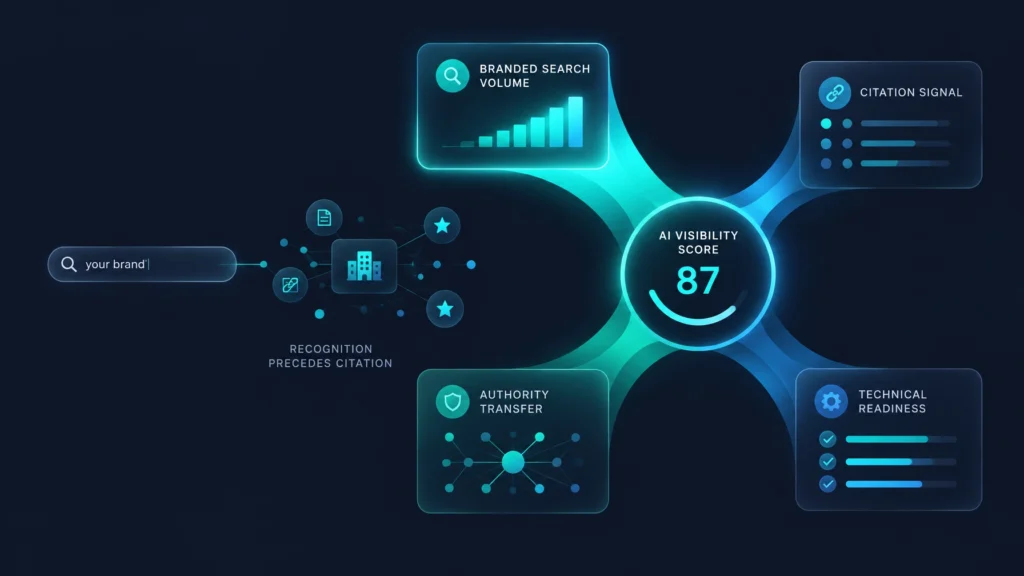
At CiteMetrix, Brand Demand is not a vanity metric placed beside an AI visibility score. It is one of the four disclosed components inside ModelScore™, our 0–100 composite measure of AI visibility.
We weight Brand Demand at 20% because it measures something different from mentions: whether people recognize and seek out the brand by name.
| ModelScore component | Weight | What it measures |
|---|---|---|
| Mention Score | 45% | Brand mentions across nine AI engines, including sentiment and prominence |
| Brand Demand | 20% | Branded search demand measured through Google Search Console |
| Authority Transfer | 20% | AI-referred traffic measured through GA4 or Adobe Analytics |
| Technical Readiness | 15% | Schema, crawlability, and llms.txt readiness |
The largest component is Mention Score because direct AI visibility remains the central outcome. It looks at whether your brand appears, how prominently it appears, and how AI platforms characterize it.
Brand Demand is different. It is a demand-side signal, not an output-side signal.
It captures recognition: are people searching for your company, product, or brand by name? That matters because recognition creates the conditions for stronger entity understanding and more confident recommendations.
Authority Transfer measures what happens after visibility begins to produce visits. If AI-referred users reach your site and engage with it, GA4 or Adobe Analytics can help connect AI visibility to business traffic.
Technical Readiness measures whether AI systems can access and interpret your content. Schema, crawlability, and llms.txt are not substitutes for reputation or demand, but technical barriers can prevent the rest of your program from working.
Every component is disclosed because a score should be explainable. Your team should be able to reason about why ModelScore moved instead of treating it as an oracle.

What a Brand Demand gap tells you
A low Brand Demand score does not necessarily mean you need more blog posts.
It may mean you have a recognition problem.
That changes the work your team should prioritize. Instead of immediately producing more owned content, look at the broader brand system:
- Third-party coverage and earned media
- Reviews and relevant industry directories
- Consistent entity naming across every channel
- Founder and executive visibility
- Partnerships and community participation
- Clear descriptions of your category and differentiators
- Consistent product, company, and location information
This is cross-functional work. Marketing may lead it, but legal, product, PR, and content operations all influence how the brand is represented and corroborated.
It is also the slowest ModelScore component to move.
Technical fixes can produce a relatively quick change. A new content asset may begin receiving impressions soon after publication. Brand recognition takes repeated exposure and consistent reinforcement. It compounds over time rather than responding to a single optimization.
That is not a reason to ignore it. It is a reason to measure it early.
Use AI visibility data to find the real gap
CiteMetrix is designed to separate these problems instead of blending them into one headline number.
The Google Search Console connector provides the branded-search data behind Brand Demand. Brand Perception and Model Sentiment show how AI describes your company, not simply whether it mentions you.
Competitor Share of Voice lets you compare your brand head-to-head against named competitors on every monitored platform. This is where you can see whether competitors are winning the unbranded queries where your brand is absent.
Citation Gaps make that problem practical. They surface the queries where your brand should be cited but is not. A gap may point to a missing piece of evidence, a weak third-party presence, unclear positioning, or a competitor with stronger authority.
CiteMetrix also provides per-platform breakdowns across all nine AI engines. A brand may be recognized by one platform and overlooked by another. An average across platforms can hide that difference.
The goal is not to chase a single universal AI ranking factor. The goal is to understand how your brand is represented across the systems your buyers use.

Measure the lag between recognition and recommendation
The phrase “branded search volume is the new link” is useful because it points to a broader change in how authority is established.
Links traditionally represented a third party choosing to reference your brand. Branded searches represent people actively seeking you out. Neither signal should be treated as a complete measure of authority, and neither eliminates the need for relevant content, credible sources, or technical accessibility.
But together, they help explain how AI systems move from awareness to recommendation.
That is why we built ModelScore as a glass box. With the Report Analysis feature, you can ask the Analyst about your actual numbers and save the answers into the PDF you hand to a client. CiteMetrix includes more than 10 report templates, PDF and PowerPoint export, shareable links, and scheduling.
AI Coaching provides a personalized debrief when your first scan lands, a coaching card on your dashboard, and a weekly AI consultant briefing. The purpose is not to replace judgment. It is to help your team turn a measurement into a next step.
CiteMetrix includes nine features working together, nine AI platforms on every plan, and no extra apps or add-ons. Plans start at $79 per month, with everything included.
Recognition is not the same as recommendation. Mentions are not the same as demand. And a single score is only useful when you can understand what moved it.
See what AI says about your brand and get your ModelScore → citemetrix.com
Related reading: How to Know If AI Recommends Your Brand and The State of AI Search 2026.