By Eric Richmond
Most generative engine optimization advice focuses on tactics: add structured data, improve your content, publish an llms.txt file, or earn more third-party mentions.
The harder question is what happens next — how do you know whether those changes worked?
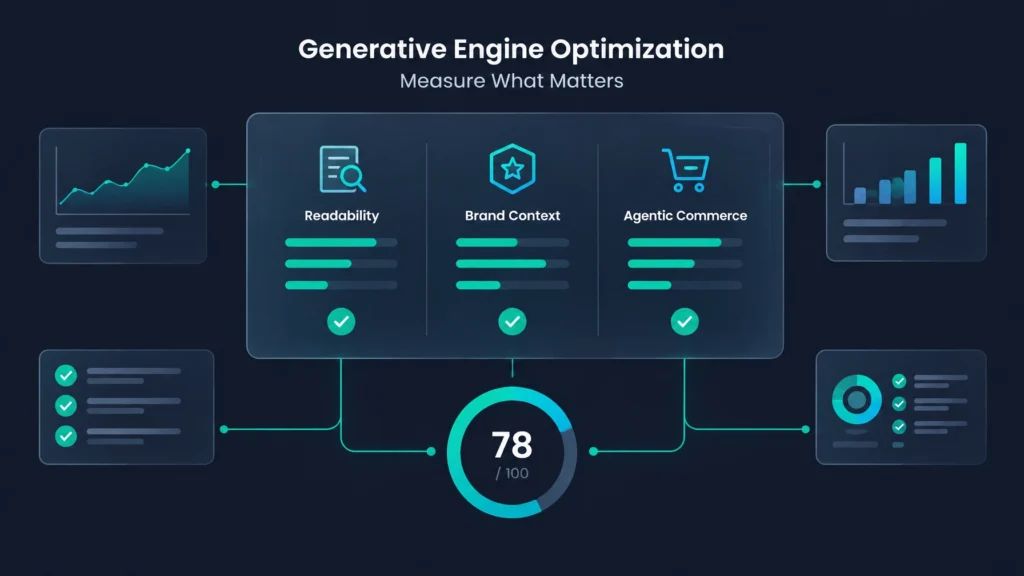
Olaf Kopp’s framework, published in Search Engine Land on September 16, 2026, is useful because it separates GEO into three measurable pillars:
- LLM readability
- Brand context
- Agentic commerce
This is Kopp’s framework, not CiteMetrix research. But it gives teams a practical way to connect GEO work to distinct signals instead of treating “AI visibility” as one mysterious number.

The three GEO pillars at a glance
| GEO pillar | What it requires | Failure mode | Measurable signal |
|---|---|---|---|
| LLM readability | Crawlable, server-rendered content; semantic headings; self-contained passages; schema; llms.txt; accessible AI crawlers |
AI cannot reliably extract or attribute your content | Technical Readiness |
| Brand context | Consistent entity naming; third-party corroboration; being named as the answer, not merely linked | Your site is cited, but a competitor is recommended — or your brand is described inconsistently | Mention Score, Authority Transfer, and Brand Demand |
| Agentic commerce | Verified, machine-readable facts about products, pricing, availability, and attributes | An agent uses a competitor’s data or repeats an outdated detail | Technical Readiness plus the verified-fact layer |
Each pillar asks a different question:
- Can AI read and extract your information?
- Does AI understand and recommend your brand in the right context?
- Can an AI agent trust your information enough to act on it?
Pillar 1: LLM readability
LLM readability is about making your content understandable and retrievable for language models.
That requires more than readable prose. Your site should have:
- Clean semantic structure
- Server-rendered, crawlable content
- Clear headings and subheadings
- Self-contained passages that make sense when extracted from the page
- Descriptive schema.org markup
- An
llms.txtfile that identifies important pages - Robots.txt rules that do not block relevant AI crawlers
What happens when readability is missing?
An AI system may be unable to extract your claims reliably. It may fail to understand which organization a fact belongs to, miss important context, or exclude your content from an answer entirely.
The result is not always a technical error you can see in analytics. Sometimes your content simply never enters the answer.
How to measure LLM readability
CiteMetrix measures this through Technical Readiness, the 15% component of ModelScore covering schema, crawlability, and llms.txt readiness.
Supporting tools include:
- AI Crawlers: See which AI crawlers actually visit your site — traffic that ordinary web analytics may not show.
- Robots Analyzer: Identify crawler blocks in robots.txt.
- Schema Advisor: Find structured-data gaps and improvement opportunities.
- llms.txt Generator: Create a focused file describing your canonical content.
- Site Crawl: Run a one-click crawl up to 500 pages, three levels deep, at one request per second while respecting robots.txt.
A typical crawl takes 10–20 minutes. Starter supports up to 250 pages; Professional and above support up to 500.
That matters because many teams monitor twelve pages while their site contains four hundred. Site Crawl helps close that coverage gap.
Learn more in the CiteMetrix Technical Readiness guide and Site Crawl documentation.
Pillar 2: Brand context
Brand context is not just about whether your domain appears in a citation.
It is about whether AI understands who you are, what you offer, and when your brand is the right answer.
That requires:
- Being named as the answer rather than only linked as a source
- Consistent entity naming across your website and external sources
- Third-party corroboration
- Presence in the sources AI systems already trust
- Clear connections between your brand, products, categories, and use cases
What happens when brand context is missing?
An AI answer may cite your website while naming a competitor in the recommendation.
Or it may describe your company inconsistently because “the product,” “the platform,” and your actual brand name appear to be separate entities. This is why brand knowledge governance needs to involve marketing, legal, product, and content operations — not just SEO.
Search Engine Land’s reporting on two GEO experiments found that third-party and earned sources can outperform owned content for AI visibility. That finding was reported by Search Engine Land, not produced by CiteMetrix. It is consistent with the brand-context pillar — AI often needs corroborating signals beyond your own website.
How to measure brand context
CiteMetrix measures brand context primarily through:
- Mention Score: The 45% component of ModelScore. It tracks how often nine monitored AI engines name your brand, weighted by sentiment and prominence.
- Authority Transfer: The 20% component measuring AI-referred traffic through GA4 or Adobe Analytics.
- Brand Demand: The 20% component based on branded searches from Google Search Console.
Supporting analysis tools include Brand Perception, Model Sentiment, Share of Voice, Source Pages, Citation Gaps, and Competitor Intelligence.
Together, these show whether AI mentions your brand, how it describes you, which sources support that understanding, and whether visibility leads to measurable traffic.
Pillar 3: Agentic commerce
Agentic commerce raises the standard for the first two pillars.
An agent cannot recommend what it cannot read. It will not act on what it cannot verify.
For an agent to research, compare, select, or purchase on someone’s behalf, your information needs to be:
- Deterministic and machine-readable
- Accurate on price and availability
- Complete on product attributes
- Verified rather than written only as marketing prose
- Marked up correctly with schema.org
What happens when agentic commerce readiness is missing?
An agent may resolve a request using a competitor’s data. Or it may repeat an outdated price, product attribute, or availability detail because the underlying source was never verified.
Agentic commerce protocols and entity-map standards are still emerging. No organization can guarantee that an agent will recommend or purchase a product. The practical goal is to make your facts accessible, consistent, and trustworthy enough to be eligible for those workflows.
How to measure agentic commerce readiness
This pillar is measured through a combination of Technical Readiness and the verified-fact layer — not one standalone score.
CiteMetrix Source of Truth lets teams state a fact once, verify it, and use that record to generate:
llms.txt- Schema.org markup
- Structured brand facts
- Consistent entity information
The system includes a verified-only publishing gate restricted to Owner and Admin roles. It also detects drift between internal records and live files, including cases where a generated file was never uploaded.
Correction Proof then checks whether AI answers actually changed after a correction. That distinction matters — publishing a fix is remediation; confirming that AI stopped repeating the problem is verification.
The Entity Map Generator assembles a structured entity file from existing verified Brand Facts, including entities, relationships, and evidence. Adoption of entity-map standards is not guaranteed, but the organizational exercise is valuable even before every platform supports the format.
Why one blended AI visibility score is not enough
Each pillar needs its own signal. A single blended score can hide which part of the system is failing.
CiteMetrix ModelScore is a transparent 0–100 composite with four disclosed components:
| Component | Weight | What it measures |
|---|---|---|
| Mention Score | 45% | Brand naming across nine AI engines, weighted by sentiment and prominence |
| Brand Demand | 20% | Branded searches from Google Search Console |
| Authority Transfer | 20% | AI-referred traffic from GA4 or Adobe Analytics |
| Technical Readiness | 15% | Schema, crawlability, and llms.txt readiness |

Four components cover three pillars because brand context needs both a presence signal and a consequence signal.
Mention Score tells you whether AI names and characterizes your brand. Brand Demand and Authority Transfer help show whether that visibility connects to broader demand and referred traffic.
The value is transparency. When the score moves, your team can investigate the inputs rather than treating the number as an oracle. See the full ModelScore methodology.
Accuracy is the missing pillar-adjacent layer
Visibility without accuracy can create a false sense of progress.
CiteMetrix Hallucination Detection checks every AI response against verified Brand Facts. It classifies five error types:
- Incorrect Fact
- Outdated Info
- Fabricated Claim
- Misleading Context
- Critical Omission
Each issue receives one of three severity levels:
- Minor
- Moderate
- Critical
The system routes each error type to contextual remediation rather than displaying a generic warning. Detection is included on Starter and above. Hallucination Watch, which rechecks issues automatically every day until they resolve, is available on Professional and above.
CiteMetrix is deliberately designed to avoid false alarms. Unverified facts and correct AI answers are tracked separately instead of being flagged as errors.
That matters because a false accuracy alert can erode trust in the tool faster than a missed issue. If an unverified fact enters your fact store, the system may incorrectly flag an accurate AI answer. Verification state — not assertion — must control the accuracy signal.
Read more about Hallucination Detection and Brand Facts.
The practical GEO loop: monitor, detect, diagnose, fix, verify
Monitoring without remediation is just a dashboard.
Remediation without verification is hope.
A useful operating loop is:
- Monitor: Track citations, mentions, sentiment, competitors, crawlers, and technical changes.
- Detect: Find citation gaps, inaccurate claims, crawler blocks, and content weaknesses.
- Diagnose: Identify the specific cause and the affected page, fact, or platform.
- Fix: Apply the appropriate content, technical, entity, or source improvement.
- Verify: Recheck whether visibility, accuracy, or citation behavior actually changed.
The CiteMetrix remediation suite includes AI Content Audit, AI Trust Audit, Answer Position Estimator, Self-Contained Passage Analyzer, Internal Linking Analyzer, Unique Content Scorer, Content Engine, Content Optimizer, Content Refresh Advisor, FAQ Generator, llms.txt Generator, Robots Analyzer, Schema Advisor, and Entity Map Generator.
Content Engine can turn measured citation gaps into CMS drafts and companion pieces for nine additional platforms. It uses verified Brand Facts, learns a brand voice from 5–10 past posts, never auto-publishes, and compares citation rate before and after publication.
CiteMetrix also includes Content Change Tracker, the conversational CiteMetrix Analyst, Report Analysis, AI Coaching, and a mobile PWA with alerts and voice-enabled analysis.
Everything included, nothing extra
CiteMetrix monitors nine AI platforms on every plan:
- ChatGPT
- Perplexity
- Claude
- Google AI Overview
- Google Gemini
- xAI Grok
- Mistral
- DeepSeek
- Copilot
Nine connected features are included, starting at $79 per month. CiteMetrix uses a BYOK model: customers use their own provider API keys, with no markup, and can run unlimited scans subject to their provider accounts.
The point is not to buy another isolated reporting tool. It is to connect measurement, diagnosis, remediation, and verification in one system.
Start measuring all three GEO pillars
Generative engine optimization is becoming less about isolated tactics and more about operational clarity.
Can AI read your content?
Can it identify and recommend your brand?
Can an agent verify your facts well enough to act?
Get your free AI visibility check or explore CiteMetrix. See what AI says about your brand, and which pillar needs attention first.