By Eric Richmond · October 5, 2026
Funding disclosure: The Vaer AI study discussed in this article was commissioned by Lightspeed Commerce, a commerce platform with a commercial interest in how independent retailers are represented. The study covered approximately 460,000 AI shopping responses across ChatGPT and Google surfaces. It was reported by Search Engine Watch on October 2, 2026, and covered by Fortune on the same date. This is a study of AI shopping recommendations in one retail category context, not a universal measurement of AI behavior.
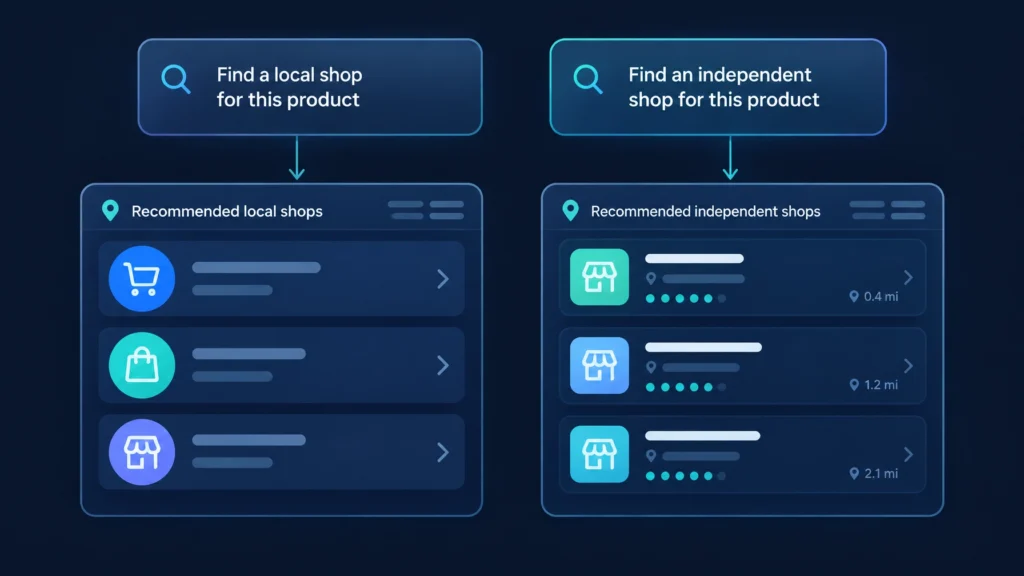
A shopper can ask AI two questions with the same intent:
- “Where can I buy this product locally?”
- “Where can I buy this product from an independent shop?”
The answers can produce two different sets of winners.
The Vaer AI study’s most actionable finding is that adding the word “independent” shifted small and local recommendations from roughly one third to nearly four fifths. That is more than a doubling. The important lesson is not to turn a dramatic result into a more precise claim than the source supports. The lesson is that recommendation is highly sensitive to query wording.
AI recommendation is a query artifact, not a verdict.
What the Vaer AI study found
The headline findings are straightforward:
- Large retail chains were the top recommendation 46% to 58% of the time, according to the Vaer AI study commissioned by Lightspeed Commerce.
- Small and local shops did appear in the sources AI cited, but were frequently passed over when it came to the top recommendation.
- Adding “independent” shifted small and local recommendations from roughly one third to nearly four fifths.
- “Local” and “near me” were far less effective.
- The bias intensified as prompts moved from general browsing toward specific product queries.
Those figures come from one funded study. They are useful as a directional finding, not as a universal benchmark for every category, location, or AI platform.
Why “independent” worked better than “local”
This is the most counter-intuitive part of the research.
| Prompt qualifier | What it describes | Reported effect in the study |
|---|---|---|
| “Local” | A geographic relationship | Far less effective at shifting recommendations toward small shops |
| “Near me” | Physical proximity | Far less effective because a nearby branch of a chain can satisfy the request |
| “Independent” | Ownership structure | Shifted small and local recommendations from roughly one third to nearly four fifths |
A reasonable interpretation, offered by the researchers rather than established as a causal finding, is that the words describe different things.
A chain branch can be local in the literal sense. It can have an address nearby, serve the surrounding area, and appear in local listings. But it cannot satisfy the ownership condition implied by “independent.”
That distinction matters for marketers. If your content strategy repeatedly optimizes for “local” phrasing, you may be optimizing for a qualifier that AI systems interpret broadly. “Independent” communicates a more specific attribute.

Being cited is not the same as being recommended
This is where the study becomes especially relevant to AI search visibility.
Small retailers appeared in the sources AI cited. Yet they were often not the lead recommendation. The information was present, but the businesses were not chosen as the answer.
A basic citation count would record those retailers as visible. That is precisely the reporting failure described in our earlier 82/3 analysis and in the related reading, AI Cites Other People 27x More Often Than You: a source can be used while the brand is not clearly credited, prioritized, or selected.
The distinction is simple:
- Presence: Was the brand or source included anywhere in the answer?
- Recommendation: Was the brand presented as the preferred or lead option?
- Prominence: How much attention and authority did the brand receive?
These are different outcomes. Treating them as one metric produces an incomplete view of visibility.
Related reading: See AI Cites Other People 27x More Often Than You for the 82/3 analysis, and read The Holiday Shopper Might Arrive as an Agent — and Your Feed Is Now Your Storefront for the commerce side of the same shift.
AI search visibility is a distribution, not a spot check
Prompt wording is a variable that brands do not control, and buyers may not think about.
A competitor appearing ahead of you in one test is not necessarily a fact about your brand. It is a fact about one prompt, one platform, one response, and one point in time.
The same store can have the same catalogue, reputation, and service area while receiving a different recommendation because the shopper used one adjective instead of another.
That creates a measurement problem. A single manual test cannot tell you whether your brand is consistently visible. It can only show you what happened once.
For serious AI search visibility work, variation is not noise to discard. It is data to measure.
A practical prompt-set methodology
A useful prompt set should reflect how buyers actually ask questions, rather than one canonical query.
1. Cover natural phrasing
Include the variations a buyer might use:
- Category and product questions
- “Best” and “top” recommendation prompts
- Use-case prompts
- Comparison prompts
- Location-based prompts
- Questions about service, availability, or fit
Do not assume that one keyword represents the entire decision journey.
2. Add ownership qualifiers where they matter
If independence, local ownership, family ownership, minority ownership, or another structural attribute is relevant to the category, test that wording explicitly.
Do not assume “local” means the same thing as “independent.” Measure the difference.
3. Include both browse-stage and product-stage prompts
The Vaer AI study reported that the bias intensified as prompts moved from general browsing toward specific product queries.
Your prompt set should therefore include both:
- Broad discovery questions
- Specific product or model questions
- Purchase-oriented comparisons
- Prompts asking where to buy a named product
Visibility at the beginning of the journey does not guarantee recommendation at the end.
4. Repeat the run
AI responses change. Run the same prompt set more than once and treat the variation as part of the result.
A recommendation that appears in one response but disappears in the next should not be treated as a stable gain or loss.
5. Record presence and recommendation separately
At minimum, capture:
- Whether your brand appeared
- Whether your site or another source was cited
- Whether your brand was recommended
- Where your brand appeared in the answer
- Which competitors appeared ahead of you
- Which platform produced the response
That is the difference between measuring mentions and measuring competitive recommendation.
What this study does not establish
The study is useful, but its limits matter.
It does not establish that AI platforms intentionally favor large chains. It does not establish that the same pattern holds identically across every platform or retail category. It does not establish that prompt wording is the only variable affecting the result.
It is one study, commissioned by an interested party, in a retail context. The findings are directional and worth testing against your own category.
That is not a weakness. It is the correct way to handle evidence: use the result to form a measurement hypothesis, then test the hypothesis with your own data.
What brands should do now
The practical response is not to manipulate prompts. It is to make the facts an assistant would need easier to verify.
Make your ownership structure explicit on important pages. State your service area clearly. Explain what distinguishes your business from nearby branches, marketplaces, resellers, or national chains.
Then make those facts machine-readable.
CiteMetrix’s Source of Truth lets a team verify a fact once and use it to generate llms.txt and schema.org markup deterministically. The output is generated from verified data rather than written by AI. Ownership structure, service area, product scope, and differentiators are exactly the kinds of facts that should be maintained this way.
The publishing gate is restricted to Owners and Admins. CiteMetrix also checks internal and live files for drift, so a verified fact does not quietly become inconsistent across the site.
This is part of brand knowledge governance: a cross-functional discipline involving marketing, legal, product, and content operations.
Where CiteMetrix fits
The direct instrument for this problem is Competitor Share of Voice. It compares your brand head-to-head against named competitors, on every platform, over time. Unlike a basic citation counter, it helps report who is being recommended, not merely who is present.
CiteMetrix’s ModelScore™ also separates the signals:
- Mention Score: 45% across nine engines, weighted by sentiment and prominence rather than raw count.
- Brand Demand: 20%, based on branded searches from Google Search Console.
- Authority Transfer: 20%, based on AI-referred traffic from GA4 or Adobe Analytics.
- Technical Readiness: 15%, covering schema, crawlability, and
llms.txt.
Prominence weighting is important here. It separates a passing citation from a lead recommendation. The exact gap the Vaer AI study demonstrates.
The nine monitored engines are ChatGPT, Perplexity, Claude, Google AI Overview, Google Gemini, xAI Grok, Mistral, DeepSeek, and Copilot. Recommendation behavior differs by platform, which is another reason to sample across engines instead of relying on one.
CiteMetrix’s nine core features are:
- AI Coaching
- Report Analysis
- Source of Truth
- Hallucination Detection
- Mobile Dashboard
- CiteMetrix Analyst
- Content Engine
- Content Change Tracker
- Site Crawl
For this specific workflow, Citation Gaps generate the working list of queries where your brand should be cited or recommended but is not. Source Pages show exactly which pages, yours and competitors’, AI cites, helping you identify where a source is being used without your brand receiving the recommendation.
Hallucination Detection, included from Starter, tracks five error types (Incorrect Fact, Outdated Info, Fabricated Claim, Misleading Context, and Critical Omission) across Minor, Moderate, and Critical severity levels. Each finding is routed to a contextual fix. It is brand-specific AI accuracy monitoring, not a general enterprise hallucination solution.
When a measured gap becomes a content opportunity, Content Engine can turn it into a publication-ready article and companion pieces for nine other platforms, grounded in verified Brand Facts. Its Companion Impact card compares citation rate before and after 30 days. It never auto-publishes; CMS connectors create drafts.
Content Change Tracker stores structured page snapshots on every scan, so a recommendation shift can be tied to a specific content change.
That creates the closed loop:
Monitor → detect → diagnose → fix → verify.
CiteMetrix starts at $79 per month, with everything included and no add-ons: “Everything Included, Nothing Extra.”

The measurement conclusion
The main takeaway from the Vaer AI study is not that one word solves retail visibility.
It is that one word can change the answer.
That means AI recommendation cannot be inferred from a handful of spot checks or from citation volume alone. Build a designed prompt set. Sample it repeatedly. Compare presence with recommendation. Review the result by platform and buyer stage.
Then verify what the models are using to describe your brand.
See what AI says about your brand → citemetrix.com
Meta description: Learn why AI search visibility changes with prompt wording, what “independent” reveals, and how to measure recommendations across platforms.
{“@type”:”Article”,”image”:”https://cdn.marblism.com/OasQ3dwk_PW.webp”,”author”:{“name”:”Eric Richmond”,”@type”:”Person”},”@context”:”https://schema.org”,”headline”:”Adding One Word to the Prompt Tripled the Small Shops. AI Recommendation Is a Query Artifact.”,”publisher”:{“url”:”https://citemetrix.com/”,”name”:”CiteMetrix”,”@type”:”Organization”},”description”:”Learn why AI search visibility changes with prompt wording, what “independent” reveals, and how to measure recommendations across platforms.”,”datePublished”:”2026-10-05″,”mainEntityOfPage”:{“@id”:”https://citemetrix.com/”,”@type”:”WebPage”}}