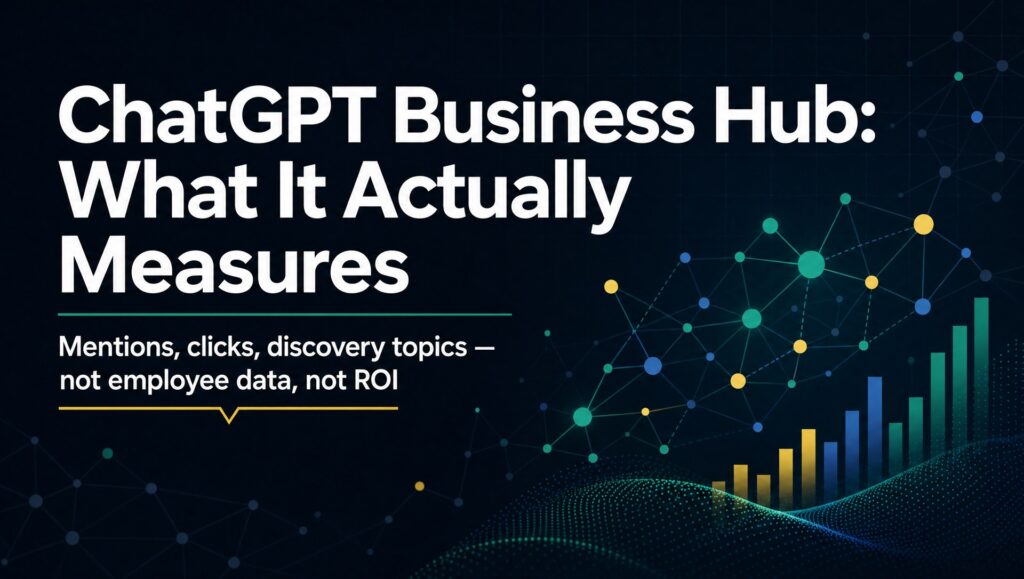
ChatGPT Business Hub measures external customer engagement with a business inside ChatGPT: mentions, website clicks, profile views, and discovery topics tied to cited pages. It is not described as measuring employee usage, workspace activity, or internal productivity. That distinction trips up more marketing teams than it should, mostly because the name sounds like it could be either one. According to OpenAI’s own description in Introducing Businesses in ChatGPT, Business Hub is built for brands that want to see how customers encounter them in ChatGPT conversations, not for IT teams auditing seat usage.
What ChatGPT Business Hub Actually Measures
OpenAI’s announcement text names three things: the number of mentions a business receives in ChatGPT, the website clicks it receives from ChatGPT, and discovery topics, the common themes across conversations where the business’s website is cited. The caption on OpenAI’s dashboard image also lists profile views, so count that as a fourth metric. The announcement describes insights into how people engage with a business. It does not describe an employee dashboard or workspace analytics for your own team’s ChatGPT usage, and it does not mention a seat-level activity log. If you were hoping Business Hub would double as workspace analytics, the announcement gives you no reason to expect that. Its stated plans are more markets, more business categories, and tools for organizations with more complex needs.
Discovery Topics Tell You Themes, Not Rankings
Discovery topics are useful, and also limited. They show what subjects tend to come up when your site is cited. A software company might notice its site keeps showing up around integration questions versus pricing questions. That is a signal about how ChatGPT is framing your brand.
What the announcement does not describe is a ranking, a share-of-voice percentage, or confirmation that a topic led to a click or a purchase. Discovery topics describe association, not performance. Treat them as a qualitative read on brand framing, not a KPI you report alongside conversion rate.
Why Some Insights Just Don’t Show Up
OpenAI says Business Hub insights are aggregated and only available when there are enough conversations or interactions to meet certain thresholds. It also says it does not share users’ conversations or Business Agent chats with businesses. If you are a smaller brand, or one mentioned in a narrow set of queries, you may see gaps or unavailable metrics. That is the privacy design at work, not a bug report. Don’t read an empty panel as zero visibility. It likely means volume hasn’t cleared the threshold, not that nothing is happening.
Business Hub vs. Independent Monitoring: Two Different Jobs
Business Hub reports engagement inside ChatGPT, aggregated and privacy-filtered. Independent monitoring tools run controlled prompts, the same query repeated across models, markets, and time, and record whether and how a brand gets cited. CiteMetrix, for example, runs this kind of sampling across nine AI platforms including ChatGPT, Perplexity, Claude, and Gemini, using the customer’s own API keys. That gives you reproducible, query-level checks across platforms. But it is still a sample: not a census of every ChatGPT conversation, and not proof of total reach. Neither source alone tells you market share or revenue impact. Used together, you get native aggregate counts from OpenAI and repeatable cross-platform citation checks from independent tooling.
What the Numbers Do and Don’t Prove
A mention is not an impression. A citation is not a click. A click is not a conversion. It is tempting to drop a Business Hub mention count straight into a reach report, and OpenAI’s description doesn’t present it as a reach measure. Mentions and clicks are aggregated ChatGPT activity. Nothing in the announcement says they tell you unique users, sentiment, or revenue attribution. If someone asks whether Business Hub can prove ChatGPT generated leads or sales, the honest answer right now is: not directly. That requires connecting cited pages to your own analytics and conversion data separately.
A Practical Measurement Checklist
- Pull Business Hub’s mentions, clicks, profile views, and discovery topics on a regular cadence
- Run controlled prompt samples across ChatGPT and other AI platforms for the same queries
- Compare citation patterns across platforms rather than assuming ChatGPT behavior generalizes
- Validate that cited pages actually match what the AI claims they say
- Track all of this as a time series, not a one-off snapshot
- Document explicitly what you don’t know: thresholds not met, platforms not sampled, conversations you can’t see
How to Report This to Stakeholders Without Overstating It
Separate your report into four buckets: native Business Hub observations, independent sample results (with sample size, platforms, and prompts listed), assumptions you’re making to connect the two, and the privacy or coverage gaps you can’t close. Business outcomes such as leads, revenue, and conversions belong in your regular analytics stack, cross-referenced against this data, not folded into it. That structure won’t make the numbers sound bigger. It will make them defensible the next time someone on the leadership team asks how you know.