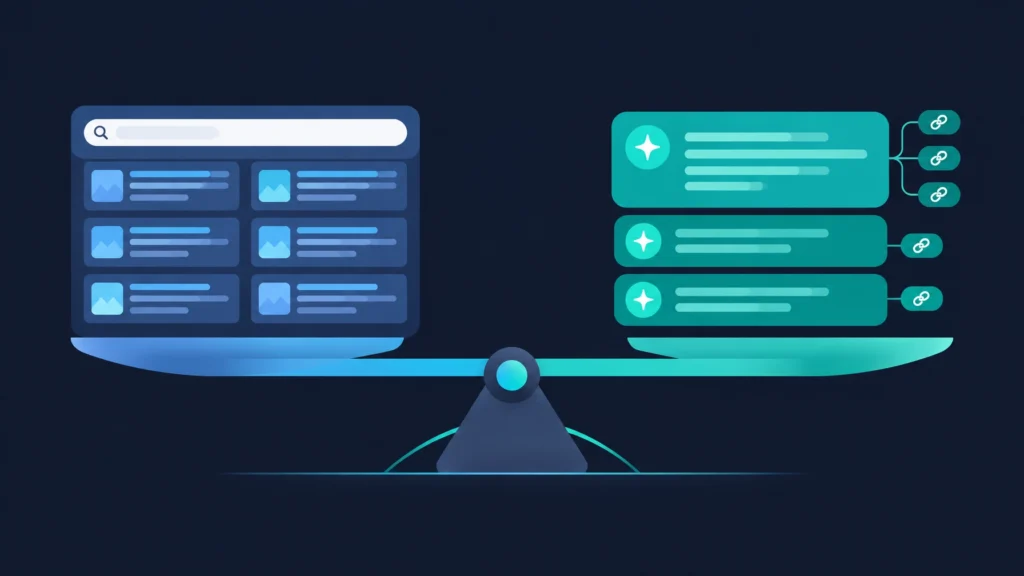
AI referrals are growing. Google still sends more traffic. Both statements can be true.
Shopify recently reported that AI-referred sessions to its storefronts grew 197% year over year, while organic search remained the largest source of merchant traffic. That is Shopify-reported data: not a universal benchmark for every industry: but it illustrates an important shift: AI discovery is growing quickly without making traditional search irrelevant.
The practical question for marketing leaders is not, “Should we choose SEO or AI?”
It is:
How do we measure the full relationship between traditional search, AI visibility, branded demand, and business outcomes?
The answer requires a two-channel view of search.
Google and AI answer engines do different jobs
Traditional search remains a broad discovery and traffic channel.
SEO helps your brand appear when someone searches for a category, problem, product, service, or question. It captures impressions, rankings, clicks, organic sessions, and conversions at scale.
AI answer engines influence a different part of the journey. When someone asks ChatGPT, Perplexity, Claude, Gemini, or another platform for a recommendation, the user may not receive ten blue links. They may receive:
- A shortlist of brands
- A recommendation for a specific product or provider
- A comparison of competing options
- A summary of your company’s strengths and weaknesses
- A citation to one of your pages
- A description of your brand’s sentiment, authority, or relevance
That influence can happen before a measurable website visit.
A buyer may see your brand in an AI answer, search for your name on Google later, visit directly, or convert through another channel. In some cases, the AI platform may send a referral. In other cases, it may simply shape the buyer’s consideration set.
This is why AI visibility should not be reduced to referral sessions.
Why last-click analytics undercount AI influence
Last-click reporting is useful for understanding the final measurable interaction before conversion. It is not designed to explain every influence that happened earlier.
Consider a simplified journey:
- A buyer asks an AI platform for recommended solutions.
- Your brand appears in the answer.
- The buyer searches your brand name on Google.
- They visit your website through an organic result.
- They return directly and request a demo.
A last-click report may credit the conversion to direct traffic. A channel report may credit the earlier site visit to organic search. Neither report, by itself, proves whether the AI recommendation influenced the journey.
That does not mean every branded search or direct visit came from AI. It means the data needs to be triangulated rather than interpreted as a single source of truth.
Google’s Search Console documentation defines impressions, clicks, position, and click-through rate for links and content appearing in Google Search. Those metrics remain essential. But they describe Google visibility and Google-referred activity: not every recommendation a buyer may have encountered elsewhere.
The same principle applies to AI-referred traffic. It is observable and valuable, but it is only one measurable part of AI influence.
A practical two-channel measurement framework
Executives do not need another disconnected dashboard. They need a measurement system that separates the signals while showing how they relate.

1. Traditional search
Continue tracking the metrics that explain reach and performance in Google:
- Organic sessions
- Rankings and average position
- Search impressions
- Click-through rate
- Organic conversions
- Revenue, leads, or pipeline from organic search
These metrics show whether your site is discoverable and useful in traditional search.
2. AI visibility
Measure whether answer engines understand, mention, and recommend your brand:
- Mention and citation rate
- Recommendation position
- Sentiment
- Accuracy of brand descriptions
- Platform distribution
- Competitor share of voice
- Source pages being cited
This is where platform-level visibility matters. CiteMetrix monitors 8 platforms + Google AI Overview on every plan: ChatGPT, Perplexity, Claude, Google AI Overview, Google Gemini, xAI Grok, Mistral, DeepSeek, and Copilot.
The goal is not to create a vanity score. It is to identify where your brand is visible, how it is characterized, which competitors appear instead, and which pages influence the answer.
3. Demand and influence
Connect visibility signals to the demand and traffic data you already use:
- Branded searches in Google Search Console
- Direct traffic
- AI-referred sessions
- Assisted conversions
- Pipeline influence, where available
- Changes in branded demand after major content or visibility shifts
CiteMetrix connects with Google Search Console, GA4, and Adobe Analytics so teams can review branded demand and AI-referred traffic alongside citations.
This is directional evidence, not perfect attribution. The purpose is to understand relationships between signals over time.
4. Readiness and action
Measurement should lead to action. Track the conditions that affect whether AI platforms can access, interpret, and trust your content:
- AI crawler access
- Crawlability
- Schema markup
llms.txt- Citation gaps
- Content changes
- Accuracy corrections
- Verification after remediation
This is the operational side of brand knowledge governance: keeping the facts, content, technical signals, and external representations of your brand aligned.
Why ModelScore is broader than referral traffic
CiteMetrix’s ModelScore™ is a transparent 0–100 composite designed to connect the major parts of AI visibility instead of collapsing everything into referral sessions.
It uses four weighted signals:
- Mention Score : 45%: Nine monitored engines, with sentiment and prominence weighted.
- Brand Demand : 20%: Branded searches from Google Search Console.
- Authority Transfer : 20%: AI-referred traffic from GA4 or Adobe Analytics.
- Technical Readiness : 15%: Schema, crawlability, and
llms.txt.
This structure reflects how AI visibility works in practice.
A brand can be cited often but described inaccurately. It can receive AI referrals but have weak branded demand. It can have strong content but block important crawlers. It can be visible on one platform and absent from another.
A broader model gives teams more useful diagnostic information than a single referral count.
Connect measurement to remediation
Visibility data becomes valuable when it tells you what changed and what to do next.
CiteMetrix’s analysis suite includes Analytics, ModelScore, Platforms, Share of Voice, Impact, Model Sentiment, Source Pages, Citation Gaps, Google AIO, AI Crawlers, and Accuracy. Together, these views help teams move from “our score changed” to “this platform, competitor, content gap, or technical issue explains why.”
The Content Change Tracker snapshots page titles, meta descriptions, headings, word count, links, schema, canonical tags, and content hashes on every scan. When citation movement and content changes happen in the same window, teams can review both events together instead of relying on memory.
For larger websites, Site Crawl can scan up to 500 pages and three link levels deep while respecting robots.txt. That matters because measuring only a handful of pages can create a misleading picture of site-wide readiness.
When facts are wrong or inconsistent, Source of Truth helps establish verified Brand Facts, generate llms.txt and schema.org markup, detect drift between internal records and live files, and provide Correction Proof after changes are made.
The workflow is straightforward:
- Measure where your brand appears.
- Identify citation gaps, inaccurate claims, or technical barriers.
- Make a controlled content or technical change.
- Monitor the next scan.
- Compare the change with citation and sentiment movement.
- Report the result alongside traditional search and analytics data.

A dashboard executives can actually use
A useful monthly view should answer four questions:
Are we still reaching people?
Review organic sessions, rankings, impressions, CTR, and conversions.
Are answer engines recommending us?
Review mention and citation rate, recommendation position, sentiment, accuracy, platform distribution, and competitor share of voice.
Is demand or influence changing?
Review branded searches, direct traffic, AI-referred sessions, and assisted conversions or pipeline where your analytics setup supports them.
What should we fix next?
Review crawler access, schema and llms.txt, citation gaps, recent content changes, and correction verification.
This framework prevents two common mistakes:
- Treating AI referrals as a replacement for Google
- Treating Google traffic as proof that AI visibility does not matter
Both channels can grow. Both can influence revenue. Neither channel explains the entire buyer journey on its own.
The action plan for 2026
Start with these steps:
- Keep investing in traditional SEO. Google remains a major discovery and traffic channel.
- Monitor AI visibility across platforms. Do not assume one chatbot represents the entire answer-engine landscape.
- Connect GSC and analytics data. Review branded demand and AI-referred traffic alongside citations.
- Track competitors by platform and query. Share of voice can vary significantly across surfaces.
- Audit your technical readiness. Check crawlability, schema, and
llms.txt. - Build a correction and content workflow. AI visibility requires ongoing brand knowledge governance across marketing, content, product, legal, and analytics teams.
- Measure change over time. Use directional evidence and controlled remediation rather than promising perfect attribution.
The future of search measurement is not SEO versus AI.
It is understanding how traditional search creates reach, how AI creates recommendation and consideration, and how both contribute to branded demand and business outcomes.
CiteMetrix helps bring those signals into one measurement and remediation workflow, with plans starting at $79 per month and nine monitored platforms included.
See what AI says about your brand → citemetrix.com