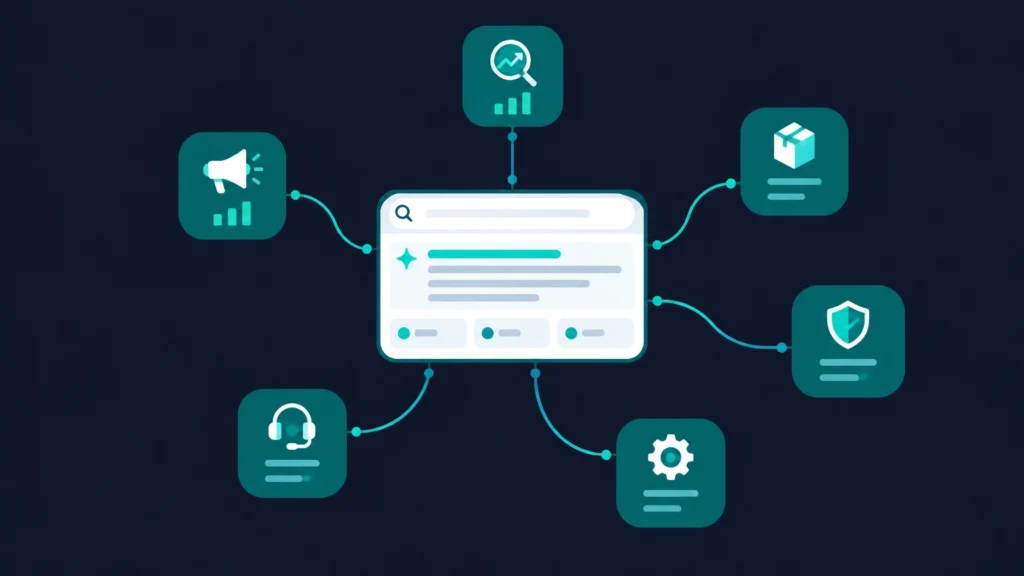
Your SEO team cannot fix what AI learns from your customers.
That is the uncomfortable reality behind AI visibility.
SEO can improve crawlability, content structure, internal linking, schema, and search demand. Those things still matter. SEO remains foundational to how AI systems discover and understand a brand.
But AI platforms are increasingly doing more than retrieving facts. They are helping people choose products, compare vendors, assess risk, and decide which brands to trust.
Those answers may reflect far more than your website:
- Customer reviews
- Support experiences
- Product quality
- Release notes
- Public complaints
- Documentation
- Operational performance
- Third-party coverage
- Brand reputation
- Consistency across public sources
If an AI system is learning from all of that, then AI visibility is no longer an SEO-only problem.
It is a company problem.
Retrieval is not the same as recommendation
The first generation of AI search questions were mostly retrieval-oriented:
- “What does this company do?”
- “What integrations does this product support?”
- “Where is the company headquartered?”
- “What is the published pricing?”
These questions still depend heavily on clear, crawlable, structured content.
But buyers are increasingly asking recommendation questions:
- “Which platform is best for a mid-market marketing team?”
- “What are the tradeoffs between these vendors?”
- “Which provider has the best support?”
- “Is this product reliable enough for an enterprise?”
- “What should I choose given my budget and requirements?”
A retrieval answer can point to a fact.
A recommendation answer has to weigh fit, tradeoffs, context, confidence, and perceived risk.
That distinction matters because a brand can have excellent technical SEO and still be missing from recommendations: or appear with an inaccurate or unfavorable description.

Why traditional SEO alone is insufficient
Traditional SEO is very good at diagnosing certain visibility problems.
It can help you identify:
- Pages that are difficult to crawl
- Missing or inconsistent structured data
- Weak information architecture
- Unclear topical coverage
- Poor search demand alignment
- Content that does not answer an audience’s questions
Those are important inputs.
But SEO cannot independently resolve a recurring product defect. It cannot rewrite a poor support experience. It cannot change a delivery policy, correct an outdated release note, or repair a public reputation issue.
That is why AI visibility programs need to distinguish between diagnosis and remediation.
SEO and marketing may be the teams that first notice that an AI answer is wrong or that a competitor is gaining share of voice. But the cause may belong to Product, Support, Operations, PR, Legal, or Content Operations.
The right question is not:
“How do we optimize this page so AI says something better?”
The better question is:
“What evidence is AI using, is that evidence accurate, and which team owns the fix?”
A cross-functional operating model for AI visibility
The model I recommend is simple:
- Monitor how AI systems represent the brand.
- Diagnose the source of the problem.
- Assign the underlying issue to the responsible team.
- Fix the source evidence or customer experience.
- Track the remediation through to the fix that went out — not to whether the AI answer changed, which nobody can promise.
SEO and marketing should usually own the monitoring and diagnosis layer. They can track which platforms mention the brand, what sources are cited, how the brand is characterized, and where competitors appear instead.
They should not automatically own every fix.
What each team should examine
| Team | Questions to investigate |
|---|---|
| SEO and Marketing | Which AI platforms cite us? Which queries produce gaps? Are our source pages crawlable, accurate, and structured? |
| Product | Are product claims current? Do release notes, feature pages, and public documentation agree? Are recurring product complaints being addressed? |
| Support | What problems appear repeatedly in tickets, reviews, forums, or public complaints? Are resolutions and support policies clearly documented? |
| Operations | Are delivery, availability, onboarding, service levels, and other operational promises consistent with customer experience? |
| PR and Brand | What do independent sources, reviews, media coverage, and public conversations say about the brand? Are corrections and responses visible? |
| Content Operations | Are important facts maintained from one verified source? Are page changes, outdated claims, and content gaps being tracked? |
This creates accountability without treating AI visibility as another isolated marketing dashboard.
What a useful AI visibility platform should measure
Monitoring only brand mentions is not enough.
A useful platform needs to show how AI sees the brand, why it sees the brand that way, and what changed after the team took action.
CiteMetrix’s ModelScore™ is designed as a transparent 0–100 composite with four components:
- Mention Score : 45%: Brand mentions across nine monitored engines, weighted by sentiment and prominence.
- Brand Demand : 20%: Branded searches from Google Search Console.
- Authority Transfer : 20%: AI-referred traffic measured through GA4 or Adobe Analytics.
- Technical Readiness : 15%: Schema, crawlability, and
llms.txtreadiness.
The score is useful because it does not reduce AI visibility to one metric. A brand may be mentioned often but receive negative sentiment. It may have strong demand but weak AI-referred traffic. Or it may have good content but poor technical readiness.
CiteMetrix monitors these 8 platforms + Google AI Overview on every plan:
- ChatGPT
- Perplexity
- Claude
- Google AI Overview
- Google Gemini
- xAI Grok
- Mistral
- DeepSeek
- Copilot
The analysis suite then gives teams different ways to investigate the result, including Accuracy, Brand Perception, Model Sentiment, Share of Voice, Source Pages, Citation Gaps, Google AIO, AI Crawlers, and Analytics.
That is the measurement layer. The next requirement is fixing what the measurement reveals.
From monitoring to remediation
Many AI visibility tools stop when they show you a score, a citation, or a competitor comparison.
That is useful: but incomplete.
CiteMetrix is built around a monitor-to-fix workflow:
Monitor → Detect → Diagnose → Fix
Establishing a trusted source of truth
The CiteMetrix Source of Truth lets teams maintain verified Brand Facts in one repository.
Those facts can:
- Generate
llms.txt - Generate deterministic
schema.orgmarkup - Establish a hallucination-detection baseline
- Use a verified-only publish gate
- Detect internal and live drift
- Produce Correction Proof showing whether AI answers changed after a fix
This matters because facts often drift across product pages, schema, crawler files, sales materials, and support documentation.
A single verified fact should not need to be maintained manually in several disconnected places.
Diagnosing and fixing the issue
Hallucination Watch and CiteMetrix’s 14-tool remediation suite help teams move from detection to action. The suite includes tools such as:
- AI Content Audit
- AI Trust Audit
- Content Optimizer
- Content Refresh Advisor
- FAQ Generator
- Robots Analyzer
- Schema Advisor
- Entity Map Generator
The purpose is not to pretend that every AI visibility issue can be solved with content.
The purpose is to identify whether the issue is technical, factual, structural, content-related, or operational: and then give the appropriate team a practical starting point.

Turn citation gaps into useful content
Some gaps are content gaps. When that is the diagnosis, the CiteMetrix Content Engine can turn measured citation opportunities into publication-ready articles and companion pieces for nine other platforms.
The workflow is designed to keep content grounded:
- Drafts are based on verified Brand Facts.
- The system learns the user’s voice from 5–10 past posts.
- It creates CMS drafts rather than auto-publishing.
- Companion Impact measures citation rate before and after publication.
That last step is important. Content production is not the same as impact. The relevant question is whether the content changed how AI systems cite or describe the brand.
The Content Change Tracker adds another layer by snapshotting page structure and content on every scan. When citation rates move in the same window as a page change, teams can see the correlation instead of guessing which edit mattered.
For larger sites, Site Crawl crawls up to 500 pages, follows three link levels, respects robots.txt, and adds discovered pages to monitoring. That helps teams avoid monitoring only the handful of pages that AI already cites while ignoring product, support, documentation, and resource pages that may become important later.
Make the operating model usable
Cross-functional programs fail when insights stay trapped in a dashboard.
CiteMetrix Analyst is available on analytical pages, reports, and mobile. It is page-context aware, persistent across sessions and devices, and voice-enabled on mobile. Teams can ask questions about their actual data instead of translating every metric manually.
AI Coaching provides a first-scan debrief within 60 seconds, an in-app coaching card, and weekly AI consultant briefings.
For agencies and enterprise teams, Report Analysis lets users ask questions about actual report numbers and save the answers into client PDFs. It supports more than 10 report templates, PDF, PowerPoint, on-screen viewing, scheduled delivery, and white-label reporting.
The Mobile Dashboard adds push alerts delivered in under three seconds, severity-aware notifications, quiet hours, and a voice-enabled Analyst.
CiteMetrix also supports BYOK. Customers use their own API keys with no markup and unlimited scans subject to their provider accounts. API Health includes spend tracking, a circuit breaker, rate limiting, and alerts.
These details may sound operational, but they determine whether AI visibility becomes a weekly cross-functional practice or another report that nobody acts on.
SEO is still foundational. It is just not sufficient.
The answer is not to abandon SEO.
SEO remains one of the primary ways a brand makes its information discoverable, understandable, and technically accessible. It is often the team best positioned to detect changes in AI visibility.
But SEO should not be expected to repair every problem AI can observe.
AI visibility is a shared reflection of the company:
- Marketing shapes the message.
- Product shapes the experience.
- Support shapes the resolution.
- Operations shapes delivery.
- PR shapes public understanding.
- Content Operations maintains the evidence.
- SEO connects the evidence to discoverability and measurement.
The companies that adapt well will not ask SEO to solve everything. They will give SEO the visibility data needed to route the right problems to the right owners: and then verify whether the fixes changed the answers buyers receive.
CiteMetrix starts at $79 per month for business plans, with all 8 AI platforms + Google AI Overview and core features included.
Get your free ModelScore and see what AI says about your brand →
Further reading: Google’s documentation on AI features in Search and CiteMetrix’s AI visibility analysis suite.