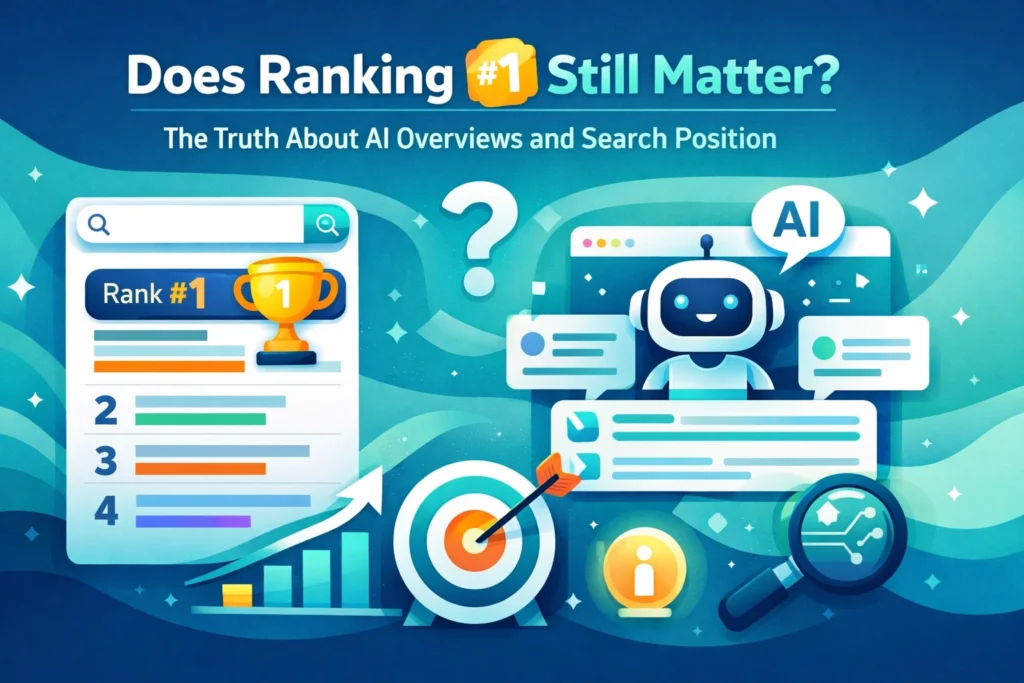
For the last twenty years, the "holy grail" of digital marketing was simple: Rank #1 on Google. If you were at the top, you won. You got the clicks, you got the leads, and you got the bragging rights.
But if you’ve looked at a search results page lately, things look… different.
Between ads, "People Also Ask" boxes, and the massive block of text known as the AI Overview (AIO), that coveted #1 organic spot has been pushed so far down the page you practically need a shovel to find it.
The question everyone is asking me lately is: Does ranking #1 even matter anymore?
The short answer is: Yes, but not in the way it used to. The long answer is that we are witnessing the death of "Rankings" and the birth of "Visibility." At Citemetrix, we’ve been obsessing over this shift, and it’s why we built the ModelScore™.
Let’s break down the truth about the new search reality and how you can actually "rank" in an AI-driven world.
The AI Takeover: Why Your #1 Spot is Feeling Lonely
In 2026, a search engine isn't just a list of links. It’s an answer engine.
When a user types a query into Google or asks Perplexity a question, the goal of the AI is to make sure the user never has to click a link. If the AI can synthesize the information from five different websites and present it in a neat, three-paragraph summary, the user is happy.
But the website owner: the person who worked hard to rank #1 for that query: is left with a "zero-click" search.
Research shows that Google is now matching intent at the passage level. This means their systems aren't just looking at your page as a whole; they are breaking your content down into "chunks." Each chunk is analyzed to see if it answers a specific micro-intent.
This is a massive shift. You might rank #1 for a broad keyword, but if an AI Overview pulls a specific sentence from a competitor who is ranking at #7 because that sentence perfectly answers the user's specific "why," they get the visibility. You get the ghost town.

A visualization comparing traditional SERP layouts with the new AI-dominated "Answer First" layout.
From SEO to GEO: The New Playbook
If traditional Search Engine Optimization (SEO) is about pleasing a keyword-based algorithm, Generative Engine Optimization (GEO) is about becoming the primary source of truth for Large Language Models (LLMs).
How do you "rank" in AI search? It’s not about keyword density anymore. It’s about:
- Directness: AI models love clear, declarative statements. If you’re trying to define a concept, don't bury the lead. Give the AI a "definition" block it can easily scrape.
- Citations: AI models are trained to avoid "hallucinations." They prefer to cite sources that are consistently mentioned across the web. If five different high-authority sites mention your brand as the expert on "marketing analytics," the AI is much more likely to include you in an overview.
- Entity Association: The AI needs to know who you are. This means your Brand Demand and your presence on third-party platforms (Reddit, LinkedIn, industry forums) matter more than ever.
See what AI says about your brand → citemetrix.com
The Truth About Authority and "Passage Ranking"
One of the biggest mistakes I see people making right now is focusing on their homepage authority while ignoring their content structure.
In the AI era, Google’s systems use pattern recognition and entity association to determine what gets featured. If your content is one giant wall of text, the AI crawler might miss the "nuggets" of wisdom that it needs to build an overview.
We’ve moved to a world of micro-authority. You don't just need to be an authority on "SaaS." You need to be an authority on specific, narrow topics. When you provide the best, most concise answer to a specific question, you trigger what we call "Authority Transfer." The AI recognizes your site as the definitive source for that specific sub-topic and cites you.
This is why "ranking #1" is a legacy metric. You’d much rather be "The Cited Source" in an AI Overview that appears for 1,000 different long-tail queries than be #1 for a single high-volume keyword that no one clicks on anymore.

An infographic showing how one piece of content can be "chunked" and cited across multiple AI search queries.
How CiteMetrix ModelScore™ Tracks This Transformation
When we started Citemetrix, we realized that traditional rank trackers were lying to people. They would say "Congrats! You're #1!" while the user's traffic was actually cratering because of AI Overviews.
We needed a new way to measure success. That’s why we created the ModelScore™.
The ModelScore™ doesn't just look at where you sit in a list of links. It analyzes:
- Citation Frequency: How often are AI models (ChatGPT, Gemini, Perplexity, Claude) mentioning your brand or content?
- Sentiment Analysis: When the AI mentions you, is it saying you’re the "best" or just "an option"?
- Brand Demand: Are people searching for you by name? This is a huge signal to AI models that you are a trusted entity.
- Technical Accessibility: Can AI crawlers actually read your site? (Hint: Check your api-key-setup-guide to ensure your data is flowing correctly).
If your ModelScore™ is high, you are winning the visibility game, even if your traditional "ranking" hasn't moved an inch.
Get your ModelScore → citemetrix.com/dashboard
Is #1 Still Relevant at All?
I don't want to tell you that SEO is dead: it’s just evolving. There are still two main areas where ranking #1 matters:
- Commercial Intent: When someone searches for "Buy CiteMetrix subscription" or "Best SEO tool for small business," they are often in "browsing mode." They want to see the options and click through to compare features and pricing. For these bottom-of-funnel searches, the organic list still carries weight.
- Brand Protection: You always want to rank #1 for your own brand name. If a competitor or a negative review site is outranking you for your own name, you have a major PR problem.
However, for informational intent: the "How-to," "What is," and "Why" searches that make up the bulk of the internet: the traditional #1 spot is being swallowed by AI.
How to Pivot Your Strategy Today
If you’re worried that your organic traffic is going to disappear into the AI void, here is your three-step survival guide:
1. Optimize for the "Crawler Gap"
Most websites are still optimized for human readers and old Google bots. You need to optimize for AI crawlers. This means using structured data (Schema) and potentially implementing an llms.txt file to tell AI models exactly what your site is about and what they are allowed to use.
2. Focus on "Mention Volume"
AI learns by association. If you want to be cited in an AI Overview about "the best marketing analytics software," you need to make sure your name appears on high-authority lists, in Reddit discussions, and in industry news. The AI sees these mentions and builds a "map" of who the experts are.
3. Track What Matters
Stop obsessing over a line graph that shows your position for "keyword X." Start tracking your AI Share of Voice. How many times did Perplexity recommend you today versus your competitor? That is the only metric that will matter in 12 months.

A mockup of the CiteMetrix dashboard showing the "Share of Voice" comparison between two competing brands.
The Bottom Line
Does ranking #1 still matter? It matters as a signal of credibility, but it’s no longer the primary driver of traffic it once was.
The future belongs to the brands that are cited, not just the brands that are ranked. The transition from a search engine to an answer engine means your content needs to be more than just "relevant": it needs to be the "source."
We are currently in the middle of the biggest shift in the history of the internet. You can either keep using the 2015 playbook and wonder why your traffic is dropping, or you can start measuring what actually matters.
Join the beta (free) and see where you stand → citemetrix.com/beta
Want to see the future of your brand's visibility?
Book a demo with our team and we’ll walk you through your current ModelScore™ and how to improve it.