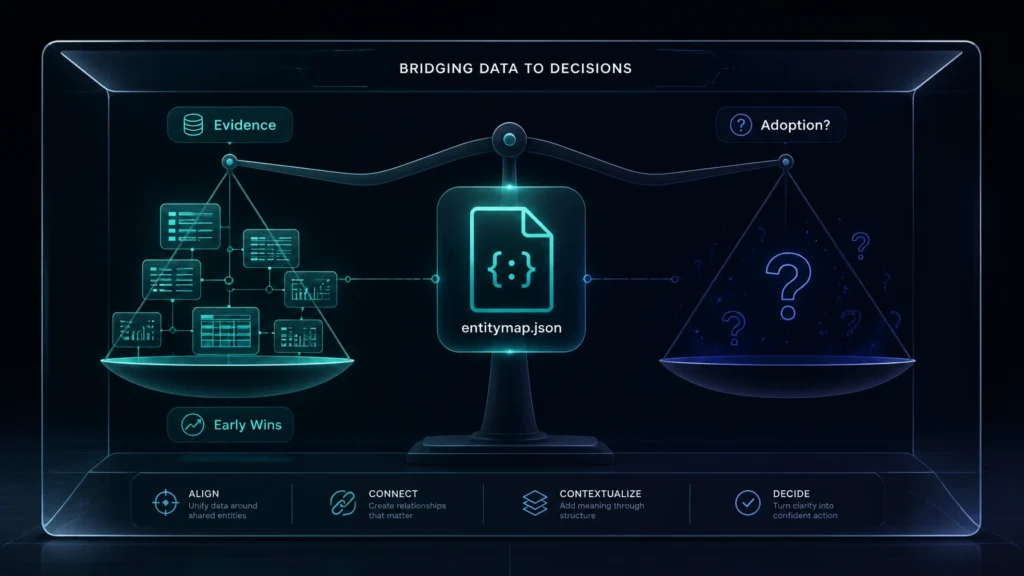
A balanced look at what EntityMap does, what the early evidence says, and why the honest answer is "we don't know yet — but the cost of being early is low."
There's a new file format asking for a spot on your web server, right alongside robots.txt and sitemap.xml. It's called EntityMap, and its pitch is simple: if sitemap.xml tells search crawlers what pages exist on your site, entitymap.json tells AI systems what your site knows — which entities you cover, how they relate, and where the evidence lives.
The standard reached v1.0 in April 2026 and formally launched on July 1 after a 33-day public consultation. It was created by Fred Laurent with the support of Dixon Jones, the co-founder of InLinks and Waikay, and it's received an endorsement from R.V. Guha — one of the co-founders of schema.org.
That pedigree is worth noting. But pedigree doesn't mean adoption, and adoption is the question that matters. So let's lay out what EntityMap actually does, what the early evidence shows, where the skeptics have legitimate points, and what a pragmatic brand should do with all of this.
What Problem Does EntityMap Solve?
When ChatGPT or Perplexity answers a question about your industry, it doesn't read your website the way a person would. It fetches HTML, chunks it into passages, embeds those passages in a vector database, and retrieves the most relevant ones when someone asks a question. Somewhere in that process, three things get lost.
Disambiguation. Your brand name, your product name, and the concept your product represents might appear under different surface forms across your site. To a human, "ModelScore," "our AI visibility score," and "the composite metric" are obviously the same thing. To a retrieval system chunking pages independently, they're three weak signals instead of one strong one.
Attribution. When an AI stitches together an answer from retrieved passages, the publisher's identity often doesn't survive the aggregation. Your content gets used in an answer. Your brand doesn't get named.
Relationships. The connections between your concepts — this product improves that outcome, this person leads that team, this service is governed by that regulation — are buried in prose. A retrieval system has to infer them. Often it infers wrong, or not at all.
EntityMap addresses these by giving publishers a standard way to declare their entities, evidence, and relationships in a machine-readable file at a predictable URL. Two files, specifically: entitymap.json (for machines) and entitymap.html (for crawlers and humans), both published at your domain root.
What the Early Evidence Shows
Waikay, the reference implementation, published an EntityMap on waikay.io on April 25, 2026, and tracked AI visibility scores across five topics for the following five weeks. The results were mixed — which is actually what makes them credible.
On one topic where the brand had room to improve, the AI visibility score jumped 26 points within 48 hours. The entitymap.html file was cited 2.2 to 3.0 times more often than the site's own About page on both Gemini and Perplexity's Sonar model.
On topics where the brand was already at ceiling (scores in the 90s), nothing changed. That's exactly what you'd expect if the intervention is real — improvement where there's room for it, no change where there isn't.
But the results came with a significant caveat. The EntityMap was not submitted to Bing Webmaster Tools, not added to sitemap.xml, and not linked from the homepage. As a result, Bing never indexed the file, which meant ChatGPT, Microsoft Copilot, and Claude — all of which rely on Bing-derived signals — never saw it. The positive results came exclusively from Google-indexed surfaces (Gemini and Perplexity Sonar). Evidence from the Bing-dependent stack is entirely absent from the case study.
That's one site, one deployment, with incomplete cross-platform coverage. It's encouraging, but it's not proof.
What the Skeptics Say (And They Have a Point)
The most honest assessment came from an early adopter named Suganthan, who installed EntityMap on his site in late May 2026 and wrote about the experience with uncomfortable clarity:
"The number of AI systems reading it is zero. That includes ChatGPT, Claude, Perplexity, and Google. The GitHub repo has 11 stars. Measured today, the file does nothing."
He shipped it anyway, reasoning that the cost was half a day and the people behind the standard have credibility in the structured data community. But his observation is factually correct as of the time he wrote it, and it's the thing every brand evaluating EntityMap needs to hear plainly.
Here are the legitimate concerns:
No major AI lab has committed to consuming entitymap.json. The consumer-side conformance guidance in the spec is non-normative. Google, OpenAI, Anthropic, and Perplexity have not announced support. The discovery conventions (the robots.txt EntityMap: directive, the <link rel="entitymap"> tag) are proposed conventions, not standards that any crawler team has committed to honoring.
The certification registry mentioned in the spec is not yet operational. It's planned for Q3 2026 but isn't live. The verificationStatus field in the file is a publisher self-declaration that consuming tools are instructed to treat as a hint, not a guarantee.
Every value claim about EntityMap ultimately depends on future adoption. If AI platforms don't consume the file, it doesn't matter how well-structured it is.
The Case for Implementing Anyway
The strongest counterargument is historical, and it's a legitimate one. GoodRelations, an independently published vocabulary for e-commerce structured data, launched in 2008 with no mandate from any search engine. By 2012, schema.org had absorbed its core concepts, and the brands that had already implemented it had a head start.
EntityMap is betting on the same trajectory: publish openly, demonstrate implementation value, and wait for the ecosystem to catch up. Whether it follows that path depends entirely on adoption — but the cost of being early is genuinely low.
For a brand that already maintains structured data and has its entity information organized, generating an EntityMap is a half-day project at most. The files are static JSON and HTML. They don't require ongoing maintenance unless your entity landscape changes. If AI platforms start consuming them, you're already there. If they don't, you've lost a few hours.
The structural argument is also worth considering. AI retrieval is moving from page-level to entity-level understanding. Whether that happens through EntityMap specifically or through some other mechanism, the brands that have their entity data organized — names, relationships, evidence, attribution — will be better positioned than the ones that haven't. EntityMap is one way to force that organization exercise, and it produces a usable artifact even if the standard itself doesn't achieve widespread adoption.
What a Pragmatic Brand Should Do
If you're evaluating EntityMap for your brand, here's the honest framework:
Implement if your Brand Facts are already organized, the cost is a few hours, and you treat it as a research investment rather than a proven optimization technique. The downside is minimal and the upside, if adoption materializes, could be significant.
Wait if implementing would require a major content audit or entity mapping exercise that you haven't already done for other reasons. The standard is three months old and unproven at scale. Don't build an EntityMap as a standalone project — build it as a byproduct of entity work you'd do anyway.
Don't oversell it to stakeholders, clients, or executives as a proven AI visibility technique. The evidence is early, limited to one site, and incomplete across platforms. Position it honestly: emerging standard, credible backers, low implementation cost, uncertain adoption timeline.
Where CiteMetrix Fits
We've built an Entity Map generator into CiteMetrix that takes your existing Brand Facts — the verified claims you've already loaded for hallucination detection — and assembles them into a spec-compliant EntityMap v1.0 file automatically. The entities, the evidence chunks, the publisher attribution, and the typed relationships are all derived from data you've already entered. No new data collection needed.
We built it because the fit is natural. CiteMetrix already stores the entity data that EntityMap requires: brand facts, citation evidence, source URLs, competitor relationships, and topic coverage from monitored queries. The generator is an assembly job, not a research project.
We also built it because we practice what we preach. We generated an EntityMap for citemetrix.com, validated it against the official spec validator at entitymap.org, and deployed it on our own site. We'll be tracking whether it moves our own visibility scores across the 8 AI platforms + Google AI Overview we monitor — and we'll publish what we find, whether the results are positive or not.
If you're a CiteMetrix customer, the Entity Map generator is available now on all paid plans. Generate your files, review the output (the generator marks everything as "generator-draft" per the spec — it's designed for your review before publishing), and deploy when you're ready.
If you're not a CiteMetrix customer, the EntityMap spec is open (CC BY 4.0) and the reference validator is free at entitymap.org/validate. You can build an EntityMap manually or with any tool that supports the standard. We'd rather you implement it with any tool than not implement it at all — the standard benefits from adoption, regardless of which tool generates the file.
The jury is still out on EntityMap. We think the direction is right and the cost of being early is low. But we'd rather tell you that honestly than pretend the evidence is stronger than it is.
Eric Richmond is the founder of CiteMetrix, an AI visibility intelligence platform that monitors how brands appear across nine major AI platforms. CiteMetrix's Entity Map generator is available on all paid plans.