By Eric Richmond, CiteMetrix
The queries that convert best are often the ones your visibility report is least likely to cover.
That is the practical problem behind the long-tail shift. As search becomes more conversational, buyers are asking longer and more specific questions. Those questions may reveal stronger intent than a broad category term, but they are difficult to track with traditional keyword reporting, and even harder to measure across AI platforms.
This is the practical companion to our earlier post, “AI Mode Is Changing the Query, Not Just the Results Page”. The question here is simple:
Can you see whether your brand is present when buyers ask the detailed questions that lead to a decision?
The reported shift toward longer queries
In a September 11, 2026 article, Search Engine Land reported on Google Ads data showing a shift away from short queries and toward longer ones.
According to the reported Google Ads data:
- Impression share for 1–2 word queries fell from 42% to 24%.
- Impression share for 3–4 word queries rose from 33% to 48%.
- Conversion share for 5–6 word queries tripled.
- Conversion share for 7+ word queries quadrupled.
Every figure above comes from the Search Engine Land report and the Google Ads data it covered. The data is not a universal statement about every search account, industry, or query. It is a clear reason to examine whether your own reporting is focused too heavily on short, high-volume terms.
A simple query-length reference
| Query length | Reported impression-share finding | Reported conversion finding |
|---|---|---|
| 1–2 words | Fell from 42% to 24% | – |
| 3–4 words | Rose from 33% to 48% | – |
| 5–6 words | Not specified in this reference | Tripled |
| 7+ words | Not specified in this reference | Quadrupled |
The important operational point is not that every long query will outperform every short query. It is that longer, more specific queries are becoming important enough that visibility teams cannot treat them as a keyword research footnote.
Why long-tail visibility is structurally invisible
Traditional keyword tools are built around measurable search volume.
That makes sense for head terms. A phrase such as “CRM software” is easy to group, compare, and trend. It has enough volume to appear in a database, and enough repetition to support a monthly estimate.
Buyer questions do not behave that way.
A buyer may ask:
- “What is the best CRM for a small B2B SaaS team with a short sales cycle?”
- “Which analytics platform can show whether ChatGPT recommends our brand?”
- “How should an enterprise SEO team measure citations across AI search platforms?”
- “What should we fix first if competitors appear in AI answers and we do not?”
These prompts are sentences, not stable keywords. They vary from user to user and from one session to the next. Many have no measurable keyword volume at all.
That is precisely why they get ignored, and precisely why they matter.
A keyword report can tell you that a page ranks for a category term. It usually cannot tell you whether your brand appears when a buyer adds constraints, asks for alternatives, compares vendors, or seeks validation before taking action.
Traditional reporting tends to compress this behavior into broad categories. AI visibility reporting needs to do the opposite: preserve the question, the context, the platform, the competitors named, and the source pages cited.
The AI-specific wrinkle: one question can become many
AI search adds another layer of complexity.
An assistant may take one conversational question and fan it out into several subqueries behind the scenes. A user might ask:
“What is the best AI visibility platform for an enterprise SEO team that needs competitor tracking and measurable content recommendations?”
The system may investigate several related questions:
- Which platforms track AI citations?
- Which platforms monitor competitors?
- Which tools cover multiple AI engines?
- Which vendors provide source-page analysis?
- Which claims can be supported by third-party content?
- Which product best matches enterprise requirements?
Your brand may appear for the parent question but be absent from the subqueries. Or you may be cited for one supporting question without appearing in the final answer.
That means a single prompt is not a complete picture of visibility. It is an observation point in a larger query landscape.
The goal is not to pretend you can see every question every buyer will ask. You cannot. The goal is to build a consistent, representative prompt set that lets you measure patterns over time.

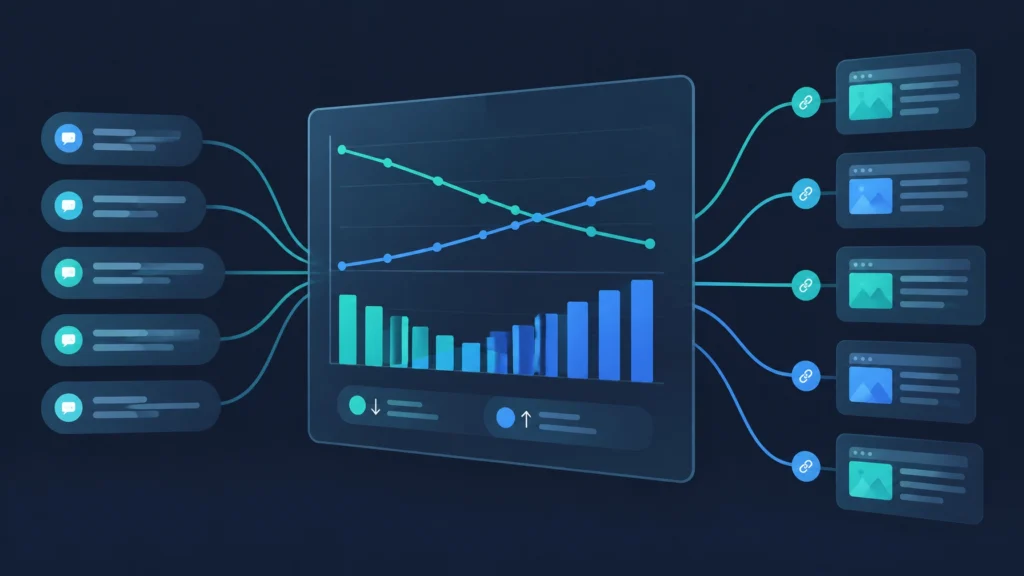
Reference graphic: query-length movement is a measurement signal, not a CiteMetrix dataset or forecast.
A practical methodology for building a prompt set
A useful prompt set should reflect how buyers make decisions, not how a keyword tool organizes phrases.
1. Start with buyer intent stages
Organize prompts around the questions buyers ask as they move toward a decision:
- Clarify: What is this category or problem?
- Constrain: What solution fits my industry, size, budget, or use case?
- Compare, Which providers or approaches are alternatives?
- Validate: Is this product credible, accurate, secure, or widely used?
- Act: What should I choose, implement, buy, or do next?
This gives you a structure that is more useful than a list of keywords. It also exposes gaps. You may be visible for broad clarification questions but absent when buyers add the constraints that make the query commercially meaningful.
2. Write prompts in natural language
Write the questions as a buyer would ask them.
Do not turn every prompt into an awkward keyword variation. Include context, tradeoffs, constraints, and desired outcomes. A real buyer is more likely to ask:
“What should a mid-market SaaS company track to understand whether AI assistants recommend its product?”
They are less likely to ask:
“AI visibility SaaS mid-market tracking.”
Natural language matters because AI platforms are responding to intent and context, not only exact phrase matches.
3. Include unbranded category questions
Branded prompts are useful for monitoring existing demand, but they can make your visibility look healthier than it is.
Include questions where your brand is not named:
- “What are the best tools for tracking AI brand mentions?”
- “How can an SEO agency measure visibility in ChatGPT and Perplexity?”
- “Which platforms compare a company’s AI citations with competitors?”
- “How do I know whether AI search traffic is affecting my business?”
These are the prompts where category awareness and recommendation visibility become visible.
4. Add comparison questions
Comparison prompts are especially useful because they expose the specific alternatives buyers and assistants associate with your category.
Use formats such as:
- “What is the best alternative to [category leader] for [specific use case]?”
- “[Competitor] vs. [category]: which is better for [buyer constraint]?”
- “Which tools offer [feature] without requiring multiple add-ons?”
- “What should I compare before choosing an AI visibility platform?”
Comparison questions should not become a reason to make negative claims about competitors. Their purpose is measurement: understand which brands are named, what sources support the answer, and where your own presence is missing.
5. Sample enough prompts to identify patterns
A prompt set is a sample, not the universe.
Do not draw strategic conclusions from three prompts or from one manual check. Cover the major intent stages, use multiple phrasings, include relevant constraints, and repeat the set over time.
The exact number will depend on your category, audience, and resources. What matters is consistency. A smaller, well-structured set that you can monitor regularly is more useful than a large list that no one reviews after the first scan.
6. Track by platform and over time
Prompt coverage varies by platform. A brand may be cited in one assistant and absent in another, even when the questions appear similar.
This is why CiteMetrix’s analysis suite provides per-platform breakdowns across all nine AI engines. You can see where a prompt produces visibility, where it does not, and whether the pattern is consistent.
Repeat the same prompt set on a regular schedule. Then add new prompts when your products, competitors, audience, or market changes.

What to do when the results come back
Measurement only matters if it changes what you do next.
Find the citation gaps
CiteMetrix’s Citation Gaps identify queries where your brand should be cited but is not. This becomes the working list for the methodology above.
A gap is more useful when it includes context:
- The prompt that was tested
- The platform where the gap appeared
- Which competitors were mentioned
- The sentiment and prominence of each mention
- The pages used as sources
- Whether the issue is new, persistent, or improving
Compare your presence with named competitors
Share of Voice provides a head-to-head view against named competitors across every platform you monitor.
This lets you move from “we seem less visible” to a specific finding:
“For these comparison prompts on this platform, the competitor is named and we are not.”
That is a much better starting point for content planning than a generic instruction to publish more articles.
Inspect the source pages
Source Pages shows exactly which pages, yours and your competitors’, AI platforms cite.
This is where the prompt-level diagnosis becomes actionable. You may find that competitors are being cited because their pages:
- Answer the question directly
- Define the audience and use case clearly
- Compare alternatives in a structured format
- Include verifiable product details
- Address constraints that your content ignores
- Make important facts easy for systems to extract
The answer is not always “write a longer article.” Sometimes it is to clarify a product page, improve an explanation, add structured comparisons, or correct inconsistent facts across your site and other sources.
Turn gaps into measured briefs
CiteMetrix’s Content Engine can turn a measured citation gap into a publication-ready article and companion pieces for nine other platforms. The output is grounded in verified Brand Facts, so the content is tied to your approved source of truth and supports better brand knowledge governance.
It also creates CMS drafts rather than publishing automatically. Nothing auto-publishes.
After publication, the Companion Impact card compares citation rate before and after 30 days. That gives your team a way to evaluate whether the content changed visibility instead of merely proving that something was published.

Measure presence, not just position
AI answers do not always provide a traditional ranking position. A brand may be mentioned first, mentioned in passing, cited as a source, or described with positive or negative sentiment.
That is why the Mention Score within CiteMetrix’s ModelScore measures presence in answers rather than assuming a blue-link position tells the whole story. It is weighted across nine engines, with sentiment and prominence included, and accounts for 45% of ModelScore.
The measurement question is not simply:
“Did we rank?”
It is:
“Were we present when the buyer asked a relevant question, how prominently were we represented, and what source supported the answer?”
To attribute movement accurately, the Content Change Tracker stores page snapshots on every scan. If citation visibility changes after an update, you can connect that movement to a specific content change rather than relying on memory or correlation alone.
CiteMetrix also includes AI Coaching, with a personalized first-scan debrief and a weekly AI consultant briefing to help turn findings into a repeatable operating process.
This is not a task for SEO alone. Long-tail AI visibility touches marketing, legal, product, public relations, and content operations. Consistent facts, clear ownership, and documented changes matter because assistants are building an understanding of your brand from many sources.
The long tail needs its own visibility program
Longer queries are not just a new keyword bucket. They are evidence that buyers are expressing more of their intent in the question itself.
If your reporting only covers high-volume terms, you may miss the questions that reveal the buyer’s use case, constraints, objections, and readiness to act.
Start with a representative prompt set. Organize it by intent. Track it across platforms. Find the Citation Gaps. Compare competitor presence. Inspect Source Pages. Publish against measured opportunities, then re-measure after the content has had time to work.
CiteMetrix brings those workflows together through nine features, nine AI platforms on every plan, and one subscription: $79/month, everything included, with no extra apps or add-ons.
Get your ModelScore and see your AI visibility → citemetrix.com