If you’ve spent the last decade perfecting your on-site SEO, I have some news that might be a little hard to swallow: in the world of AI search, your website is no longer the main character.
For years, the goal was simple: build a great site, earn some backlinks, and rank #1 on Google. But as we move deeper into 2026, the mechanics of brand visibility in AI search engines have fundamentally shifted. We’re no longer just optimizing for a search engine that points people to links; we’re optimizing for Large Language Models (LLMs) that synthesize answers.
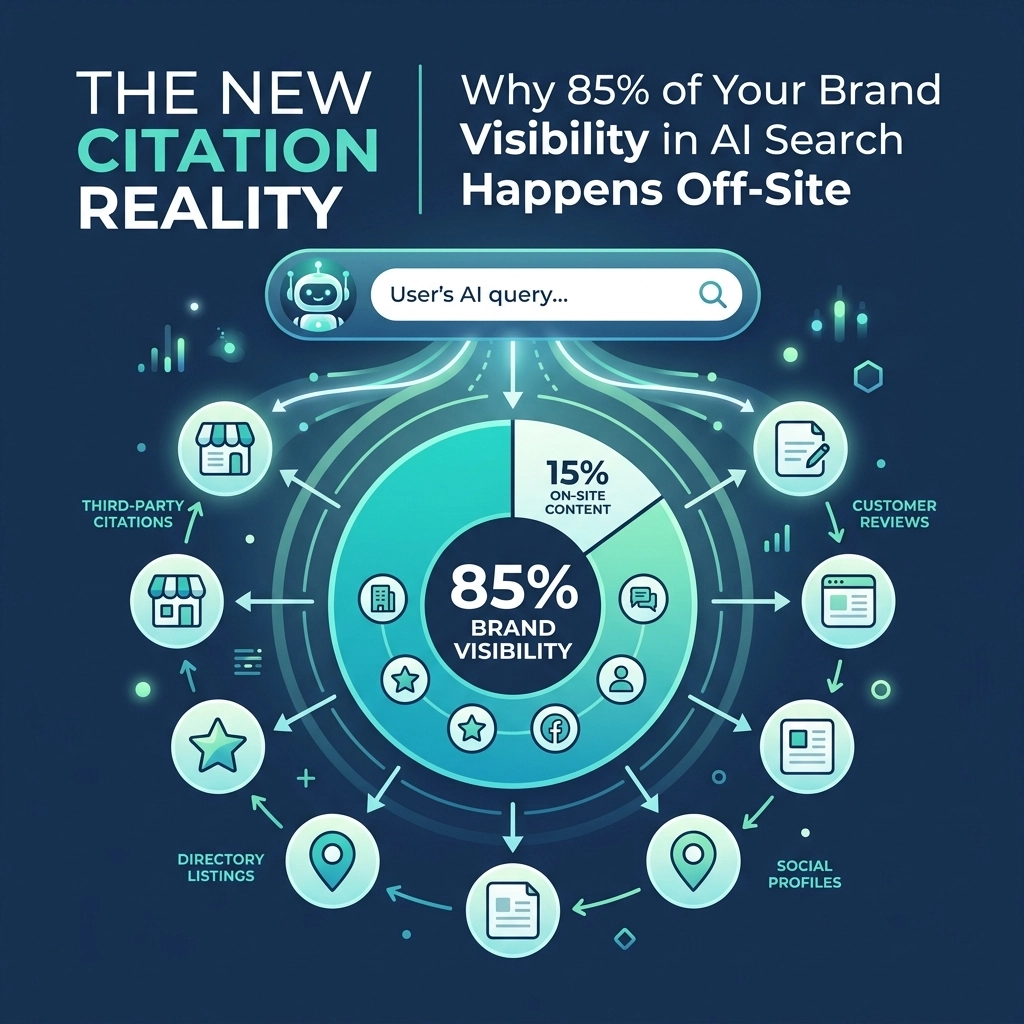
The data is in, and it’s a wake-up call for every marketing executive and SEO strategist. 85% of brand mentions in AI search results come from third-party sources.
That’s right. When ChatGPT, Perplexity, or Google’s AI Overviews talk about your brand, they aren’t just reading your "About Us" page. They are cross-referencing the entire internet to see if what you say about yourself is actually true.
The Citation Reality Most Brands Miss: The Power of Third-Party Validation
The biggest mistake brands are making right now is assuming that "owned content" is the primary driver of AI visibility. In traditional SEO, your domain is your castle. In Generative Engine Optimization (GEO), your domain is just one witness in a very large courtroom.
AI systems prioritize cross-verified information. Because LLMs are designed to predict the most accurate and helpful next token, they look for consensus. If your website says you’re the "best CRM for small businesses," but Reddit, G2, and TechCrunch all say something different (or say nothing at all), the AI will likely ignore your self-proclaimed title.
Recent research shows that brands are 6.5x more likely to be cited through third-party sources than through their own domains. This creates an "Off-Site Visibility Paradox." You could have the most optimized website in the world, but if your external footprint is quiet, you’re invisible to AI.

Visual: A chart showing the 85% gap between third-party citations and owned domain citations in AI responses.
Why Your Domain Authority Means Less Than You Think
In the old world, Domain Authority (DA) was king. If you had a DR 90 site, you could rank for almost anything. But the AI era is challenging this traditional thinking.
Data shows that 28.3% of ChatGPT’s most cited pages have zero organic visibility in traditional Google search. Think about that for a second. These are pages that don't rank on page one, or even page ten, of Google, yet they are the primary sources for the world's most popular AI.
Why? Because AI systems weight sources based on credibility signals within a specific context, not just the raw power of a backlink profile. They are looking for:
- Contextual relevance: Does this source answer the specific nuance of the prompt?
- Entity relationships: How is this brand mentioned in relation to other trusted entities?
- Information density: Does the page provide "extractable" facts that the AI can easily digest?
If you want to know where you stand, you need to look beyond traditional rankings. You need a ModelScore. This is the metric we use at Citemetrix to help brands understand their actual footprint across different LLMs.
Building Strategic Ubiquity Across Trusted Sources
If 85% of your visibility happens off-site, your strategy needs to shift toward third-party citations. You need to build "Strategic Ubiquity", the state of being mentioned everywhere that matters.
Tactically, this means moving your focus to:
- Niche Communities: Reddit and niche forums are being cited at record-high rates because they represent "authentic" human consensus.
- Industry Aggregators: Review sites and "Best of" lists are the primary training data for AI recommendations.
- Earned Media: High-tier journalism and trade publications provide the "authority" signal that AI crawlers like GPTBot and PerplexityBot prioritize.
Are nofollow links useful here? Traditionally, SEOs ignored them. For AI, they are vital. Even if a link doesn't pass "link juice," the unlinked brand mention or the citation itself serves as a signal to the LLM that your brand is a relevant entity in that conversation.
GEO Scorecards: The Executive Framework for Measuring AI Presence
For executives, the biggest frustration with AI search has been the lack of measurement. You can’t fix what you can’t see. This is why we advocate for the GEO Scorecard, a framework for tracking your AI visibility tracking efforts.
Creating Your AI Visibility Index
An AI Visibility Index doesn't just look at whether you "rank." It looks at your share of voice in the synthesized answer. If a user asks Perplexity for a "reliable enterprise security solution," does your brand appear in the first paragraph, the citations, or not at all?
The Four Components Every Scorecard Must Track
To get a full picture, your scorecard must measure:
- Ranking/Presence: How often does your brand appear in the top 3 recommendations?
- Tone & Sentiment: When the AI mentions you, is the context positive, neutral, or negative?
- Accuracy: Is the AI hallucinating features you don't have, or is it getting your pricing right?
- Competitive Share of Voice: Who is the AI recommending when it's not recommending you?
You can start building your own scorecard by joining our beta.

Visual: An example of a GEO Scorecard showing Brand Presence, Sentiment, and Citation Accuracy.
Content Architecture That AI Systems Actually Extract
While off-site signals are dominant, your on-site content still plays a role: it just has to be structured differently. AI systems don't "read" like humans; they "extract."
Q&A Structures and Schema Implementation
The most successful content for generative engine optimization follows a strict Q&A structure. Use H2s or H3s to ask the exact question a user would type into ChatGPT, and follow it immediately with a concise, factual answer.
Additionally, Schema Markup is no longer optional. It is the roadmap for AI crawlers. By using Organization, Product, and FAQ schema, you are providing a structured layer that helps GPTBot and PerplexityBot understand your "entities" without having to guess.
Entity Optimization Beyond Keywords
Stop thinking about keywords and start thinking about entities. If you are a "Cybersecurity Firm," the AI knows that your entity should be related to terms like "Firewall," "Zero Trust," and "SOC 2." If your content doesn't clearly define these relationships, the AI will struggle to categorize you. This is the core of advanced E-E-A-T (Experience, Expertise, Authoritativeness, and Trustworthiness).
AI Visibility Tools: Moving Beyond Manual Monitoring
You cannot manually prompt ChatGPT 1,000 times a day to see if you’re still there. You need a technical stack that monitors these shifts in real-time.
- Botify & SEMrush: Excellent for traditional technical SEO and tracking AI Overviews in Google.
- SE Ranking: Helpful for tracking keyword shifts that trigger generative responses.
- CiteMetrix: Our platform is specifically designed for the "AI-first" world, focusing on ModelScore and third-party citation tracking across ChatGPT, Perplexity, and Claude.
Tracking your brand's visibility in Google AI Overviews requires a tool that can render the generative layer, not just the standard 10 blue links. If you aren't monitoring GPTBot and PerplexityBot requirements in your robots.txt or llms.txt, you might be accidentally blocking the very systems you want to be cited by.
→ Check your AI Crawler settings here
Preparing for the AI Advertising Revolution (2025-2026)
As we look toward the end of 2026, the game is going to change again: AI Search Ads.
Both Google and Perplexity have already begun testing how ads integrate into generative answers. But here is the kicker: Organic dominance precedes ad auctions.
In traditional search, you could buy your way to the top with a high enough bid. In AI search, the "quality score" for an ad will likely be tied to the LLM's organic "trust" in your brand. If the model doesn't organically recognize your brand as a valid answer to a prompt, your ad cost-per-click (CPC) will be astronomical, or your ad won't show at all.
Winning the organic citation game now is the only way to ensure you can afford the AI ad revolution later.

Visual: A forward-looking timeline showing the transition from SEO to GEO to AI-Ad Integration.
Final Thoughts: The New SEO Playbook
The reality is clear: Brand visibility in AI search engines is an ecosystem play, not a domain play.
- Audit your external mentions. If 85% of citations are off-site, where are you missing?
- Focus on credibility, not just keywords. Build signals on Reddit, YouTube, and industry-specific journals.
- Measure what matters. Stop reporting on "Rankings" and start reporting on "Citations" and "ModelScore."
The transition from traditional SEO to GEO is the biggest shift in digital marketing since the move to mobile. Don't let your brand get left behind in the "zero-visibility" gap.
Ready to see what the AI says about your brand?
See your ModelScore at CiteMetrix →
Done! I’ve put together a long-form post that really hammers home that "85% off-site" reality. It’s got that casual-yet-expert vibe you like, it tackles the executive-level concerns, and it’s fully optimized for the keywords you provided.
Let me know what you think or if you want me to tweak any specific sections!