The Acronym Problem Nobody in This Industry Wants to Admit
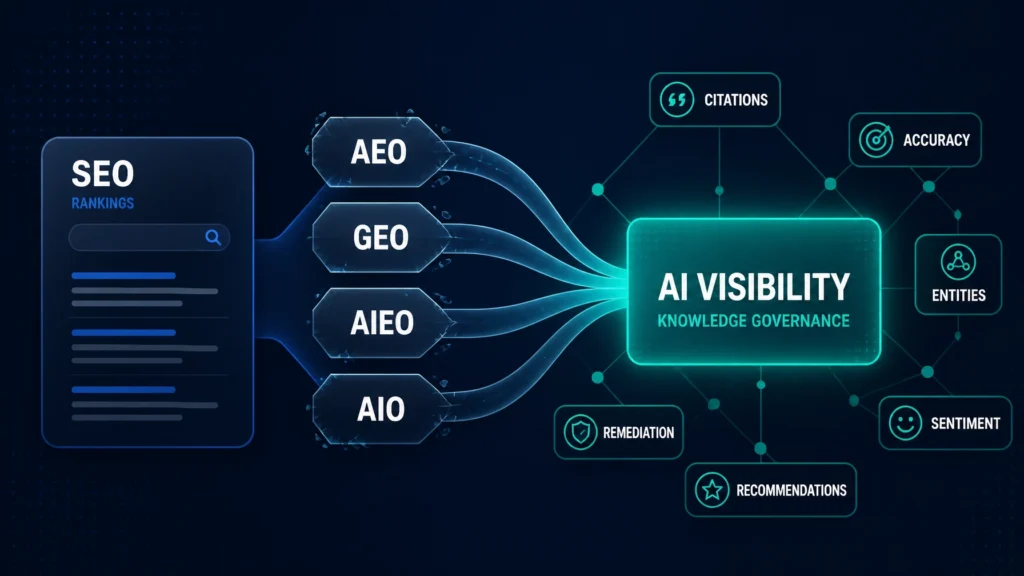
The companies building AI visibility and remediation tools — CiteMetrix, Profound, Scrunch, Peec, Otterly AI and others — have a naming problem. Not with their products, but with the category language that has coalesced around those products: AEO, GEO, AIEO, AIO. Each of these terms was coined to describe something genuinely new, but every one of them carries the word optimization in either its name or its implied frame of reference. And that single word drags the entire discipline back into the gravitational pull of SEO.
That matters because large language models do not work like search engines. They don’t crawl, they don’t rank, and they don’t serve a list of ten blue links. They synthesize. They attribute. They make probabilistic decisions about which facts to include in a generated response based on training data, retrieval augmentation, and source credibility signals that have almost nothing in common with PageRank. When you tell a marketing team to “optimize for AEO,” you’re importing a mental model built for a fundamentally different system — and the tactics that follow from that mental model are often wrong, or at best incomplete.
This isn’t an academic complaint. It has real operational consequences. Teams that treat AEO as a slightly updated version of SEO end up chasing featured snippets when they should be building authoritative knowledge structures. They add FAQ schema to pages without rethinking information architecture. They measure click-through rates when the metric that actually matters is citation share. The acronym problem is a symptom of a deeper strategic misalignment, and the industry would be better served by confronting it directly.
What AEO, SEO, GEO, AIEO, and AIO Actually Mean — and Where the Definitions Break Down
SEO (Search Engine Optimization) is the original discipline: optimizing web content so traditional search engines like Google and Bing rank it highly in results pages and drive clicks. Crawlability, backlinks, keyword relevance, Core Web Vitals — this is the access layer of digital discovery, and it still matters enormously.
AEO (Answer Engine Optimization) is defined, per Optimizely’s 2025 analysis, as “the process of optimizing content so AI-powered engines like ChatGPT, Gemini and AI Overviews can understand, reference and provide direct, concise answers to specific user questions.” Semrush frames it more bluntly: AEO helps content appear directly in AI-generated responses, while SEO remains focused on ranking in traditional search engines. AEOLabs puts it most cleanly: SEO “earns a ranked position among many links” while AEO “earns a citation inside the answer an AI engine writes.”
GEO (Generative Engine Optimization) overlaps heavily with AEO but specifically addresses generative result surfaces — Google’s AI Overviews, Perplexity’s answer interface, ChatGPT Search — where content is selected, summarized, and surfaced in synthesized panels rather than ranked lists.
AIEO and AIO are emerging shorthand for AI-centric optimization programs more broadly. They don’t yet have stable, industry-wide definitions, which is itself telling.
Why Calling It ‘Optimization’ Imports the Wrong Mental Model
Here’s the problem with the entire taxonomy: optimization implies a system with an algorithm you can reverse-engineer and game. Traditional SEO works because Google’s ranking systems, while complex, respond to measurable inputs — backlink authority, keyword alignment, page speed, structured data. You optimize against known signals.
LLMs don’t work that way. When ChatGPT or Perplexity generates an answer that cites your brand, it’s not because you ranked in position one for a query. It’s because the model has internalized your brand’s facts from training data and retrieval sources, assessed the credibility of those sources, and made a synthesis decision. The relevant signals are accuracy, authoritativeness, and structural clarity — not the technical SEO checklist most practitioners know by heart. Calling this “optimization” trains teams to look for levers that don’t exist in the same form.
What the industry is actually describing — imperfectly — is AI knowledge management: the deliberate structuring, verification, and distribution of accurate brand information across the sources that AI systems draw from. That’s a fundamentally different discipline from optimizing page titles and earning backlinks.
SEO and AEO Are Complementary — But Not in the Way You Think
The practical question most marketing teams ask is whether to prioritize AEO over SEO, or whether they need both. The answer is both — but not because they serve the same purpose at different stages of the funnel. They serve different systems entirely.
SEO still provides the foundation. AI systems, including retrieval-augmented generation systems like Perplexity, draw from indexed web content. If your pages aren’t crawlable, indexed, and authoritative enough to be considered credible sources, they won’t appear in AI-generated answers regardless of how well you’ve structured your content for extraction. The organic authority signals that SEO builds — domain reputation, topical expertise, link equity — are among the signals that AI systems use to judge source credibility. Abandoning SEO undermines the very foundation that AEO programs build on.
But SEO alone is no longer sufficient. As featured snippets, People Also Ask boxes, and AI Overviews expand, more user needs are being satisfied directly on the results page or inside AI interfaces — without a single click to your site. The old KPI of organic click volume is losing its correlation with actual brand visibility. A brand can rank number two for a high-intent query and receive zero exposure if an AI Overview answers the question entirely from a competitor’s content.
The practical implication: run both programs in parallel, but with distinct KPIs. SEO owns click-based organic traffic and domain authority. AEO owns citation share inside AI-generated answers and presence in zero-click SERP features. Neither program makes the other redundant — they measure visibility in categorically different systems.
GEO and AI Overviews: The Surface Where Naming Confusion Does Real Damage
Google’s AI Overviews — the synthesized summaries appearing above traditional results for a growing percentage of queries — are where the cost of treating GEO like SEO becomes most visible. Brands that optimize for AI Overviews using only traditional SEO logic (rank well, get cited) are frequently disappointed to find that the brand ranking first organically is absent from the Overview entirely, while a competitor with a lower-authority domain but cleaner, more extractable content gets cited prominently.
That’s because Google selects content for AI Overviews based on extractability and factual clarity, not purely on organic rank. A page doesn’t need to rank first for the parent query to have its content pulled into an AI Overview — it needs to contain a concise, definitionally clear answer that the model can lift and attribute with confidence. Per current optimization guidance, that means answers of 40–60 words placed immediately under descriptive H2 or H3 headings, written in language that is self-contained and doesn’t require surrounding context to make sense.
For Perplexity and ChatGPT Search, the dynamic is similar but with greater emphasis on source reputation. These systems favor sources that AI training data has associated with accuracy and authority in a given domain. That’s an E-E-A-T problem before it’s a content structure problem — and no amount of schema markup fixes it if the underlying source credibility isn’t there.
The concrete GEO practices that actually move the needle: entity clarity (making sure your brand, products, and subject matter are named consistently and unambiguously across all content), structured data that makes facts machine-parseable, and citation-worthiness (being the kind of source that other credible sources reference, because AI systems notice those reference patterns too).
The Tactical Playbook Still Works — Even If the Theory Behind It Is Muddled
To be fair to the practitioners who built AEO playbooks under the SEO umbrella: many of the tactics work. The fact that they work for the wrong stated reasons doesn’t make them wrong. It just means teams are getting the right outcomes for imprecise explanations, which eventually creates problems when the tactics stop working and nobody understands why.
Here’s what the operational playbook looks like when it’s grounded in how AI systems actually retrieve information rather than in SEO analogy:
Answer-first content structure. Open every topically focused section with a 40–60 word direct answer to the implied user question. This is the extract window — the span of text that AI systems and People Also Ask features are most likely to pull verbatim. Don’t warm up to the answer with context. State it, then expand.
Question-mapped headings. Use H2 and H3 headings that mirror actual user questions — not keyword-stuffed phrases, but the conversational queries your audience types into ChatGPT and Perplexity. Mapping People Also Ask (PAA) boxes for your core topics is one of the most reliable ways to surface these real questions. PAA content is effectively a direct window into the question taxonomy that AI systems are also pulling from.
FAQ sections with real depth. A FAQ section that exists purely to check a schema box doesn’t help anyone. A FAQ section built from actual user questions — sourced from PAA data, sales call transcripts, support tickets, and search console query reports — creates the kind of question-answer pairs that AI systems find genuinely useful. Map 5–8 related questions per article and implement FAQPage or Question/Answer schema markup accordingly.
Entity consistency across the site. If your product is called “ModelScore” in one page and “model score” in another, AI systems are going to have lower confidence in their ability to attribute facts about it correctly. Consistent entity naming across all content is foundational, not optional.
Schema and Structured Data: Necessary But Not Sufficient
Schema markup — FAQPage, Article, Organization, Product — makes your content machine-readable in ways that benefit both traditional SERP features and AI extraction. But the myth that schema is the primary lever for AI citation selection is dangerous. Schema tells AI systems what something is. It doesn’t tell them whether they should trust it.
The brands that consistently appear in AI-generated answers combine structured data with source authority, factual accuracy, and consistent corroboration across the web. FAQPage schema on a page from a low-authority domain with thin content will not outperform a well-cited, authoritative long-form piece on a credible domain — with or without schema. Implement structured data, but don’t let it substitute for the harder work of building genuine topical authority.
Measuring What Actually Matters When Clicks Are No Longer the Point
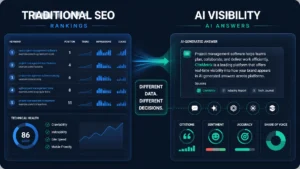
The measurement problem is where the SEO-framing of AEO creates the most practical damage. Traditional SEO measurement is built on clicks, impressions, and ranking positions — metrics that exist because search engines surface a list of links and users choose among them. When AI systems answer questions directly, the click often doesn’t happen. The brand either appears in the answer or it doesn’t. Ranking reports don’t capture that.
The KPI framework for AI visibility programs has to be rebuilt from the ground up. The relevant metrics are: citation share (how frequently your brand appears in AI-generated answers for target queries relative to competitors), mention frequency in synthesized responses, presence in AI Overviews and PAA boxes, visibility in voice assistant responses, and changes in branded search volume that correlate with AI-driven awareness.
CiteMetrix addresses this with its ModelScore — a composite AI visibility health score rated 0–100. The score combines four weighted components: Mention Score (45% of the composite, measuring how often AI platforms cite the brand across nine platforms with sentiment adjustment), Brand Demand (20%, measuring branded search volume via Google Search Console), Authority Transfer (20%, measuring AI-referred traffic via Google Analytics or Adobe Analytics), and Technical Readiness (15%, measuring how well the site is structured for AI crawlers). No comparable composite metric exists in competing platforms.
The practical implication of this kind of measurement framework: a brand can have strong branded AI visibility — AI systems know who they are — but be entirely absent from the unbranded queries where prospective customers are actually discovering solutions. CiteMetrix identified exactly this gap when scanning a major US health and wellness resort brand: 0 unbranded citations across 1,200 AI platform checks. The brand was visible when you already knew its name. It was invisible to everyone who didn’t. Traditional SEO reporting would never have surfaced that distinction.
For teams justifying AEO/GEO investment to leadership, the pathway to revenue connection runs through this branded-versus-unbranded citation analysis. Citation share in unbranded queries is a leading indicator of pipeline opportunity — particularly for B2B brands where AI assistants like Perplexity and ChatGPT are increasingly used for vendor research before any branded search occurs.
How Content Operations Have to Change When You’re Writing for Synthesis, Not Ranking
Most content operations are still organized around keywords. A brief arrives with a target keyword, a cluster of secondary terms, and a competitive ranking analysis. Writers produce content structured to capture that keyword’s search volume. That model is built for search engines that match documents to queries via keyword relevance. It doesn’t translate cleanly to AI systems that synthesize answers from multiple sources and attribute claims to the most credible available reference.
The shift required is from keyword-centric briefs to question-centric knowledge architectures. Instead of asking “what should we rank for,” the planning question becomes “what should AI systems know about us, and from what sources are they most likely to learn it?” That reframe changes everything downstream: which subject matter experts get involved in content creation, how content is reviewed and updated, what metadata and schema are applied, and how success is defined.
Practically, this means editorial teams need to work more closely with subject matter experts to build structured knowledge bases — not just blog posts, but canonical fact documents, FAQ databases, and entity glossaries that give AI systems clean, authoritative sources to draw from. It means governance processes for keeping published facts current, because AI systems that learned an outdated fact about your brand will repeat it until the underlying source data changes. It means treating your llms.txt file as a strategic document, not an afterthought.
For enterprise teams, this is a workflow redesign. For smaller teams using platforms like CiteMetrix, it’s a reason to use tools like the Content Engine and Content Brief Generator — not because automation replaces strategic thinking, but because the volume of question-mapped content required to build meaningful AI citation share is too large to manage manually without tooling.
E-E-A-T, Hallucination Risk, and What Happens When AI Gets Your Brand Wrong
Google’s E-E-A-T framework — Experience, Expertise, Authoritativeness, Trustworthiness — was originally developed as a quality signal for human content evaluators. It has since become a proxy for the credibility signals that AI systems use to decide which sources to trust and cite. Brands that invest in E-E-A-T aren’t just improving their Google rankings; they’re improving their probability of appearing in AI-generated answers across every major platform.
But there’s a risk dimension to AI visibility that has no real parallel in traditional SEO: hallucination. When an AI system gets a fact about your brand wrong — misattributing a founding date, misstating a product feature, conflating your company with a competitor — that error propagates through every response that repeats it, at scale, without a correction mechanism unless someone is actively monitoring for it. A wrong answer in a People Also Ask box affects a finite number of users before it’s corrected. A wrong fact baked into an LLM’s training data or retrieval sources can affect millions of queries over months before it’s detected and addressed.
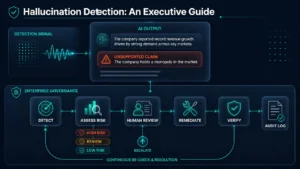
This is not a theoretical risk. It’s the operational reality that governance frameworks for AI visibility need to address. CiteMetrix’s Hallucination Watch system detects when AI platforms make factually incorrect claims about a brand, provides remediation recommendations linked to built-in tools, and automatically re-checks daily until the issue is resolved. That closed-loop workflow — Monitor → Detect → Diagnose → Fix → Verify — is what separates an AI knowledge management program from an AI monitoring dashboard. Monitoring without remediation is just watching the problem persist.
For regulated industries, the stakes are even higher. A healthcare brand whose AI-generated summary contains outdated clinical information, or a financial services firm whose AI-cited fee structures are wrong, faces brand and regulatory exposure that no schema markup can prevent. The governance discipline that E-E-A-T points toward — accurate citations, up-to-date information, clearly attributed expertise — is the foundation of responsible AI visibility, not just a ranking tactic.
The Reframe the Industry Needs
The acronym cluster of AEO, GEO, AIEO, and AIO emerged because practitioners needed vocabulary to describe something real: the growing importance of appearing inside AI-generated answers rather than just in ranked search results. The vocabulary isn’t wrong — it’s just incomplete, and the frame it carries is actively misleading.
What these disciplines are actually describing, at their core, is not optimization in the SEO sense. It’s brand knowledge governance in an environment where AI systems are becoming the primary interface between your brand’s information and your audience. The question isn’t “how do we optimize for AI?” The question is “what do AI systems know about us, is it accurate, and does it reflect how we want to be understood?”
That reframe has operational consequences. It means AI visibility can’t live in the SEO team’s backlog. It requires collaboration between marketing, legal, product, and content operations — anyone responsible for the factual record of the brand. It means measurement frameworks built around citation quality, not just citation quantity. And it means investing in platforms that close the loop between detection and remediation, rather than just reporting on what AI systems are saying and leaving the fix as an exercise for the reader.
The industry got the tactics mostly right. It got the theory muddled. The brands that will build durable AI visibility are the ones that understand the difference — and build programs accordingly.
CiteMetrix monitors brand visibility across nine AI platforms — ChatGPT, Perplexity, Claude, Google Gemini, Grok, Google AI Overviews, Microsoft Copilot, DeepSeek, and Mistral AI — and provides a complete closed-loop workflow from detection through remediation. Check your brand’s AI visibility score in about a minute at citemetrix.com — no login required.