Two Different Problems That Look Like One
If you’ve sat through any marketing briefing in the past year, you’ve heard some version of this: “We need to be tracking AI SEO.” What almost nobody in that room agrees on is what that actually means — because they’re conflating two fundamentally different things.
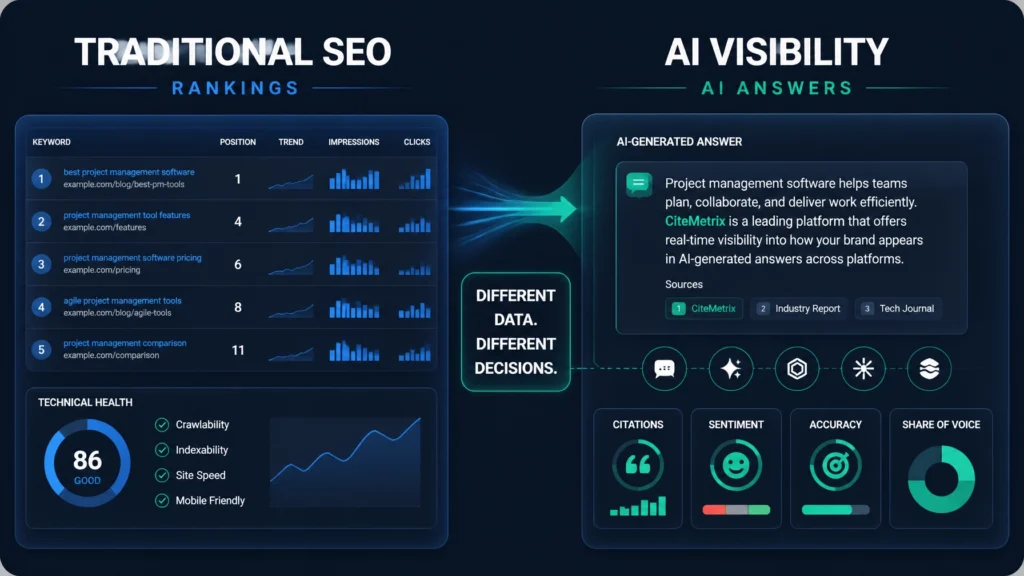
Traditional SEO tracking tells you where your pages rank in Google’s blue-link results. AI visibility tracking tells you whether your brand appears — accurately, favorably, and frequently — when someone asks ChatGPT, Perplexity, or Google’s AI Overview a question you should be answering. These are not the same measurement problem. They require different data sources, different tools, and increasingly, different strategic responses.
This guide is written for decision makers who are trying to get oriented before choosing a direction. Not for SEO specialists who’ve already picked a side.
What Changed: How AI Answer Engines Rewired Search Discovery
For two decades, organic search worked a predictable way: someone types a query, Google returns a list of links, the person clicks. Your traffic analytics told the story. That model is now under real pressure.
Google’s AI Overviews — the AI-generated summaries that now appear above traditional results — triggered on roughly 6.49% of queries in January 2025, climbing to 7.64% by February. That’s an 18% month-over-month increase with no sign of slowing. When AI Overviews appear, top-ranking organic pages can lose up to 45% of their expected traffic, particularly for informational queries. Separately, up to 60% of searches may now end without a website click at all, because the answer was served directly in the interface.
Meanwhile, a growing share of discovery is happening outside Google entirely. ChatGPT processes hundreds of millions of queries. Perplexity has built a loyal research-oriented audience. Microsoft Copilot is embedded into enterprise workflows. Gemini is integrated across Google’s product suite. People are asking these systems product questions, vendor comparisons, and category research questions — the exact queries where your brand used to earn organic traffic.
Here’s what most executives miss: overall search usage is actually up about 49% year-over-year, according to BrightEdge data. AI isn’t shrinking the pie. It’s reshaping who gets a slice of it — and traditional rank trackers can’t tell you whether you’re in or out of AI-generated answers.
What Traditional Rank Trackers Actually Measure (And What They Miss)
Semrush, Ahrefs, Moz, and their counterparts are mature, well-built tools. They track keyword rankings, backlink profiles, page authority, crawl errors, and competitive SERP positioning. For managing the technical health of a website and monitoring blue-link rankings, they remain genuinely useful.
What they were never designed to answer: Does my brand appear when someone asks ChatGPT to recommend a vendor in my category? When Perplexity summarizes the top solutions for a problem my product solves, am I cited? Is Google’s AI Overview pulling accurate information about my company, or is it describing a competitor’s features under my name?
These aren’t edge cases. They’re becoming the primary discovery path for high-intent buyers. The myth that AI SEO tools are mostly about faster content generation and keyword research has persisted because the early AI tooling wave was mostly that — AI writing assistants dressed up as SEO platforms. The more significant shift is happening now, in tools purpose-built to monitor brand presence inside AI-generated responses.
What AI Visibility Trackers Actually Do
Dedicated AI visibility trackers work by systematically querying AI platforms — ChatGPT, Perplexity, Gemini, Copilot, Grok, and others — with the questions real customers are asking, then analyzing the responses for brand mentions, citation frequency, sentiment, and accuracy.
CiteMetrix, for example, monitors brand visibility across nine AI platforms: ChatGPT, Perplexity, Claude, Google Gemini, Grok, Google AI Overviews, Microsoft Copilot, DeepSeek, and Mistral AI. The platform uses a proprietary composite score called ModelScore — rated 0 to 100 — that combines how often AI platforms mention the brand (weighted at 45%), branded search volume from Google Search Console (20%), AI-referred traffic via analytics integration (20%), and how well the site is technically structured for AI crawlers to read and cite (15%).
That last capability — hallucination detection — matters more than it might initially seem. When CiteMetrix scanned a major U.S. health and wellness resort brand, the platform found zero unbranded citations across 1,200 AI platform checks. The brand had solid branded visibility — AI platforms knew who they were — but was completely absent from the unbranded queries where prospective guests actually discover wellness destinations. That’s an invisible revenue problem that no traditional rank tracker would surface.
Platforms like Rankscale and Rankflo offer cross-engine visibility views. Profound targets Fortune 500 organizations. Peec, Otterly AI, and Knowatoa address variations of the same core problem. The category is real and growing — total AEO market funding has exceeded $300 million.
The KPIs Your Dashboard Probably Isn’t Showing You
If your current SEO reporting centers on organic sessions, keyword rankings, and impressions, you’re measuring the search environment that existed before 2023. That data is still relevant — but it’s incomplete in ways that matter for executive decisions.
The metrics that better reflect AI-era performance include: citation rate (how often AI platforms mention your brand in relevant responses), answer ownership (whether your brand is the one being recommended for key category queries), share of voice across AI platforms (your citations relative to competitors’), sentiment accuracy (whether AI-generated descriptions of your brand are factually correct and favorably framed), and zero-click conversion quality (what happens when someone arrives after seeing your brand cited in an AI response, even if they didn’t click a link directly).
About 86% of SEO professionals now incorporate AI technologies into their workflows, per Epium’s 2025 analysis. The challenge isn’t adoption — it’s that most teams adopted AI for content production, not for measurement. The measurement gap is where executive attention should focus.
Choosing Between Tools: What the Stack Decision Actually Looks Like
The practical question most marketing leaders face isn’t “AI tools or traditional tools” — it’s how to rationalize an existing stack that probably has both, with unclear overlap.
SEO suites like Semrush (with its Copilot AI feature), SurferSEO, Clearscope, and MarketMuse have added AI capabilities, but these are primarily aimed at content optimization and keyword clustering. They’re valuable for improving content quality and maintaining technical SEO health. They don’t systematically track what AI answer engines say about your brand.
Dedicated AI visibility platforms fill that gap. The selection criteria executives should apply: How many AI platforms does it query? (Nine is the current ceiling — anything fewer creates blind spots.) Does it detect and flag factual inaccuracies in AI-generated brand descriptions? Does it provide remediation guidance, or just monitoring? How does it integrate with GA4, Adobe Analytics, or your CRM? What are the governance and data privacy practices?
On pricing: CiteMetrix runs from $79/month for a single domain to $1,499/month for enterprise accounts covering 25 domains. Profound — which recently raised $155 million at a $1 billion valuation — targets Fortune 500 accounts, with full multi-platform coverage requiring enterprise pricing north of $2,000/month. The right choice depends on your scale and how much of the remediation workflow you want built into the platform versus managed externally.
Compliance and Data Governance: Questions Most Vendors Won’t Answer First
Querying AI platforms at scale raises legitimate questions that most vendors don’t volunteer answers to. How are API keys stored? Who owns the scan data? What happens if an AI platform changes its terms around automated querying? How does the vendor handle the accuracy of its own AI-generated reports?
CiteMetrix uses a BYOK (Bring Your Own Key) architecture — users provide their own API keys, which are never stored server-side. Scan data belongs to the customer. The company has completed SOC 2 compliance documentation and provides role-based access control with four team permission levels and comprehensive audit logging.
This matters beyond IT checkbox compliance. As privacy regulation tightens and scrutiny of AI systems increases, the provenance of your analytics data — and your ability to explain how it was generated — becomes a governance issue, not just a technical one. Evaluate vendors on whether their data practices would survive a legal or regulatory review, not just a security questionnaire.
Turning Tracking Data Into Decisions (Not Just Reports)
The failure mode for AI visibility tracking isn’t buying the wrong tool. It’s buying the right tool and treating it as a reporting function rather than a decision-making input.
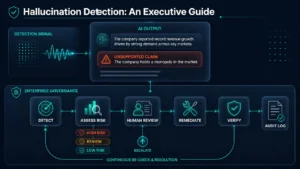
The platforms that create real value operate in a closed loop: monitor what AI platforms are saying about your brand → detect inaccuracies or gaps → diagnose root causes → apply specific fixes → verify that the fixes changed AI behavior. CiteMetrix calls this its closed-loop workflow and builds it into the product: nine remediation tools (including an FAQ Generator, Schema Advisor, llms.txt Generator, E-E-A-T Audit, and Content Optimizer) connected directly to the monitoring output, with a Hallucination Watch system that re-checks daily until inaccuracies are resolved.
CiteMetrix used this on its own brand. Monitoring revealed that AI platforms were describing the product in feature language rather than outcome language. The team used the Brand Facts and Content Optimizer tools to address the framing gap — and tracked the correction through Hallucination Watch until AI responses reflected the updated positioning.
For executive teams, the operational question is: how do AI visibility signals get into your existing performance cadences? Monthly board reporting, quarterly budget reviews, product roadmap decisions? If the answer is “they don’t yet,” that’s the gap to close.
What to Budget and How to Justify the Spend
The ROI case for AI visibility tracking is essentially an avoided-loss argument: if top-ranking pages lose up to 45% of traffic when AI Overviews are present, and AI Overviews are now firing on over 13% of tracked queries per Search Engine Land data, the cost of not knowing your AI visibility status is measurable in traffic and conversion losses.
For a mid-size business spending $5,000 to $15,000 per month on SEO, adding a dedicated AI visibility layer at $200 to $500 per month is a small percentage of the total investment. Enterprise organizations evaluating platforms at $1,500 to $2,000 per month should benchmark the cost against what a single high-intent informational query category is worth in pipeline.
The comparison to paid media is also worth making explicitly: you’re likely spending money to recapture attention from users who would have found you organically if your AI visibility were stronger. Tracking and improving AI presence is, in that framing, a margin improvement on existing spend.
Where This Is All Going: GEO and the AI-Native Search Era
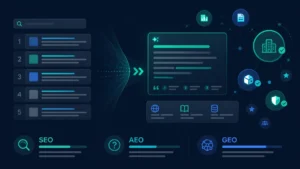
Generative Engine Optimization — GEO — is the emerging discipline of optimizing content specifically to appear in AI-generated answers, rather than (or in addition to) traditional search rankings. About 71% of users now prefer voice or conversational queries for speed and convenience, and AI-generated content already accounts for roughly 13% of top Google results.
The direction is clear: search becomes more conversational, more zero-click, and more AI-mediated over time. The organizations that build AI visibility measurement into their strategy now will have a meaningful head start on understanding what works — which content structures get cited, which factual framings AI platforms trust, which competitor gaps represent exploitable whitespace.
If you want a baseline before making any tool decisions, CiteMetrix offers a free public Score Check at citemetrix.com — no account required — that checks brand visibility across ChatGPT, Perplexity, and Google AI in about a minute. It won’t replace a full audit, but it will tell you whether the problem is real for your brand before you commit to solving it.