If your brand does not appear in an AI-generated answer, a strong Google ranking may not help you.
That is the uncomfortable reality behind the growing collection of terms now competing for attention: answer engine optimization, generative engine optimization, AI optimization, AI engine optimization, and several variations in between.
The industry has created useful language for a real change in how people discover information. But it may also have created the wrong mental model.
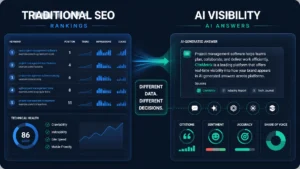
At CiteMetrix, our view is simple: SEO remains foundational, but AI visibility is not merely SEO with a new interface. The systems are different, the outputs are different, and the measurements are different.
So did we name AI visibility wrong?
In many ways, yes.
The acronym problem in AI visibility
Marketing technology has a habit of turning every emerging discipline into an acronym. Sometimes that helps. A short label can make a complex category easier to discuss, compare, and sell.
But acronyms also carry assumptions.
When we describe AI visibility as AEO, GEO, AIO, or AIEO, we place it next to SEO. That suggests a familiar workflow:
- Find a keyword.
- Optimize a page.
- Improve its ranking.
- Earn a click.
That workflow still matters for traditional search. It is not an accurate description of what happens when an AI assistant answers a recommendation, comparison, or research question.
The result is category confusion. Buyers may assume they need another SEO tool, another ranking report, or another content optimization layer.
What they often need is visibility into something broader: how AI systems retrieve, interpret, combine, describe, recommend, and cite information about their brand.

SEO is the foundation: but not the whole structure
Traditional SEO is still essential.
A site needs to be crawlable, indexable, technically sound, clearly structured, and useful to people. Content needs to demonstrate relevance and authority. Internal links, structured data, page experience, and accessible text all continue to matter.
Google’s own documentation says that the same foundational SEO best practices apply to appearing in AI Overviews and AI Mode. Pages still need to be eligible for Google Search, and there are no separate technical requirements for inclusion in those AI features.
That is an important point. AI search does not eliminate SEO.
But it does change what happens after information is found.
SEO primarily helps a search engine discover and rank pages. AI visibility involves understanding whether an AI system uses those pages: and many other signals: to construct an answer that represents your brand accurately.
SEO helps make your information retrievable.
It does not, by itself, tell you:
- Whether an AI system mentions your brand
- Which competitors appear beside you
- What sources influence the answer
- Whether the recommendation is positive, neutral, or negative
- Whether the information is accurate
- How your visibility changes across different AI platforms
Those are AI visibility questions.
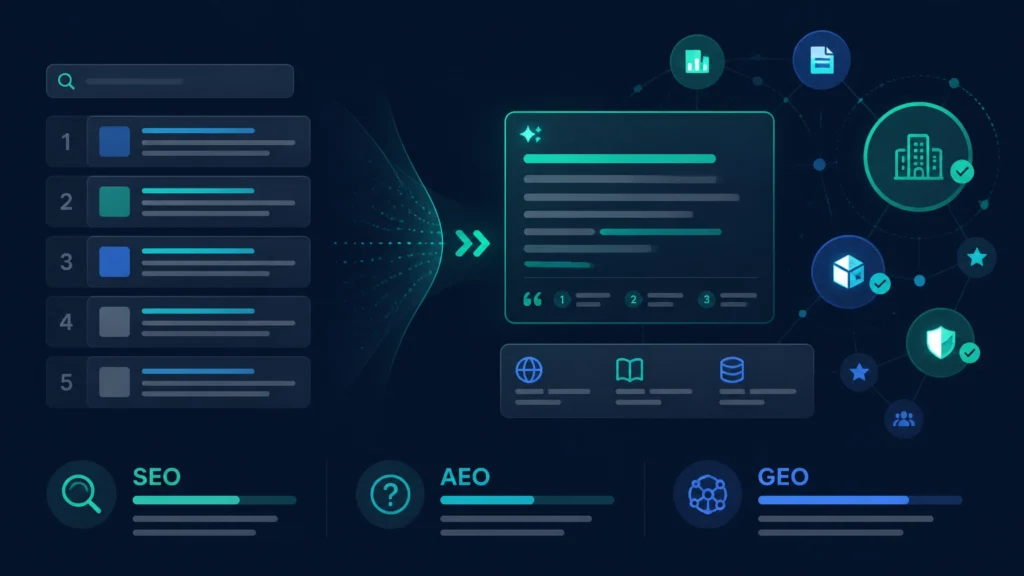
Ranked pages are not generated answers
The difference becomes clearer when we compare the outputs.
A traditional search engine usually returns a ranked set of documents. The user reviews the results, chooses which links to open, and assembles an answer from those pages.
An AI answer engine may retrieve multiple sources, interpret the information, combine it, and generate a response in a single interface.
Google describes AI Overviews and AI Mode as potentially using a “query fan-out” process, where related searches are issued across subtopics and data sources before an answer is generated. Other AI platforms may use different retrieval, grounding, ranking, and generation methods.
The important point is not that AI systems ignore ranking. Many still use search indexes, retrieval systems, or ranked sources.
The important point is that ranking is no longer the final product.
The final product is an answer.
That answer may:
- Mention only three brands from a much larger category
- Combine claims from several sources
- Recommend one company for a specific use case
- Describe a brand using language found elsewhere
- Include citations that vary from one platform to another
- Omit a highly ranked page because the system does not consider it useful for the response
This is why AI visibility cannot be reduced to “where do we rank?”
The better question is: How does the system represent us when our category is discussed?
Why answer engine optimization is useful: but incomplete
Answer engine optimization is not a meaningless term.
It can describe practical work designed to make content easier for answer engines to understand and extract. Clear question-and-answer structures, concise definitions, useful lists, descriptive headings, and well-supported explanations can all improve machine readability.
For example, a page targeting the question “What is customer data enrichment?” should answer that question directly. It should define the concept, explain how it works, clarify common use cases, and provide enough context for a reader: or an AI system: to understand the subject.
That is useful optimization.
But answer engine optimization can still imply that the goal is simply to win a featured answer or occupy a new answer box. It focuses primarily on the content layer.
AI visibility is broader.
A brand can publish well-structured content and still be absent from recommendations. It can be mentioned but described incorrectly. It can appear frequently but with negative sentiment. It can be cited by one platform and ignored by another.
Answer engine optimization is therefore best understood as a tactical practice, not the name of the entire category.
GEO, AEO, AIO, and AIEO describe tactics: not one market
The current terminology is not entirely useless. Each term points toward a different emphasis:
SEO: foundational discoverability
SEO helps your website and content become crawlable, indexable, relevant, and authoritative in traditional search environments.
Answer engine optimization: extractable answers
AEO focuses on making content clear and structured enough to be selected as a direct answer, featured result, AI Overview component, or voice response.
Generative engine optimization: reuse and citation
GEO focuses on how content and brand information are reused inside generated answers from systems such as ChatGPT, Perplexity, Gemini, Claude, and other AI assistants.
AIO and AIEO: broad but ambiguous labels
AI optimization and AI engine optimization attempt to describe the wider discipline. However, they are broad enough to mean almost anything: from prompting and model training to content formatting and technical accessibility.
The problem is not that any one term is completely wrong.
The problem is that these terms are often used interchangeably, even though they describe different activities and outcomes.

The metrics are different, too
Traditional SEO reporting has established metrics:
- Rankings
- Impressions
- Click-through rate
- Organic sessions
- Conversions
- Backlinks
Those metrics remain valuable. But they do not fully explain how AI systems treat a brand.
AI visibility requires additional measurements:
- Citation rate: How often does the brand appear as a cited source?
- Mention rate: How often is the brand named in an answer, whether or not it receives a link?
- Recommendation share: How frequently is the brand included among recommended options?
- Sentiment: Is the brand characterized positively, neutrally, or negatively?
- Accuracy: Does the answer describe the company, product, and positioning correctly?
- Source influence: Which pages and third-party references appear to shape the response?
- Entity understanding: Does the system correctly connect the brand to its category, use cases, and differentiators?
- Platform variation: Does the brand appear consistently across different AI answer engines?
These measurements are not just new versions of ranking position.
They describe the behavior of a probabilistic information system that may produce different answers to similar prompts, depending on the model, retrieval layer, context, and platform.
The category should be called AI visibility intelligence
So what should the industry call itself?
“AI search visibility” is clear and accessible. It tells buyers what the category is about: understanding whether their brand appears in AI-powered search and answer experiences.
“AI visibility intelligence” is more precise for platforms that measure and help remediate the problem.
It reflects three connected needs:
- Visibility: Is the brand present?
- Intelligence: Why is it present, absent, cited, recommended, or misrepresented?
- Remediation: What should the marketing and content team do next?
That is the category CiteMetrix is building toward.
We measure how AI answer engines cite, mention, and describe brands across nine platforms. The goal is not to replace an SEO dashboard. It is to provide the measurement layer that traditional SEO tools were never designed to provide.
In other words:
SEO tells you how search engines discover and rank your pages. AI visibility intelligence tells you how answer engines use and represent your brand.
What this means for SEO teams
The practical answer is not to abandon SEO for a new acronym.
Instead, treat the disciplines as connected layers:
- Keep SEO strong so your information can be discovered and retrieved.
- Use answer-oriented content structures where they improve clarity.
- Build trustworthy, specific content that AI systems can interpret and cite.
- Strengthen your brand’s entity signals across your site and the wider web.
- Monitor what AI platforms actually say, not what you hope they will say.
- Measure changes in citations, recommendations, sentiment, and accuracy over time.
Start with the questions your customers ask.
For example, a marketing analytics company might track prompts such as:
- “What are the best marketing analytics platforms for a mid-market SaaS company?”
- “Which tools help measure brand visibility in ChatGPT?”
- “Compare AI visibility platforms for an enterprise SEO team.”
- “What should a company do if AI assistants describe its product incorrectly?”
Then evaluate the answers across platforms. Is your brand present? Is it presented accurately? Which competitors appear? Which sources are cited?
That is a more useful starting point than trying to decide whether your team should “do GEO” or “do AEO.”
The name matters because the mental model matters
The industry may continue using AEO and GEO. Those terms have already entered the marketing vocabulary, and they remain useful when discussing specific tactics.
But we should be careful about treating them as synonyms for SEO.
AI answer engines do not simply display a reordered list of web pages. They interpret entities, combine sources, generate language, make recommendations, and create a new layer between information retrieval and user decision-making.
That layer deserves its own category.
At CiteMetrix, we call it AI visibility intelligence.
The name may not be as catchy as another three-letter acronym. But it describes the problem more honestly: and gives marketers a better framework for solving it.
See how AI sees your brand
Want to know whether AI answer engines cite, mention, and accurately describe your brand?
Get your ModelScore™ and start tracking your AI visibility → citemetrix.com
For more context, read our guides on generative engine optimization and how prompts are changing search queries. You can also review Google’s guidance on AI features and your website.