When a false claim comes with a source name, it can look like research: and travel like fact.
A public LinkedIn post recently described a large AI-search study and attributed it to CiteMetrix. The post claimed that CiteMetrix had cited, understood, and published findings from a report tracking hundreds of millions of AI citations.
CiteMetrix did not conduct that study. It did not publish those findings. It did not cite the report as research. The specific claims: including the dataset size, correlation, and conclusions: are unverified and are not CiteMetrix research.
This is not an accusation of malicious intent. It is an example of a control failure: a plausible narrative acquired false authority because its source provenance was not checked.
That distinction matters. The problem is not only that an AI-related claim may be wrong. The problem is that a polished claim can manufacture the appearance of evidence.
A wrong fact is one problem. False evidence is another.
An ordinary factual error might say that a company was founded in the wrong year. That is serious, but the error is usually limited to the claim itself.
A fabricated study creates a larger failure chain:
- A source is named.
- The source appears credible.
- A statistic is attached to it.
- A conclusion is presented as evidence-based.
- Other people repeat the conclusion.
- Teams change strategy, budgets, or policies based on it.
The original error becomes harder to find because each repetition makes the claim look more established.
This is why hallucinated evidence can be more dangerous than obvious nonsense. A nonsensical answer tends to be rejected. A confident answer with an organization name, methodology-sounding language, and a precise number may be trusted, shared, and cited by people who never verify the underlying source.
As IBM explains, AI systems can produce invented studies, nonexistent URLs, and incorrect details about real entities while presenting them as factual. The issue is not that every AI output is unreliable. It is that plausibility is not proof.
The failure modes behind manufactured evidence
AI hallucinations are not limited to completely invented facts. They can occur at several points in the evidence chain.
1. Fabricated source
The cited report, paper, dataset, or webpage does not exist.
The title may sound credible. The organization may be real. The citation may even include a date, sample size, or methodology. But there is no original source to inspect.
2. False attribution
A real claim or report is assigned to the wrong organization, author, or publisher.
In the CiteMetrix example, the company was presented as the origin of research it never conducted or published. This can create reputational problems even when the person sharing the claim had no intention to mislead.
3. Citation mismatch
The source exists, but it does not support the claim being made.
A report may discuss AI visibility generally, while a post attributes a specific correlation or causal conclusion to it. The citation is real; the evidence for the statement is not.
4. Unsupported extrapolation
The source supports a narrow observation, but the conclusion goes much further.
For example, an analysis of a limited set of platforms, queries, industries, or time periods may be presented as a universal rule about AI search. A measured association may then be described as a proven causal mechanism.
5. Stale or distorted evidence
The source was once accurate but is now outdated, or its findings are summarized without important context.
Platform behavior changes. Product capabilities change. Definitions change. A number without its date, scope, and methodology can become misleading even when it was reported correctly at the time.
These failures can begin with an LLM-generated draft. They can also happen when someone summarizes a real article, copies a claim from another post, or trusts a citation-shaped URL without opening the original source.
The human does not need to be careless or dishonest for the control to fail. The workflow simply needs to reward fluency more than verification.

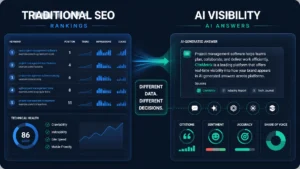
Why this matters for AI visibility
Claims about AI search are not academic curiosities. They can influence:
- Which content programs receive funding
- Whether a marketing team prioritizes brand demand or technical optimization
- How an agency advises clients
- Which vendors an organization buys
- How executives interpret changes in organic traffic
- What a company tells its board about AI visibility
A false claim about what predicts AI citations can redirect an entire strategy.
It can also create a second-order trust problem. If a vendor is falsely named as the source of a study, readers may later assume that vendor is careless, deceptive, or overstating its capabilities. Correcting the record after a claim has circulated is much harder than verifying it before publication.
This is why AI visibility needs to be treated as part of brand knowledge governance: the cross-functional discipline of keeping the facts AI systems encounter accurate, consistent, traceable, and current.
Marketing may own the content. Legal may assess risk. Product and communications teams may maintain facts. Content operations may manage publication. But the control cannot belong to one person or one department alone.
A source name is not source verification
A company name, report title, or citation-shaped link should be treated as a starting point: not as proof.
Before repeating an AI-related study or statistic, ask:
Can the original report be found?
Search the organization’s official website, research archive, publication library, or newsroom. Search the exact title and distinctive phrases. If the source cannot be located, treat the claim as unverified.
Does the named organization confirm authorship?
Check whether the organization identifies itself as the author, publisher, sponsor, or data provider. A company being mentioned in a post is not evidence that it produced the underlying research.
Is the methodology available?
Look for the research question, sampling method, platform scope, dates, definitions, exclusions, and limitations. A large number without methodology is a persuasion device, not a reproducible finding.
Do the numbers appear in the original?
Verify the exact sample size, correlation, percentage, or chart. Do not assume that a number repeated in a summary came from the cited source.
Does the conclusion exceed the evidence?
Ask whether the source supports correlation, causation, prediction, or only an observation. Check whether a limited study is being used to make a universal claim.
Are the date and platform scope clear?
AI systems change quickly. A finding from one period or platform set should not automatically be applied to every AI assistant today.
Can another reviewer reproduce the check?
For material claims, record the source URL, access date, relevant passage, and reviewer. Verification should create an audit trail: not just a private feeling that the source “looked right.”
The standard is simple: before trusting a number, verify the method. Before repeating a study, verify who conducted it.
What a serious hallucination detection program should do
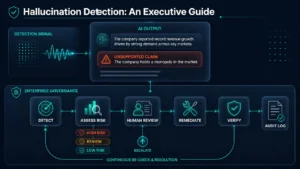
Detection is not just a label that says “probably wrong.” A useful program should help an organization understand the claim, assess its risk, and take corrective action.
A practical control system should:
- Monitor AI outputs across relevant platforms and use cases
- Identify the exact unsupported or incorrect claim
- Classify the failure type and severity
- Trace the claimed source and provenance
- Route high-risk outputs to human review
- Sample and audit medium-risk outputs
- Log low-risk outputs for trend analysis
- Maintain an incident history
- Re-check outputs after corrections are made
A tiered model keeps review effort aligned with potential harm:

- High risk: Human review before external use or operational action
- Medium risk: Structured sampling, audit, and escalation when patterns appear
- Low risk: Logging, monitoring, and periodic review
At board or executive level, useful metrics include:
- Hallucination rate by deployment or platform
- Hallucination rate by severity
- Mean time to resolution
- Percentage of high-risk outputs reviewed
- Recurrence rate after remediation
- Trend lines by business unit, topic, or use case
The goal is not to claim that hallucinations can be eliminated. The goal is to make failures visible, measurable, and correctable.
How CiteMetrix approaches brand-specific AI accuracy
CiteMetrix is not a universal solution for every hallucination problem in every enterprise AI deployment. Its focus is narrower and practical: monitoring how public AI platforms represent a brand and helping teams correct inaccurate claims.
CiteMetrix Hallucination Watch monitors when AI platforms make factually incorrect claims about a brand. It provides:
- Severity ratings
- Hallucination classifications
- The triggering passage
- The verified fact that was contradicted
- Remediation recommendations
- Platform, query, and timing context
CiteMetrix also provides a Source of Truth for verified Brand Facts. Those facts can support:
- A verified-only publishing gate
- Generated
llms.txt - Deterministic
schema.orgmarkup - Internal drift detection
- Live-file drift detection
- Correction Proof showing whether an AI answer changed after a fix
This matters because publishing a correction is not the same as proving that the correction worked. AI systems may refresh information on different schedules. A control is stronger when it can measure the post-fix result.
Monitor → Detect → Diagnose → Fix → Verify
Hallucination detection is most useful as a closed loop:

- Monitor what AI platforms say about the brand.
- Detect incorrect, outdated, fabricated, misleading, or missing information.
- Diagnose the exact claim, source gap, severity, and likely cause.
- Fix the relevant brand fact, website content, schema, or external source.
- Verify whether the AI answer changed after remediation.
Detection without remediation becomes a dashboard. Remediation without verification becomes a hope. The control is the complete loop.
Questions to ask when evaluating a tool
Before buying any hallucination or AI-accuracy solution, ask vendors:
- What benchmark or evaluation set supports the detection claims?
- Is the benchmark relevant to my industry and use case?
- How are precision and recall measured?
- Does the system match detection methods to different task types?
- Can each flagged claim be traced to its source or reference fact?
- Is there a workflow for human review and escalation?
- Are high-risk outputs handled differently from low-risk outputs?
- Are corrections re-checked after remediation?
- Can the organization export incident history and trend data?
A polished demo is not enough. Ask to see the evidence behind the product’s own claims.
Before optimizing an AI answer, verify its evidence
The most important lesson from this incident is not about one post or one platform.
It is this:
Before optimizing for an AI answer, verify that the answer’s evidence exists.
Before repeating a study, verify who conducted it. Before relying on a statistic, verify the methodology. Before accepting a citation, check that the source supports the conclusion.
AI can make unsupported claims sound researched. That is why hallucination detection is not merely a model-quality feature. It is a governance control for marketing, research, procurement, legal, healthcare, finance, and executive decision-making.
The cost of checking evidence is usually small compared with the cost of building a strategy on manufactured evidence.