What an AI SEO Tool Actually Does
An AI SEO tool is software that uses machine learning to handle tasks that used to require a team: keyword and intent analysis, content optimization, technical auditing, competitor tracking, and — increasingly — monitoring whether a brand gets mentioned accurately inside AI-generated answers. The outcome that matters to an executive isn’t the feature list. It’s whether the tool helps the business get found and get described correctly when a prospective customer asks ChatGPT, Perplexity, or Google’s AI Overviews a buying question instead of typing a search query.
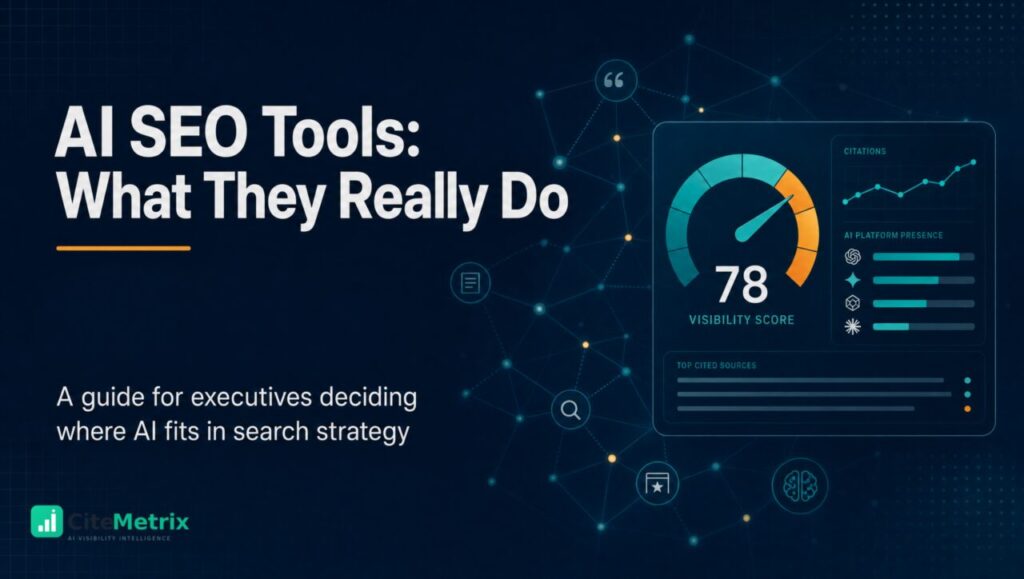
This is a different job than classic rank tracking. A tool like CiteMetrix, for example, monitors brand visibility across nine AI platforms — ChatGPT, Perplexity, Claude, Google Gemini, Grok, Google AI Overviews, Microsoft Copilot, DeepSeek, and Mistral AI — and scores it with a proprietary ModelScore from 0 to 100. The score weights four things: how often and how favorably the brand gets mentioned (45 percent), branded search demand (20 percent), AI-referred traffic (20 percent), and how well the site is technically structured for AI crawlers to read and cite (15 percent). That composite approach matters because mentions alone don’t tell you whether the mentions are helping.
AI SEO Tools vs. Traditional SEO Platforms: What Actually Changes
Here’s what most people get wrong when comparing the two: AI SEO doesn’t replace traditional SEO, it extends it. Generative answer engines still rely heavily on pages that already demonstrate crawlability, topical authority, and clean information architecture — the same fundamentals Screaming Frog, Ahrefs, and Google Search Console have measured for years. If your technical SEO is weak, no amount of AI tooling fixes that.
The practical evaluation framework for an executive deciding where AI tools fit: keep your crawler and rank tracker for technical health and traditional SERP position; add an AI visibility layer for citation tracking, hallucination detection, and answer-engine presence; and keep human editorial judgment in the loop for anything involving brand voice, regulatory claims, or competitive differentiation. None of the three replace the others.
Generative Engine Optimization: Getting Cited in AI Overviews, ChatGPT, and Perplexity
Google AI Overviews appeared on 86.7 percent of buying-intent searches in April 2026, up from 56.9 percent a year earlier, according to Peec.ai’s generative engine optimization benchmark data. The same reporting found that when an AI summary appears, click-through to traditional results drops to roughly 8 percent, versus 15 percent when no summary shows. Pew Research separately found that 58 percent of surveyed U.S. adults encountered at least one AI-generated summary during observed browsing in spring 2025. Put plainly: a meaningful share of commercial search now ends without anyone clicking a blue link at all — aggregated benchmarks put the no-click rate near 60 percent.
So how do you optimize for ChatGPT and AI Overviews specifically? Start with entity clarity — make sure your brand, products, and claims are unambiguous and consistent across your site and third-party sources. Then track citations directly rather than guessing. CiteMetrix’s Hallucination Watch, for instance, flags when an AI platform states something factually wrong about a brand and re-checks it daily until the issue is resolved — a closed-loop that plain monitoring tools don’t offer. Note that Claude and Perplexity are mandatory platforms in CiteMetrix’s setup because they power the core scoring; the other seven activate only if you supply your own API key for them.
How to Choose the Right AI SEO Platform
There isn’t a single best AI SEO tool — there’s a best tool for your use case. For keyword and intent research, established platforms with large keyword databases still do that job well. For AI visibility and citation monitoring specifically, the field is narrower and newer: Profound, Peec, Otterly AI, Knowatoa, and Brandlight all compete here alongside CiteMetrix.
Price and access vary sharply. Profound’s Starter plan runs about $99/month for ChatGPT monitoring only; full multi-platform coverage requires an Enterprise contract priced around $2,000 or more per month. Brandlight starts near $4,000/month, enterprise-only. CiteMetrix’s Business track starts at $79/month for one domain covering all nine platforms, scaling to $1,499/month for Enterprise, with a separate Agency track from $299 to $4,999/month for unlimited domains. Because CiteMetrix uses a bring-your-own-key model, you pay AI providers directly with no markup, though you do need to supply and manage those keys yourself. For enterprises specifically, the checklist should include data isolation between accounts, documented remediation workflows (not just scores), reporting that exports cleanly for leadership, and — for regulated industries like pharma — a record of AI statements that may have bypassed MLR review.
The Operating Model: From Discovery to Verified Fix
A workable AI SEO operating model has five stages: monitor citations across platforms, detect factual inaccuracies, diagnose severity and root cause, fix the issue using structured remediation tools, and verify the fix actually resolved it. Most monitoring tools stop at the first step. Governance matters here too — marketing, SEO, content, and legal should agree in advance on who approves AI-assisted content before it publishes, and someone needs explicit ownership of fixing hallucinated brand claims once they’re flagged.
Measuring ROI: Why a Visibility Score Isn’t the Finish Line
A visibility score is not proof you’re winning. Scores depend on which prompts were sampled, which models, which locations, and when — treat them as directional, not definitive. Real ROI measurement connects AI SEO activity to qualified traffic, conversions, revenue, and citation quality over time, alongside traditional rankings. AI referral traffic grew 693 percent year-over-year for U.S. retail sites during the 2025 holiday season according to Adobe Digital Insights, cited in Omnibound’s AI search statistics roundup — but it’s still a smaller channel than conventional search for most businesses, which is exactly why segmenting and tracking it separately matters rather than lumping it into generic organic traffic.
Where AI SEO Tools Still Need Human Judgment
Are AI-generated articles bad for SEO? Not inherently — but publishing more AI content isn’t a strategy. Content volume stopped being a durable advantage once every competitor had access to the same generation tools. What differentiates now is accurate intent mapping, first-party evidence, and expert review before anything ships. AI content scores are useful directional signals, not guarantees of ranking or citation — treat a high score as a starting point for human review, not a finish line. And no, AI SEO tools can’t replace a competent agency or in-house team; they accelerate the work that humans still have to validate.