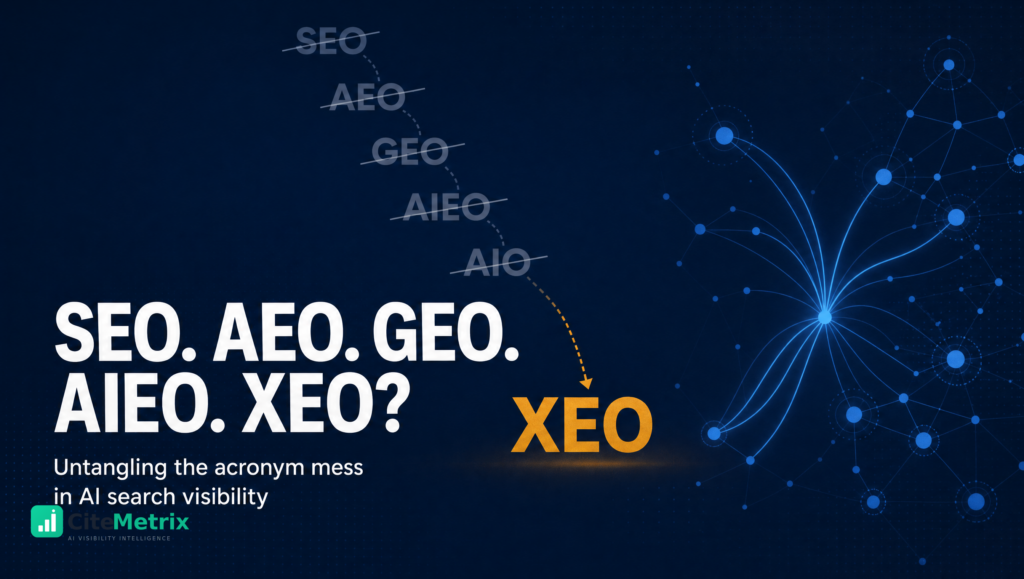
I wrote one of the early pieces trying to untangle SEO, AEO, GEO, AIO and AIEO. I’ve also gone on record saying this industry may have shot itself in the foot by insisting, in year one, that whatever this new discipline was, it should be framed as an extension of SEO. That framing felt safe at the time. It also set us up for the mess we’re in now: five overlapping acronyms, no consensus on which one to use in a client pitch, and a growing pile of LinkedIn posts arguing about definitions instead of outcomes.
Personally, I’ve settled on GEO — generative engine optimization — as my default term, mostly because it’s the one prospects and search bars already recognize. But I’m not married to it. A newer proposal, XEO (Crossover Engine Optimization), has started showing up as an attempt to end the argument entirely by treating all of this as one unified practice instead of five competing ones. The question worth actually answering isn’t which acronym wins. It’s whether XEO changes how teams operate, or just gives everyone one more term to define in the first slide of every deck.
What XEO Actually Means: Crossover Engine Optimization
XEO is proposed as an umbrella term covering optimization for traditional search, answer engines, generative AI systems, AI Overviews, and whatever discovery surface comes next. It’s not trying to describe a new technical practice — it’s trying to describe a unified strategic posture: stop treating Google rankings, ChatGPT citations, and Perplexity answers as three separate workstreams run by three separate people with three separate reports.
That’s the entire value proposition. Not a new ranking factor. Not a new content format. A single framework that says: your brand’s visibility is one problem, distributed across multiple engines, and it should be measured and managed as one thing. If XEO just becomes a rebrand of the same siloed AEO/GEO/SEO reporting structure under a new name, it hasn’t done its job. If it actually gets a content team, a technical SEO, a PR lead, and a brand manager working off the same visibility dashboard, it’s earned the name.
I’d treat XEO less as a discipline to master and more as an organizing principle — the thing you put on the org chart, not the thing you put on a certification.
GEO, AEO, AIO, AIEO — Mapping the Overlap Instead of the Differences
Here’s the honest answer to “what’s the difference between SEO and GEO”: SEO optimizes for ranking in a results list a human scrolls through. GEO optimizes for being surfaced, synthesized, or cited inside an AI-generated answer the human never has to scroll past. Is GEO just a new name for SEO? No — but it inherits most of SEO’s foundation and adds a layer on top focused on how large language models select, corroborate, and phrase information.
AEO, answer engine optimization, is close enough to GEO that most practitioners use them interchangeably, and in my experience the distinction people try to draw — AEO for structured Q&A snippets, GEO for generative synthesis — doesn’t hold up cleanly in practice. AIO and AIEO show up less often and tend to mean “AI optimization” and “AI engine optimization” respectively, used by different writers to describe roughly the same territory. None of these have a standards body behind them. They’re marketing-team shorthand that calcified into category labels before anyone agreed on scope.
GEO has become the most recognizable of the group, largely because it’s the term people type into Google when they’re trying to figure out what to call this work. That recognizability is also its weakness — ambiguous enough that two people using “GEO” in the same meeting can mean different things. A Reddit thread in r/GEO_optimization on GEO vs AEO vs AI SEO captures this well — practitioners openly admitting they use the terms based on whichever one the client already knows, not based on a meaningful technical distinction.
What hasn’t changed
Authority still matters. Crawlability still matters. Content that actually answers the question still outperforms content that’s padded to hit a word count. If your technical SEO is broken, no amount of GEO strategy fixes it — AI crawlers still need to be able to read your site before they can cite it.
Is AI Search Optimization Actually Different From SEO?
Partly, yes — and the honest version of this answer matters more than the confident one. Do AI-generated results use the same ranking factors as Google? Not identically. An Ahrefs analysis of 15,000 long-tail questions found that only about 12% of URLs cited in AI answers also ranked in Google’s top 10 for the original query — a number worth sitting with, because it directly contradicts the assumption that ranking well is a reliable proxy for being cited well. You can read more of the surrounding data in this 2026 roundup of AI search statistics.
So what’s genuinely new? Citation monitoring — tracking whether and how often your brand gets named across multiple AI platforms, since a single screenshot proves nothing about your actual visibility pattern. Entity disambiguation — making sure AI systems don’t confuse your brand with a similarly named competitor or product. Retrieval testing — running the same prompt repeatedly to see what source material an engine pulls from. Source coverage — knowing which third-party sites an AI model treats as corroborating evidence for claims about your category. And answer-level measurement — evaluating whether the answer about your brand is even accurate, not just whether it exists.
What hasn’t changed: content still needs to demonstrate real expertise, sites still need clean technical structure, and authority signals built over years of legitimate SEO work still feed into how models assess credibility. The myth worth retiring is that GEO, AEO, AIO and AIEO are separate disciplines requiring separate playbooks. In practice, the effective version of this work is SEO fundamentals plus a new monitoring and verification layer — not a parallel universe of tactics.
How AI Engines Actually Pick What to Cite
Being cited is not the same as ranking first, and that distinction trips up more strategists than it should. AI systems retrieve candidate sources, check for corroboration across multiple sites making the same claim, weigh domain authority and freshness, and favor content with clear structure — defined entities, direct answers near the top of the page, and unambiguous claims a model can lift without needing to interpret intent.
So: does ranking in Google increase the chance of being cited by AI? The data is genuinely inconsistent depending on who’s measuring and how. The Ahrefs study put overlap at roughly 12%. A BrightEdge tracked-query panel found 54.5% of AI Overview citations came from pages that also ranked organically — up from 32.3% sixteen months earlier — suggesting the overlap may be increasing as Google tightens the link between its own index and its AI Overviews feature. Other citation-analysis work has put the range anywhere from 17% to 76% depending on measurement method, a spread wide enough that you can find a BrightEdge summary at the AEO Wire statistics page. The honest takeaway: ranking helps, but it is not a substitute for direct monitoring of what AI platforms actually say.
How do you get your brand cited by ChatGPT? There’s no guaranteed formula, but the pattern that shows up across available studies points toward content that states facts plainly and early, gets corroborated by other credible sources discussing the same entity, uses structured markup that makes the entity unambiguous, and gets refreshed often enough that it still reads as current. Should businesses optimize for ChatGPT and Google AI Overviews specifically? If your category gets researched conversationally — health, finance, software, travel, professional services — yes, with the caveat that it’s a visibility and consideration play right now more than a pure traffic play.
The Metrics That Actually Tell You Something
Clicks and rankings were never designed to measure whether an AI system mentioned your brand accurately, favorably, or at all — and that gap is where most teams are currently flying blind. Is AI search optimization worth investing in yet? The traffic numbers alone are modest: a Conductor study across 10 industries found AI referrals at 1.08% of total website traffic between May and September 2025, with ChatGPT responsible for 87.4% of that share. But Similarweb data reported for the period June 2025 through May 2026 showed AI platforms driving 770.7 million referral visits per month worldwide, up 117.4% year over year — a small base growing fast.
The traffic question also isn’t the whole business case. A Seer Interactive study found brands cited in an AI Overview received 35% more organic clicks and 91% more paid clicks than brands that weren’t cited — citation appears to influence consideration and click behavior even for the traffic that does flow through traditional channels.
How do you actually measure whether your brand appears in AI answers? Track citation frequency across multiple platforms, not one. Track share of voice — how often you’re named relative to competitors in the same prompt set. Track answer accuracy and sentiment, since being mentioned incorrectly can be worse than not being mentioned. Track source inclusion — which of your pages are actually getting pulled. And track it repeatedly, not once: an AirOps study of 800 questions found that roughly 57% of brands that disappeared from an AI answer in one run reappeared in a later run. A single disappearing citation isn’t evidence of failure, and a single appearance isn’t evidence of success. Will AI search replace traditional SEO? Nothing in the current data supports that — it’s converging with SEO, not replacing it, and the brands treating it as a rip-and-replace are building reports no one trusts.
A Working XEO Operating Model for Marketing Teams
Most organizations I’ve seen run this badly split it three ways — an SEO team owns rankings, a scrappy side project owns “AI search,” and nobody owns the connective tissue between them. A crossover model puts content, technical SEO, digital PR, analytics, and brand under one shared visibility framework instead of three disconnected reports that use three different vocabularies to describe overlapping work.
This is the problem CiteMetrix was built around, and it’s worth being specific about what that actually means rather than overselling it. CiteMetrix monitors brand visibility across nine AI platforms — ChatGPT, Perplexity, Claude, Google Gemini, Grok, Google AI Overviews, Microsoft Copilot, DeepSeek, and Mistral AI — using a bring-your-own-key architecture, meaning every query runs on the customer’s own API credentials rather than CiteMetrix’s. Claude and Perplexity are mandatory configurations because they power the core scoring; the other seven activate only if a customer supplies a key for them.
The platform’s ModelScore is a composite 0–100 figure combining four weighted components: how often a brand is mentioned across those platforms, sentiment-adjusted (45%); branded search demand pulled from Google Search Console (20%); AI-referred traffic measured through Google Analytics or Adobe Analytics (20%); and technical readiness — how well a site is structured for AI crawlers to parse and cite (15%). It’s one number built to replace the habit of checking five separate dashboards and guessing how they relate to each other.
It also catches things rankings never would. In one scan, a major U.S. health and wellness resort brand showed zero unbranded citations across 1,200 AI platform checks — AI assistants knew the brand by name when asked directly, but never surfaced it when someone described the experience they were actually looking for. That’s the branded-versus-unbranded gap that a rankings report simply can’t see, because the brand’s organic rankings looked fine the whole time.
CiteMetrix also runs this monitoring on itself. As of November 2026, following a fix to its recommendation-rate logic in August 2026, the platform showed a 22.1% recommendation rate across 9,382 citations analyzed. The brand perception analysis behind that number surfaced something specific: AI platforms were describing CiteMetrix in feature language — what the tool does — rather than outcome language — what a customer actually gets from it. That’s a real, usable finding, and it’s the kind of insight that only shows up when you treat monitoring, diagnosis, and remediation as one connected loop instead of three separate projects.
Whether or not you use CiteMetrix specifically, the operating principle transfers: pick a measurement layer that covers rankings, citations, sentiment, and downstream traffic together, assign it to one owner, and stop producing an “SEO report” and an “AI visibility report” that nobody on the leadership team reconciles.
Does Naming This XEO Help the Industry, or Just Add to the Pile?
I’ll push back on my own enthusiasm here, because this is a legitimate category-design problem, not just a branding exercise. A new acronym doesn’t automatically create a new marketing category — it only earns that status if it clarifies something concrete: a scope, a workflow, a set of measurable outcomes. If XEO just renames the same SEO work with a sharper logo, it adds confusion rather than removing it, and skeptical practitioners will treat it accordingly, the same way a lot of people already roll their eyes at “AIO.”
There’s also a practical search-friction cost. GEO already shows up as a search term people actually type — the Reddit discussion on whether GEO and AEO are worth optimizing for yet is a good example of how much live debate is already anchored to those terms. XEO has none of that recognition yet. If you’re writing content meant to be found, burying the familiar terms in favor of an unfamiliar one works against the exact discoverability goal this whole field is supposed to be about.
My read: XEO is useful as an internal operating model and a way to stop fighting about acronyms in strategy meetings. It’s premature to use it as your primary external-facing term. Define it plainly when you use it, keep GEO, AEO, and SEO in your titles and explanations so people can actually find what you wrote, and let the acronym earn adoption rather than demanding it.
Where I’ve Landed (For Now)
I came into this piece defending GEO and I’m leaving it more persuaded that the acronym fight was never the real problem — the real problem was treating rankings, citations, and AI-generated mentions as three different jobs. XEO names that mistake correctly. Whether it becomes the term the industry settles on, or just the framework that quietly fixes how teams organize this work before a more recognizable name catches up, is still an open question. I’d rather get the operating model right than win the naming argument.