Perplexity now lets developers turn a single search query into a standing alert. The company’s new Monitor API takes a query you’d normally run once and keeps running it, pinging you when the answer changes. That’s a notable shift for a company whose core product has always been built around the one-off question-and-answer exchange. It also happens to validate something CiteMetrix has been arguing since the day it launched: brand visibility inside AI answers isn’t a snapshot you check quarterly, it’s a moving target that needs continuous instrumentation.
Here’s what most people miss about why this matters beyond Perplexity’s own product roadmap. When a major AI search platform builds continuous monitoring into its own API, it’s tacitly admitting that answers aren’t static — they drift, update, and sometimes flip entirely based on new crawled content, model updates, or source re-ranking. That’s the exact instability that makes brand monitoring across AI platforms a real discipline rather than a nice-to-have dashboard.
What Perplexity’s Monitor API Actually Does
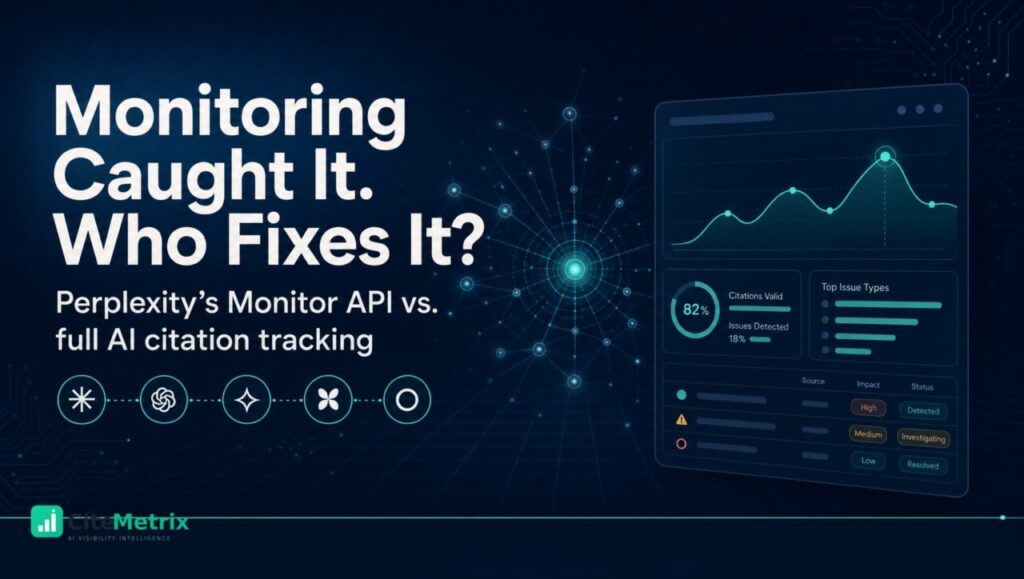
Based on what Perplexity has described publicly, the Monitor API converts a query into a persistent, recurring check rather than a single request-response call. Instead of asking a question once and getting an answer, a developer can set up a query to run on a recurring basis and receive a notification when the result changes. That’s the core mechanic: one-off queries become continuous alerts.
What isn’t described — at least not in what Perplexity has published so far — is how it handles things like sentiment scoring, factual accuracy checks against a brand’s own source material, or any kind of remediation workflow once a change is detected. It appears to be an alerting layer, not a diagnostic or corrective one. That distinction is worth sitting with, because it’s the dividing line between knowing something changed and knowing what to do about it.
Why This Is a Meaningful Signal, Not Just a Feature Release
Plenty of AI visibility vendors have spent the last two years telling brands that AI answers are volatile and need watching. Skeptics inside marketing departments have pushed back — understandably, since it’s easy to oversell a category that’s still maturing. But when the platform generating those answers builds a monitoring primitive directly into its own API, the “this is a real problem” argument gets a lot harder to dismiss. Perplexity isn’t a monitoring vendor positioning itself against incumbents; it’s the source platform, telling its own developer ecosystem that query results need to be watched over time.
Takeaway: if the AI platform itself is building infrastructure to track its own answer drift, that’s a strong signal brands should be tracking the same thing from the outside — across more than just one platform.
Monitoring vs. Citation Tracking: The Difference That Actually Matters
Monitoring tells you something changed. Citation tracking tells you what’s being said, how accurate it is, whether it’s helping or hurting you, and increasingly, what to do next. Those sound similar on a landing page. In practice they’re different categories of work.
A pure monitoring tool — which is what the Monitor API sounds like, based on what’s been described — answers the question “did this result change?” That’s useful. It’s also only the first rung of a much longer ladder. A brand needs to know things like:
- Is the AI platform mentioning us at all, and how often relative to competitors?
- Is what it’s saying about us factually correct?
- Is the sentiment favorable, neutral, or quietly damaging?
- Are we showing up on unbranded queries — the ones where someone hasn’t typed our name yet — or only when someone already knows to ask about us?
- If something’s wrong, what’s the fix, and did the fix actually work?
Those are citation tracking questions. They require a composite view across multiple AI platforms, not alerts tied to a single query on a single engine.
The Platform Coverage Problem
Perplexity’s Monitor API, as described, covers Perplexity. That’s one surface. Consumers and B2B buyers are forming impressions across ChatGPT, Google’s AI Overviews, Gemini, Claude, Copilot, Grok, DeepSeek, and Mistral too — and the mix shifts depending on the vertical and the user’s default habits. CiteMetrix was built around that reality from day one: it monitors brand visibility across nine AI platforms, with Claude and Perplexity configured as mandatory sources for every customer because they power the platform’s core scoring, and seven additional platforms activating as optional add-ons when a customer supplies their own API key for them.
That BYOK (bring-your-own-key) model is worth flagging on its own. Every API call CiteMetrix makes runs on the customer’s own credentials to the AI providers — not a shared or CiteMetrix-held key. Keys are encrypted at rest and only decrypted server-side at the moment a scan actually needs to call the provider. The customer pays the AI platforms directly with no markup, and scan data stays fully isolated between client accounts.
Takeaway: a single-platform alert system answers a narrower question than most brands think they’re asking. If your monitoring only covers one AI engine, you’re flying blind on the rest of the field where your buyers are actually forming opinions.
Detecting a Problem Is Not the Same as Fixing It
This is where the category splits in two, and it’s the part that gets glossed over in most “AI monitoring” conversations. An alert that tells you “the answer changed” or “your brand got mentioned” doesn’t tell you whether that mention is accurate, whether it’s helping you, or what you should actually do next.
CiteMetrix’s architecture treats this as a closed loop with five distinct stages: monitor citations across the nine platforms, detect inaccuracies through a brand facts accuracy engine, diagnose the severity and root cause, fix the issue using one of 15 built-in remediation tools — things like an AI Content Audit, a Schema Advisor, an llms.txt Generator, a Content Optimizer — and then verify the fix actually worked. That last step runs through a system called Hallucination Watch, which re-checks AI responses on a recurring basis and automatically marks an issue resolved once the inaccurate claim stops appearing.
Most competitors, including well-funded ones, stop at the first stage. They’ll tell you a hallucination happened. Not described, as far as published information shows, is any mechanism in Perplexity’s Monitor API — or in several other monitoring-only tools in this space — that closes the loop back to a verified fix. That gap is exactly where CiteMetrix’s remediation layer and Hallucination Watch system sit.
A Real Example of Why This Matters
CiteMetrix ran a scan for a major U.S. health and wellness resort brand and found zero unbranded citations across 1,200 AI platform checks. The brand had healthy branded visibility — AI platforms clearly knew who they were when asked directly — but was completely absent from the unbranded queries where prospective guests are actually discovering wellness destinations in the first place. An alert system tracking a known query about that brand’s name would never have surfaced this. It took a composite scan across unbranded search patterns to find the blind spot.
Takeaway: an alert tells you when something you’re already watching changes. A visibility audit tells you what you’re not watching at all — and for most brands, that’s the bigger exposure.
What CiteMetrix’s Own Numbers Show About This Work
CiteMetrix monitors itself using its own platform, which is a useful gut-check on whether the methodology holds up under its own scrutiny. As of November 2026, following an August 6, 2026 fix to the platform’s recommendation-detection logic, CiteMetrix showed a 22.1% recommendation rate across 9,382 citations analyzed. The brand perception analysis from that scan surfaced something specific: AI platforms were describing CiteMetrix using feature language — tool names, capability lists — rather than outcome language that speaks to what a buyer actually gets. CiteMetrix then used its own Brand Facts and Content Optimizer tools to start closing that gap, which is the same workflow every customer runs when a scan turns up a weakness.
Where This Leaves Industry Professionals Right Now
Perplexity shipping a Monitor API is a strong signal that continuous tracking of AI answers is becoming table stakes, not a speculative category. It’s also a reminder that “monitoring” and “visibility management” are not interchangeable terms, even though vendors across this space use them loosely.
A few things worth doing with this information:
- Don’t assume single-platform alerting covers your exposure. Buyers are querying across at least half a dozen AI engines, and coverage gaps on any one of them can go unnoticed for months.
- Ask any monitoring tool — including CiteMetrix — what happens after it detects a problem. If the answer stops at “we’ll tell you,” that’s a gap you need to plan around.
- Check your unbranded visibility specifically, not just whether AI platforms recognize your name when prompted directly.
- Treat AI-platform mentions as something that needs periodic factual verification, not a one-time setup-and-forget check.
CiteMetrix offers a free, no-login Score Check at citemetrix.com for brands that want a baseline reading before deciding how deep to go. Paid plans start at $79 a month on the Solo tier, covering all nine platforms through the BYOK model, which stands in contrast to competitors like Profound, whose entry tier covers ChatGPT only, with full multi-platform coverage requiring an enterprise contract priced well into the thousands per month.
The category Perplexity just validated with its own infrastructure isn’t going away. The question for brands now isn’t whether to monitor AI visibility — it’s whether an alert is enough, or whether you need the full loop: detection, diagnosis, remediation, and verified proof the fix worked.