Search has split into two channels.
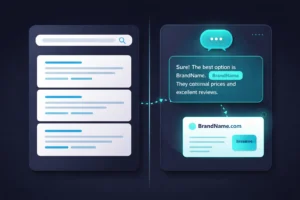
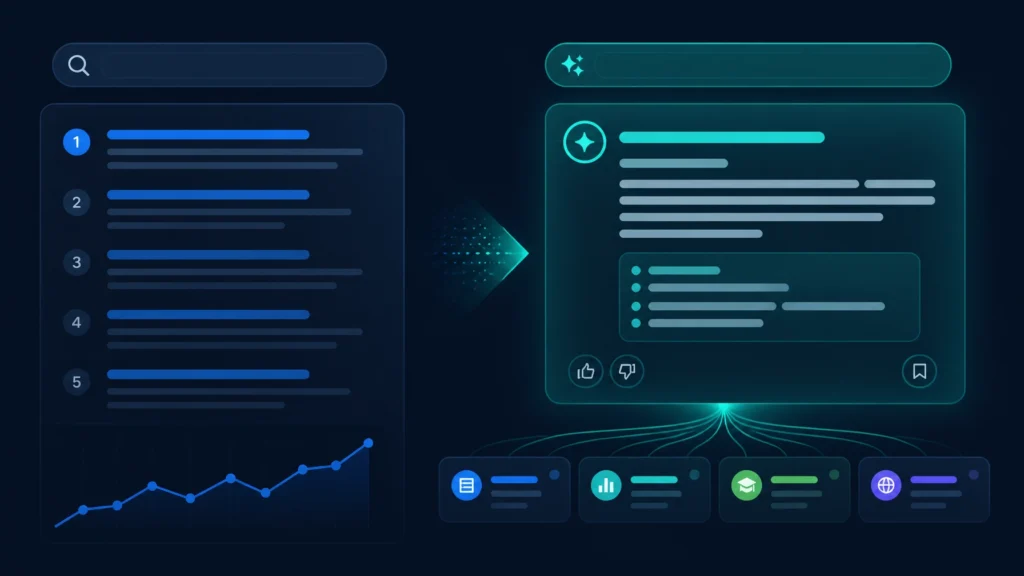
The first is traditional search: users enter a query, scan rankings, and click a result. The second is answer search: users ask ChatGPT, Perplexity, Claude, Gemini, Meta AI, or Copilot and receive a synthesized response, often with only a few cited sources.
That means ranking #1 on Google no longer guarantees that your brand will appear in the answer your audience sees.
Answer engine optimization, or AEO, is the process of making your brand and content easier for AI assistants and answer engines to discover, understand, trust, and cite.
AEO does not replace SEO. It extends SEO into a search environment where visibility is measured not only by rankings and clicks, but also by inclusion, citation quality, sentiment, and share of voice.
Use the checklist below to audit your site.
What is answer engine optimization?
Answer engine optimization is the practice of improving a website’s content, technical accessibility, entity clarity, and authority so it can be accurately represented in AI-generated answers.
Traditional SEO asks:
Can this page rank for the query?
AEO asks:
When an AI assistant answers this query, does it understand our brand well enough to mention or cite us?
The answer depends on more than a page’s position in Google. It can depend on:
- Whether AI crawlers can access the page
- Whether your organization and products are clearly defined
- Whether trusted third-party sources mention your brand
- Whether your content provides direct, extractable answers
- Whether AI systems associate your brand with the right topics
- Whether you are cited consistently across multiple platforms

The AEO checklist
1. Make your content technically citable
Before optimizing content for AI, confirm that answer engines can access and process it.
Robots.txt and crawler access
- Check that important pages return a successful HTTP response.
- Confirm that key pages are not blocked by
noindex, accidental authentication, or firewall rules. - Review your
robots.txtfile for broad disallow rules that could block useful content. - Confirm that your CDN or web application firewall allows legitimate AI crawler requests.
- Make sure your XML sitemap is current and includes canonical URLs.
- Check that important content is available in HTML, not only after JavaScript runs.
Crawlers and controls vary by platform. For example, OpenAI documents separate user agents for search and training. OAI-SearchBot is used to surface websites in ChatGPT search, while GPTBot is associated with crawling content that may be used to train OpenAI foundation models. These settings can be managed independently in robots.txt.
Review the official OpenAI crawler documentation before changing your rules.
Anthropic also documents separate crawlers for training, search, and user-directed retrieval, including ClaudeBot, Claude-SearchBot, and Claude-User. Its crawler guidance explains how each one works.
llms.txt
- Decide whether an
llms.txtfile fits your site and operating model. - If you use one, publish it at the root of your domain.
- Describe your organization, products, services, and key topics clearly.
- Link to authoritative pages that explain your business.
- Keep the file concise, current, and non-promotional.
- Review it whenever your positioning, products, or important URLs change.
llms.txt should be treated as a supplemental discovery document, not a replacement for crawlable HTML, internal links, structured data, or authoritative content.
Also keep your expectations realistic. AI platforms do not all use llms.txt in the same way, and publishing one is not a guarantee of citations.
Structured data
- Add Organization schema with your official name, URL, logo, and relevant
sameAsprofiles. - Use Article or BlogPosting schema for editorial content.
- Use Product, Service, or other relevant schema types where appropriate.
- Add FAQPage markup only when the questions and answers are visible on the page.
- Make sure structured data matches the visible content.
- Validate your JSON-LD and resolve errors.
- Keep entity names, descriptions, dates, and URLs consistent across the site.
Structured data gives machines additional context about what a page represents. It does not guarantee a ranking, rich result, or AI citation, but it can reduce ambiguity.
Use the official Schema.org Article definition and Organization definition as references. For Google-specific requirements, follow Google’s structured data policies.
2. Build clear brand and entity signals
AI assistants need to distinguish your organization from similarly named companies, products, categories, and concepts.
- Use one consistent brand name across your website and external profiles.
- Explain what your company does in plain language.
- State who your product is for and which problems it solves.
- Define important products, services, categories, and locations.
- Link related pages together with descriptive anchor text.
- Connect your company to relevant people, founders, authors, and experts.
- Add visible author bios and credentials to important content.
- Maintain consistent descriptions across business listings, social profiles, review sites, and partner pages.
- Link to authoritative external profiles using
sameAswhere appropriate.
Avoid relying on vague positioning. “We help businesses grow” gives an answer engine very little to work with. A clearer statement might explain the audience, category, use case, and differentiator in one sentence.
For example:
CiteMetrix is an AI visibility analytics platform that helps SEO and marketing teams track how brands appear in AI-powered search results.
That statement is specific, repeatable, and easy to associate with a category.
3. Create answer-ready content
AI assistants often need to extract a concise answer before they can cite a source. Make the answer easy to find.
- Put a direct definition near the top of the page.
- Answer the primary question within the first 100–150 words.
- Use one clear H1 and a logical H2/H3 hierarchy.
- Phrase relevant headings as questions or direct tasks.
- Break long explanations into short paragraphs.
- Use bullets, numbered steps, tables, and comparison blocks.
- Include specific examples and use cases.
- Define acronyms the first time you use them.
- Add a short FAQ section based on real customer questions.
- Show publication and update dates when freshness matters.
- Cite data and claims close to where they appear.
Answer-ready content is not content written for machines instead of people. It is content that makes the main point clear for everyone.
A strong AEO page usually follows this structure:
- Direct answer
- Supporting explanation
- Examples or evidence
- Practical steps
- Related questions
- Clear next action
Google’s official guidance on AI features makes an important point: the same foundational SEO practices still apply to AI Overviews and AI Mode. Pages need to be crawlable, indexable, useful, and eligible to appear with a snippet. AEO should strengthen those fundamentals, not distract from them.

4. Earn citations from authoritative sources
Your own website is only one part of your AI visibility.
Answer engines may use third-party sources to understand your category, reputation, product capabilities, and relationships. That makes external authority a core part of AEO.
- Identify the publications and websites your audience already trusts.
- Earn coverage in relevant industry publications.
- Build relationships with analysts, partners, and subject-matter experts.
- Contribute original research, benchmarks, and useful data.
- Keep review profiles accurate and up to date.
- Encourage specific customer testimonials that describe real outcomes.
- Look for authoritative comparison pages where your product genuinely belongs.
- Correct inaccurate or outdated descriptions of your brand.
- Avoid low-quality directories and manufactured mentions.
The goal is not to collect as many links as possible. The goal is to create a credible network of references that consistently describes your brand, expertise, and category.
This is also why original research can be so valuable. A useful report may be cited by journalists, analysts, bloggers, and other companies, creating multiple independent references that an AI system can connect back to your brand.
5. Monitor AI citations across platforms
Spot-checking one ChatGPT prompt is not an analytics strategy.
AI answers can vary by platform, query wording, location, freshness, model, and available sources. A brand that appears in one answer may be absent from another.
- Create a query set based on your most important customer questions.
- Include branded, non-branded, comparison, category, and problem-based queries.
- Test queries across ChatGPT, Perplexity, Claude, Gemini, Meta AI, and Copilot.
- Record whether your brand appears.
- Record which URL or third-party source is cited.
- Track your position or prominence within the answer.
- Review how the platform describes your company.
- Monitor positive, neutral, and negative sentiment.
- Recheck priority queries on a consistent schedule.
- Compare your results with key competitors.
This is where a measurement layer becomes useful. CiteMetrix combines citation tracking with competitor share of voice and ModelScore, helping teams move from isolated prompt tests to a repeatable view of AI visibility.
The important question is not simply “Did we appear?”
It is:
Are we appearing for the queries that matter, on the platforms our audience uses, with an accurate and favorable description?
6. Measure the gap between rankings and AI visibility
Traditional SEO and AEO measure different parts of the search journey.
Track both:
| Traditional SEO | Answer engine optimization |
|---|---|
| Keyword rankings | Brand inclusion in AI answers |
| Organic impressions | Citation rate |
| Click-through rate | Share of voice |
| Backlinks | Cited source quality |
| Organic sessions | AI-referred visits |
| SERP features | Answer position or prominence |
| Conversion rate | Sentiment and accuracy |
- Export your priority queries from Search Console.
- Group them by intent and business value.
- Compare ranking performance with AI citations for the same topics.
- Identify pages that rank well but are rarely cited.
- Identify pages that are cited despite modest traditional rankings.
- Compare your visibility with competitors.
- Connect Search Console and analytics data where possible.
- Track changes over time rather than relying on a single snapshot.
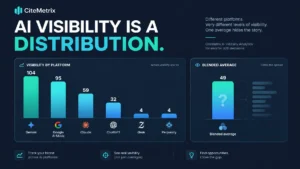
A page can rank well on Google and still be missing from the answer layer. Conversely, a trusted third-party article may influence AI responses even if your own site does not rank first.
CiteMetrix’s AI visibility measurement tools are designed for this gap: tracking citations, comparing competitors, and monitoring the signals that shape how AI platforms represent a brand.
A practical 30-day AEO rollout
You do not need to rebuild your entire site to begin.
Week 1: Audit access and clarity
Review robots.txt, XML sitemaps, rendering, indexability, structured data, brand descriptions, and important entity pages.
Week 2: Improve priority content
Select five to ten pages tied to valuable customer questions. Add direct answers, clearer headings, supporting evidence, internal links, and relevant schema.
Week 3: Build authority
List the external sources that influence your category. Prioritize realistic opportunities for original research, partnerships, expert contributions, reviews, and accurate business profiles.
Week 4: Establish measurement
Create your query set, benchmark competitors, and start tracking citations across major AI platforms. Review changes monthly and investigate both gains and losses.
Use CiteMetrix’s source-of-truth approach to keep your brand facts, structured data, and llms.txt information aligned as your company changes.
Final AEO checklist
Before calling your audit complete, confirm that:
- Search and AI crawlers can access your important content.
- Your technical controls reflect your search and data-use preferences.
- Your brand, products, and services are clearly defined.
- Your structured data matches visible content.
- Your pages answer important questions directly.
- Your content includes evidence and relevant sources.
- Trusted third-party sites describe your brand accurately.
- You monitor citations across multiple AI platforms.
- You track sentiment, prominence, and competitor share of voice.
- You compare AI visibility with traditional rankings and traffic.
- You review performance continuously instead of treating AEO as a one-time audit.
Answer engine optimization is not about finding a secret phrase that makes an AI assistant recommend your company. It is about making your brand easier to access, understand, verify, and cite.
Start by measuring the gap between where you rank and where AI mentions you.
Get your ModelScore and see what AI says about your brand → citemetrix.com
Frequently asked questions
Is answer engine optimization different from SEO?
Yes, but the two disciplines overlap. SEO focuses heavily on rankings, organic visibility, and website traffic. AEO adds visibility in direct AI-generated answers, including whether your brand is mentioned, cited, accurately described, and visible relative to competitors.
Does llms.txt guarantee AI citations?
No. llms.txt may help communicate important site and organization information, but it is not a guarantee of crawling, indexing, inclusion, or citation. It should support: not replace: good content, crawlability, structured data, and external authority.
Can a page rank #1 on Google and still be invisible in AI answers?
Yes. Google rankings and AI citations are related but not identical. AI systems may use different retrieval methods, sources, query expansion, and answer-generation processes. Measuring both channels is the only reliable way to identify the gap.
What should I measure first?
Start with citation rate for a defined set of high-value queries. Then add cited URL, answer prominence, sentiment, competitor share of voice, and any available AI-referred traffic. A composite metric such as ModelScore can help summarize progress while preserving the underlying breakdown.
How often should I monitor AI visibility?
Use a consistent cadence that matches the importance of the channel. Weekly or monthly monitoring is more useful than occasional manual checks because AI responses and cited sources can change over time.