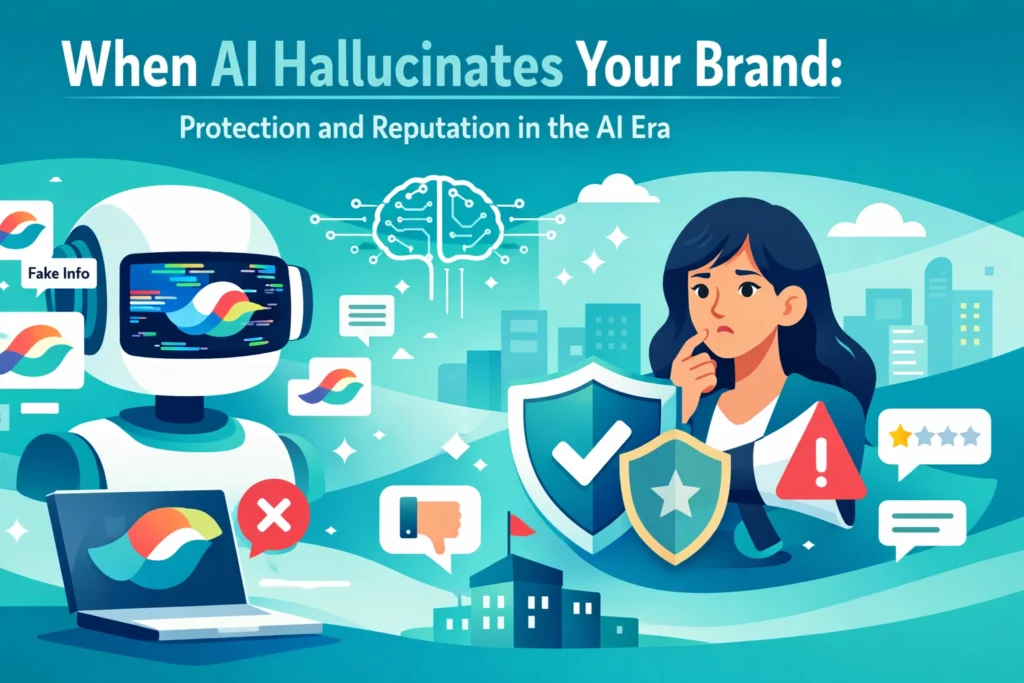
In 2026, your brand’s most influential spokesperson isn't your PR lead, your CEO, or even your top influencer. It’s an Large Language Model (LLM).
Whether a potential customer is using ChatGPT to compare SaaS features, asking Perplexity for a pricing breakdown, or using Claude to research your company’s history, the AI is the one "closing" the sale. But there is a growing problem that traditional marketing dashboards are completely missing: AI hallucinations.
When an AI "hallucinates," it doesn't just make a harmless mistake. It confidently asserts that your product has features it lacks, quotes pricing from five years ago, or suggests that your company is embroiled in a scandal that never happened. For a brand, this isn't just a technical glitch: it is a direct threat to your reputation and your bottom line.
The Hallucination Problem: Why AI Lies About You
To protect your brand, you first have to understand why these errors occur. AI models are not databases; they are sophisticated prediction engines. They are trained to be helpful and conversational, which means they are biased toward providing a complete answer, even when they lack the specific data to back it up.
Research shows that even the most advanced models: GPT-5, Gemini, and Claude: suffer from hallucination rates ranging from 15% to over 50%. When these models encounter "gaps" in their training data or find conflicting information on the web, they bridge those gaps with high-confidence guesses.
Common brand hallucinations include:
- Pricing Inaccuracy: AI models often scrape outdated PDF guides or third-party review sites, leading them to tell customers that your product is much more expensive (or cheaper) than it actually is.
- Feature Fabrication: If a competitor has a specific feature, the AI might assume you do too, leading to "feature drift" where the model promises capabilities you don't support.
- Historical Distortion: LLMs frequently "mix and match" founders, launch dates, and acquisition histories, which can be devastating for B2B brands relying on authority and longevity.
If you aren't actively monitoring these outputs, you are essentially leaving your brand story in the hands of a creative writer who hasn't read your latest brief.

Image Instruction: A split-screen 'scan' effect. On the left, blurred, navy-toned text showing a hallucinated pricing table labeled "Incorrect." On the right, a sharp, teal-highlighted section with a checkmark and accurate data labeled "Correct." Dark mode, minimalist aesthetic.
Detection: How to Spot Fictional Claims in Real-Time
The biggest challenge with brand monitoring ChatGPT and other engines is the sheer volume of possible queries. Unlike traditional SEO, where you track a few hundred keywords, AI search is generative. Users ask complex, long-tail questions that don't always follow a pattern.
To catch hallucinations, you need to move beyond "search volume" and start looking at "semantic accuracy." At CiteMetrix, we use visibility tools that simulate thousands of user prompts to see how different models characterize your brand.
This discovery sweep usually targets four main areas:
- Identity: "Who is [Brand Name] and what is their primary mission?"
- Product/Service: "Does [Brand Name] offer [Feature X]?"
- Pricing: "How much does the Pro plan of [Brand Name] cost in 2026?"
- Comparison: "How does [Brand Name] compare to [Competitor] regarding security?"
When a tool like CiteMetrix flags a low "fidelity score," it means the AI’s description of your brand has drifted too far from your official documentation. This "semantic drift" is the first warning sign that a hallucination is becoming embedded in the model’s "understanding" of your company.
Reputation Management: AI Sentiment Analysis
Accuracy is only half the battle. The other half is sentiment. Even if the AI gets the facts right, how is it framing them?
AI models don't just report facts; they synthesize opinions. They look at Reddit threads, Glassdoor reviews, and tech blogs to build a "vibe" for your brand. This results in an AI sentiment analysis that can be either your greatest asset or your silent killer.
For instance, an AI might correctly state that you are a market leader but add a "hallucinated" caveat that your customer support is notoriously slow because it picked up a few disgruntled tweets from 2022. Because the AI presents this as a consensus view, the user accepts it as truth.
Tracking your ModelScore™ allows you to see how different LLMs "feel" about your brand. Is the AI recommending you as a "reliable partner" or a "budget-friendly but risky" option? Understanding these nuances is the only way to manage your reputation in an era where AI is recommending against your brand.

Image Instruction: A Citemetrix dashboard visualization showing a "Sentiment Radar." Several points are plotted showing "Positive," "Neutral," and "Negative" sentiment across different AI models (ChatGPT, Claude, Perplexity). The colors are Navy and Teal with a small red dot indicating a hallucination risk.
Actionable Steps: How to Fix Wrong AI Info
So, what do you do when you find out ChatGPT is telling your customers the wrong price? Unlike Google, you can't just "request a crawl" and see a change in 24 hours. However, you can influence the "Source of Truth" that AI models rely on.
1. Source Content Optimization
AI models prioritize high-authority, clearly structured data. If your pricing page is a complex interactive slider, the AI might fail to parse it. Simplify your most important brand facts into clear, bulleted lists and high-fidelity text. This makes it easier for the AI to "cite" the correct information rather than guessing.
2. Technical Readiness: llms.txt and Schema
One of the most important developments in 2026 is the adoption of the llms.txt file. Much like robots.txt told Google what to crawl, llms.txt provides a streamlined, markdown-friendly version of your site specifically for AI agents. By hosting a "truth file" at your root directory, you give AI models a direct path to accurate data.
3. Strengthening the Knowledge Graph
AI models rely heavily on relationships. Ensure your LinkedIn, Wikipedia (if applicable), and major industry directories are perfectly aligned. If your LinkedIn says you have 500 employees but your website says 200, the AI may hallucinate a "recent massive layoff" to explain the discrepancy.
4. Generative Engine Optimization (GEO)
Traditional SEO focused on keywords; GEO focuses on authority and citations. The more high-quality sources that cite your correct information, the more likely the AI is to treat that information as the "consensus." You can learn more about this in our guide to Generative Engine Optimization.
Accuracy of the Tools: The CiteMetrix Advantage
When you are fighting hallucinations, the last thing you need is a tool that hallucinates its own data. This is a common problem with low-tier AI SEO tools. Many simply ask ChatGPT "What do you think of Brand X?" and report the answer. This is anecdotal, not analytical.
CiteMetrix ensures high-fidelity data through a multi-layered verification process:
- Cross-Model Verification: We don't just check one model. We compare responses across the entire LLM landscape to identify patterns of misinformation.
- Prompt Engineering Rigor: We use "adversarial prompting" to see how your brand holds up under pressure. If a user asks a leading question like "Why is [Brand] so expensive?", we track how the AI defends (or fails to defend) your value proposition.
- Real-Time Citations: We track exactly which URLs the AI is using to build its answers. If an AI is citing a random blog post from 2019 to explain your 2026 features, we alert you immediately so you can target that specific "source of error."

Image Instruction: A minimalist graphic showing three interconnected nodes labeled "Data Input," "Verification Layer," and "High-Fidelity Insight." Clean teal lines, dark background, professional B2B feel.
Conclusion: Don't Wait for the Hallucination to Become the Truth
In the AI era, silence is not a strategy. If you aren't actively monitoring and managing how AI models perceive your brand, you are allowing a machine-generated consensus to define your reputation.
Hallucinations are inevitable, but being blindsided by them doesn't have to be. By using tools like CiteMetrix to detect "fictional" claims and implementing technical safeguards like llms.txt, you can ensure that when a customer asks an AI about your brand, the answer they get is the one you actually wrote.
Ready to see what the AI is telling your customers?
→ See what AI says about your brand at citemetrix.com
→ Get your ModelScore for free
→ Join the beta and start tracking AI citations today