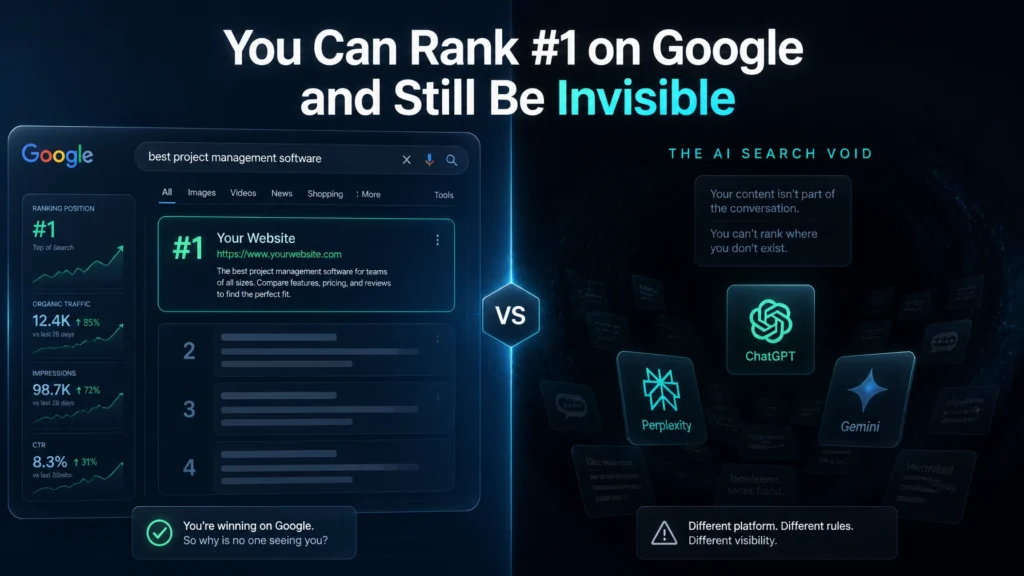
A client asked me a simple question last month: "We're number one on Google for our category. Why does it feel like nobody new is finding us?"
It’s a good question, and the answer is uncomfortable for anyone who has built a career on search. The honest version is this: ranking #1 on Google is still worth a lot: and it no longer guarantees you’re being found.
In fact, the metrics you’ve relied on for years might be masking a massive blind spot in your brand’s visibility.
Search Quietly Split into Two Channels
For twenty years, "being found" meant one thing: showing up high on a results page so someone would click through to your site. That's the world SEO was built for, and SEO got very good at it.
But as we move deeper into 2026, the landscape has fundamentally shifted. We are witnessing The Great Search Split.

A growing share of the time, people don't scroll a list of links anymore. They ask. They open ChatGPT, or they read Google’s AI Overview, or they ask Gemini, Perplexity, or Copilot: and they take the answer the assistant gives them. Often they never visit a results page at all.
Recent data shows that AI-native platforms now handle an estimated 15–20% of informational query volume. These are the research, learning, and commercial investigation queries that historically fed content-site SEO. Furthermore, Gartner predicts that traditional search engine volume will drop by roughly 25% by the end of this year as users migrate toward AI assistants.
This creates a second channel, and it plays by completely different rules. There's no ranked list to climb. When someone asks an AI assistant "who are the best providers of X," the assistant writes an answer that either names you: accurately: or it doesn't. You're in the answer, or you're absent from it. There’s no "Page Two" to be stuck on. There’s just present, or invisible.
The Part That Catches People Off Guard
You can be the undisputed leader in traditional search and still be missing from, or wrong in, the AI answer to the exact same question.
At CiteMetrix, we see it constantly. A brand with strong rankings, solid traffic, and a healthy site finds that when you actually ask the major assistants about their category, the brand is omitted. Or worse, a competitor is named instead, or the assistant states something about them that is simply false.
None of that shows up in a rankings report. The traffic dashboard looks fine. The blind spot is invisible precisely because the tools built for the first channel can't see the second one.
Why Your "Invisible" AI Visibility is Costing You Revenue
If you think AI search is just for "questions," consider this: while AI referrals currently represent a small slice of total traffic, they convert at a staggering rate.
Research indicates that AI-sourced visitors are 6–9x more likely to convert than typical organic search visitors. ChatGPT referrals have been shown to convert at nearly 16%, compared to the standard 1.76% for traditional Google organic traffic.
When you are invisible in AI search, you aren't just losing "impressions": you are losing the most qualified, high-intent leads in the market.
Why This Isn't an Argument Against SEO
Here’s where I want to be careful, because it would be easy to read this as "SEO is dead." It isn't, and anyone who tells you that is selling something.
Traditional search is still enormous, and: this is the part that gets missed: strong SEO actually feeds AI visibility. The assistants are built largely from the open web. When they decide how to describe a brand, they lean on the same authoritative content, the same structured data, and the same credibility signals that good SEO produces.

Doing the foundational work well doesn't just help your Google rankings; it improves how accurately and favorably the AI systems represent you. This is what we call Generative Engine Optimization (GEO).
The two channels aren’t rivals. They’re interdependent:
- Strong Web Presence: Improves how AI models perceive and represent your brand.
- AI Visibility: Covers the discovery happening where traditional SEO tracking tools can't reach.
Do only the first, and you’re building authority while staying blind to a fast-growing share of how people form impressions of your brand. Do only the second, and you’ve ignored the still-dominant channel and the foundation that feeds the answers.
Measuring the Invisible: The ModelScore™
If you can't see the gap, you can't fix it. This is why we developed the ModelScore™. It’s a proprietary 0-100 composite score that finally gives SEO professionals a metric for the second channel.

ModelScore™ measures your visibility across four critical dimensions:
- Citation Rate: How often are you actually mentioned by name in AI answers?
- Brand Demand: Are people asking AI specifically about you?
- Authority Transfer: Are the sources citing you considered "authoritative" by the LLM?
- Technical Readiness: Can AI crawlers actually access and understand your content? (e.g., your llms.txt configuration).
By correlating your ModelScore with your traditional Google Search Console data, you can finally see the full picture of your brand's digital footprint.
See your ModelScore for free → citemetrix.com
What a Modern Visibility Strategy Looks Like
It’s not complicated to describe, even if it takes work to do:
- Keep doing strong, technical, authoritative SEO. It still drives discovery, and it feeds the AI layer.
- Monitor how you actually appear across the major AI assistants. Are you being cited, recommended, and described correctly?
- Catch and fix it when an assistant gets you wrong. AI misrepresentation is shaping buyer perception whether you’re watching it or not.
- Treat the two as one connected program. Ensure that your content strategy doesn't just target keywords, but provides the "consensus" answers that AI platforms seek.
The Question Worth Asking
If you’re evaluating your own visibility: or a strategy someone’s presenting to you: there’s one question that cuts straight to the heart of the matter:
"If your rankings were strong but your brand was missing from the AI answers in your category, would your current program even detect that?"
For most brands today, the answer is no. That gap is the whole story. A strategy built only around keywords and Google rankings isn’t wrong: it’s just half of the current picture. The other half is now too big to leave unmeasured.

Search didn't go away. It split in two. The brands that win from here are the ones strong in both: and, just as importantly, measuring both.
Ready to see what AI says about your brand?
Join the CiteMetrix beta and get your first visibility report today.