Hallucinations Are a Governance Problem, Not Just a Technical One
Ask most engineering teams how they handle AI hallucinations and they will describe a combination of prompt tuning, model upgrades, and retrieval improvements. Ask their legal or compliance counterparts whether any of that constitutes a documented risk control, and the silence tends to be informative.
Hallucinations — instances where a large language model generates factually incorrect, unsupported, or entirely fabricated content — are not a bug that a better prompt will permanently fix. They are an emergent behavior of current-generation LLMs, and they represent material risk in any enterprise deployment. In finance, a model that misquotes regulatory thresholds or fabricates a fund’s historical return exposes the firm to liability. In healthcare, a clinical decision support tool that invents a drug interaction can cause direct patient harm. In legal services, hallucinated case citations — a well-documented failure mode — have already produced sanctions against practicing attorneys.
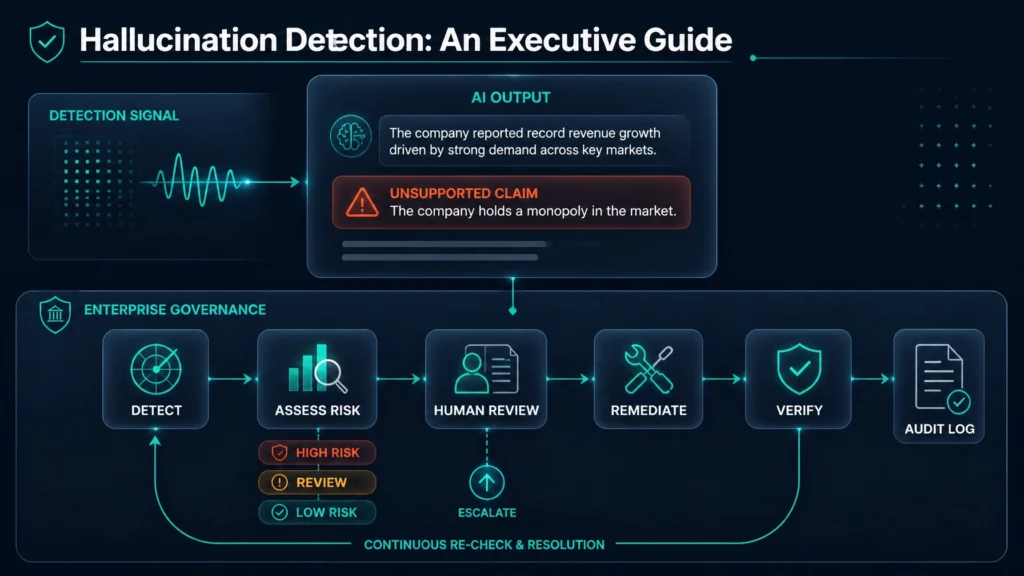
The governance gap here is not that companies lack good engineers. It is that most organizations have no formal policy defining what constitutes an acceptable hallucination rate, no documented incident response process for when a hallucination reaches a customer, and no board-level metrics for tracking whether the problem is improving or worsening. Hallucination detection only has value when it feeds into controls — escalation paths, tiered review workflows, documented thresholds — rather than sitting as an isolated technical feature.
Executives who treat this as purely an AI product team concern are misreading the risk surface.
How Hallucination Detection Actually Works: Four Families of Methods
The field has converged on four main approaches, each with meaningfully different trade-offs between accuracy, cost, latency, and integration complexity.
Confidence scoring and calibration works by measuring how certain a model is about its own output — using probability distributions over tokens or purpose-built calibration layers. When a model generates a low-confidence response, the system flags it rather than passing it downstream. Recent work on cost-effective detection pipelines focuses specifically on generating calibrated confidence scores per response and applying a threshold to route high-risk outputs for review. This approach can be embedded directly in inference without adding a second LLM call, which matters enormously at production scale.
Internal-state analysis goes deeper, examining hidden states and attention maps to find signals that correlate with hallucination before they manifest in the output text. The MIND framework, which introduced the HELM benchmark for evaluating detection across multiple models without requiring human labels for every example, uses this approach to achieve unsupervised, real-time detection. The practical advantage is low latency; the limitation is that these signals can be model-specific and require access to internals not exposed by all APIs.
Self-evaluation by the generating model — asking the LLM to check its own output — is widely used but consistently underperforms specialized detectors. The intuition makes sense; the empirical results do not always support it. A model that hallucinated an answer does not reliably catch that it hallucinated it.
External detectors, including dedicated models trained specifically on hallucination classification, are currently the most accurate option for production environments. Tools like MiniCheck 7B and HHEM-2.1, along with commercial offerings such as Azure Groundedness, represent this category.
Can an LLM Reliably Detect Its Own Hallucinations?
Not reliably enough for high-stakes use cases. On the HalluMix benchmark, Trustworthy Language Models — specialized external detectors — materially outperformed generic self-check prompt methods across four RAG benchmarks. If self-evaluation were sufficient, there would be no need for a $155M company (Profound) or an entire research subfield. The answer executives should demand from their teams: what external detector validates this output, and what is its measured accuracy in our specific domain?
RAG Doesn’t Eliminate Hallucinations — It Just Changes Where They Hide
Retrieval-augmented generation has become the dominant enterprise pattern for deploying LLMs precisely because grounding outputs in retrieved documents should reduce fabrication. That logic is correct but incomplete. RAG reduces hallucinations; it does not remove them.
The RAGTruth corpus — approximately 18,000 annotated examples built specifically to evaluate hallucination detection in RAG settings — documents exactly this. Models using RAG still fabricate details not present in retrieved documents, misinterpret retrieved evidence, and overgeneralize from partial source material. Failure modes include unsupported additions (inserting facts that sources do not support), fabricated references (inventing identifiers, methods, or citations), and selective omission that distorts the meaning of retrieved content. Span-level hallucination detection research finds that these errors tend to cluster in specific segments of a response — a fabricated number here, an invented method name there — which makes them easy to miss in a casual review and harder to catch with coarse-grained detection.
For executives managing RAG deployments, two things follow. First, faithfulness metrics — scores that measure whether a generated response is actually supported by its source documents — should be in every vendor SLA for AI systems touching customer output. RAGAS Faithfulness, for instance, reached an F1 of approximately 0.82 with recall near 0.95 on HalluMix benchmark tasks. Frameworks like RAGAS++ show dramatic improvements in evaluation reliability: null result rates on the DROP benchmark dropped from 58.9% to 0.1%, and from 83.5% to 0.0% on FinanceBench, meaning evaluations that previously produced no signal now surface actionable findings. Second, the quality of your retrieval layer is as important as the quality of your detection layer. Noisy retrieval that surfaces irrelevant or contradictory documents gives the model more material to hallucinate from.
Reading Benchmark Claims Without Getting Misled
Vendors claiming their model is trustworthy or grounded deserve scrutiny. The key question is not whether the model scored well on a benchmark — it is which benchmark, in which domain, and on which task type.
FaithJudge leaderboards and HHEM-based evaluation frameworks now track overall hallucination rates across RAG tasks — summarization, question answering, and data-to-text generation — giving enterprises standardized comparison tools that did not exist two years ago. Multi-domain benchmarks like HalluMix and RAGTruth evaluate detectors across finance, biomedical, and general QA settings, making it much harder for vendors to demonstrate performance on narrow toy datasets and claim broad applicability.
Here is what most procurement teams miss: hallucination rates vary significantly by task type. A detector that achieves strong precision on question-answering tasks may underperform on summarization or data-to-text, because the nature of the hallucination differs. Fabrications in summarization tend to be semantic distortions; in data-to-text they often involve specific numeric or factual errors; in QA they may be confident wrong answers. The HalluMix results — where Quotient Detection achieved F1 around 0.84 and MiniCheck 7B around 0.83 — represent strong but imperfect performance, with recall above 0.93. That means roughly one in fourteen hallucinations is still getting through in optimal conditions. In a regulated context, that number matters.
When evaluating vendor claims, ask specifically: What benchmark was used? Was it in-domain for your use case? What were the precision and recall figures, not just F1? Was the evaluation conducted on the same task type your application performs?
Deploying Detection at Scale Without Doubling Your Inference Bill
A common objection to systematic hallucination detection in production is cost. Running a large external LLM as a judge against every response in a high-volume customer support or search application is not economically viable — it can double inference spend while adding latency customers will notice.
Two recent developments make this more tractable. The first is calibrated confidence scoring: assigning a risk score to each response and routing only high-confidence-risk outputs for deeper review or human escalation. This creates a tiered pipeline where the majority of responses pass through a lightweight check and only a fraction trigger expensive secondary evaluation. The second is the emergence of unsupervised real-time detection using internal model states — frameworks like MIND that operate at inference time without requiring a separate model call. These can be embedded directly into inference pipelines, making them viable for throughputs where adding 300–500ms of latency per call is not acceptable.
The practical design principle: treat hallucination detection as a triage system, not a binary gate. Flag high-risk responses, route medium-risk responses to lightweight checks, and let low-risk responses pass — with sampling-based audits to validate that the thresholds remain calibrated as your model and data evolve.
Why No Single Detector Is Enough — and What to Do About It
The most dangerous place to be is confident that you have solved hallucination detection. Commercial APIs like Azure Groundedness are genuinely useful, but deploying one detector and declaring the problem managed is a form of false assurance that empirical benchmarking consistently exposes.
Detectors trained on general-domain corpora can underperform meaningfully in specialized domains — clinical terminology, financial instrument language, legal reasoning chains. Domain transferability is an active research problem, not a solved one. Span-level hallucination research also highlights that subtle errors (a fabricated trial identifier, an incorrect regulatory citation number) may not trigger a general-purpose detector even while representing high-impact failures in context.
The appropriate design is a portfolio approach: a primary detector optimized for your domain and task type, a secondary check for high-stakes or high-risk outputs, domain-specific evaluation sets drawn from your actual production data, and human review for any workflow where the downstream consequence of an error is material. Treating any single tool as comprehensive coverage is an audit finding waiting to happen.
Turning Detection Into Enterprise Controls: Policies, Tiers, and Human Oversight
Detection without response workflow is just a dashboard nobody acts on. The operational question is how detected hallucinations flow through your organization.
A practical tiered model assigns outputs to risk levels based on use case: a customer-facing medical summary is not in the same category as an internal content draft. High-risk outputs require human review before delivery. Medium-risk outputs are flagged and sampled for audit. Low-risk outputs pass with logging for retrospective review. Every tier needs a defined escalation path, not just a technical flag.
Board-level metrics worth tracking include: hallucination rate by deployment (detections per thousand outputs), mean time to resolution for flagged incidents, percentage of high-risk outputs reviewed before reaching end users, and trend lines over time for each metric. These translate the technical problem into risk management language that governance bodies can act on.
Platforms like CiteMetrix Hallucination Watch operationalize a version of this for brand-specific AI accuracy — detecting when AI platforms make factually incorrect claims about a brand, providing remediation recommendations, and automatically re-checking daily until resolution is confirmed. The closed-loop model — detect, diagnose, fix, verify — is the right template for enterprise hallucination management regardless of the specific tooling.
From Detection to Prevention: Where the Field Is Heading
Detection is a control layer, not the destination. The trajectory of the field is toward reducing hallucinations before they require detection — through better retrieval pipelines that surface cleaner, more relevant evidence; structured prompting techniques that constrain the model’s generative latitude; and fine-tuning approaches that improve factual calibration on domain-specific corpora.
The realistic near-term picture is that detection and prevention improve together, but neither achieves zero hallucination rates on current architectures. The enterprise that wins is the one that builds a layered assurance framework — retrieval quality, prompting discipline, model selection informed by task-specific benchmark data, real-time detection with calibrated thresholds, human oversight for high-stakes decisions, and governance policies that treat hallucination risk with the same rigor as data security risk. Detection is one essential layer in that stack. Treating it as the whole stack is the mistake most organizations are still making.