You’ve done everything right. Your content team is churning out high-quality, long-form articles. Your SEO agency says your technical health is "green" across the board. You’re even ranking on the first page of Google for your target keywords.
But then you open ChatGPT, Claude, or Perplexity and ask a question directly related to your expertise.
The AI gives a perfect answer. It lists three of your competitors. It quotes a blog post from 2022 that hasn't been updated in years. But it doesn't mention you. Not even once.
Welcome to the AI Crawler Gap.
In 2026, being "search engine optimized" is no longer enough. There is a massive disconnect between what Googlebot sees and what AI crawlers (like GPTBot or ClaudeBot) actually consume and prioritize. If your technical foundation isn't built specifically for the needs of Large Language Models (LLMs), your best content is essentially invisible to the engines that are increasingly driving consumer decisions.
At Citemetrix, we’ve spent thousands of hours analyzing how these new bots behave. The truth is simple: if the crawler can’t digest your data efficiently, the model won't cite you.
The Myth of the "One-Size-Fits-All" Crawler
For twenty years, we lived in a Google-centric world. If Googlebot could crawl your site, you were fine. But AI crawlers are different. They aren’t just looking for keywords to index; they are looking for relationships, context, and data structures they can use to "train" their understanding of a topic.
The research is showing a growing divide. While traditional search engines are getting better at rendering complex JavaScript and heavy pages, AI crawlers are often more restrictive or, in some cases, more aggressive.
Recent data suggests that nearly 25% of the top thousand websites are now actively trying to restrict AI crawlers. This has created a "cat and mouse" game. Some bots are bypassing robots.txt instructions entirely, while others are being blocked by firewalls that mistakenly identify them as malicious scrapers.
If your site's security settings are too tight, you’re blocking the very bots that could turn your brand into an AI-recommended authority. If they’re too loose, you might be getting hit by a million requests in 24 hours, slowing down your site for actual human users.

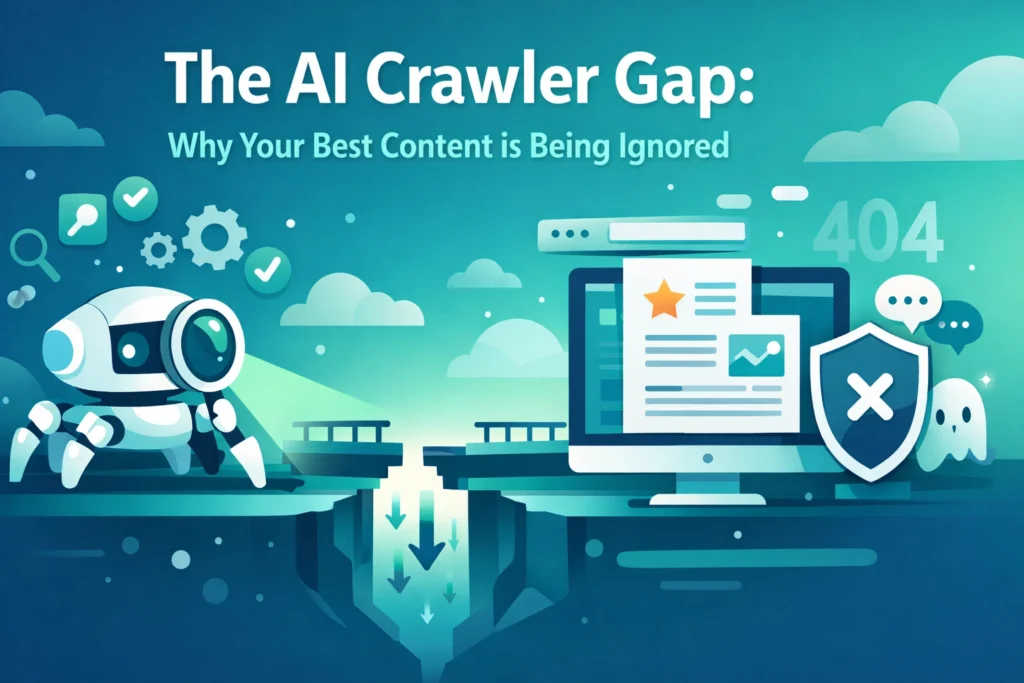
Caption: A conceptual visualization of the "Gap" between traditional search indexing and AI model training.
Why Robots.txt Isn't Saving You Anymore
We used to treat robots.txt like the law of the land. In the age of AI, it’s more like a polite suggestion.
Research into the behavior of major AI players like OpenAI and Anthropic has revealed a hard truth: many AI agents are bypassing these directives. They are looking for high-value data, and they are finding ways around the traditional "No Entry" signs.
On the flip side, some platforms like Cloudflare have moved toward a "block by default" model for new domains. This means you might be invisible to AI crawlers without even knowing it. You could be sitting on the most authoritative guide in your industry, but because of a default server setting, GPTBot has never even seen it.
This is why AI Crawler Monitoring is the new essential vertical for marketing teams. You can't just set it and forget it. You need to know:
- Which AI bots are visiting your site?
- Are they successfully reaching your high-value pages?
- Are they getting stuck on technical hurdles like slow load times or complex JS?
The Technical Foundations of AI Visibility
If you want to close the gap, you have to stop thinking about "ranking" and start thinking about "readiness." At CiteMetrix, we focus on technical readiness as the absolute floor for AI visibility. If the floor is missing, your ModelScore will never move.
1. The Rise of llms.txt
You’re likely familiar with sitemap.xml, but have you implemented llms.txt? This is a new standard designed specifically for AI. It’s a markdown file that provides a simplified, high-context map of your site’s most important information. It tells the AI, "Don't bother with the fluff; here is the core data you need to understand our brand."
Without an llms.txt file, you’re forcing an AI crawler to guess what’s important. And usually, it guesses wrong.
2. Structured Data (Schema) on Steroids
AI models love structured data. While Google uses Schema to show "rich snippets" (like star ratings), AI uses it to build a knowledge graph. If you aren't using robust Organization, Product, and Author schema, you’re making the AI work too hard.
3. Permission Management
Are you accidentally blocking the "good" bots? Many B2B sites use aggressive rate-limiting to prevent scraping. The problem is that AI crawlers from Anthropic or Perplexity often look like scrapers to basic security software.
With Citemetrix AI Crawler Monitoring, you can see exactly which bots are being let in and which ones are being bounced.

Caption: The CiteMetrix dashboard showing real-time AI crawler access and success rates.
The "Laziness" Factor in AI Crawling
It’s important to remember that crawling the entire internet is expensive. Companies like OpenAI are looking for the most "signal" for the least "noise."
If your page takes 4 seconds to load because of unoptimized images, a human might wait, and Google might still rank you. But an AI crawler might just give up. It has billions of other pages to get through. It wants clean, fast, text-heavy content that it can parse in milliseconds.
This is the "Gap" in action. Your content is great, but your delivery is too expensive for the bot.
How to Close the Gap: A 3-Step Plan
You don't need a PhD in computer science to fix this, but you do need to be proactive.
Step 1: Audit Your Bot Logs
You need to see who is knocking at the door. Use CiteMetrix to monitor your server logs specifically for AI user agents. Are you seeing GPTBot, Claude-Web, and PerplexityBot? If not, you have a connectivity problem. You can start by checking our ultimate checklist for AI search visibility.
Step 2: Implement AI-Specific Technical Files
Create an llms.txt file today. It’s a simple text file that lives in your root directory. Fill it with clear descriptions of your products, your mission, and links to your most authoritative whitepapers or blog posts. This acts as a "cheat sheet" for the models.
Step 3: Optimize for "Prompt Readiness"
Think about how people interact with AI. They don't type "best project management software." They ask, "Which project management software is best for a remote team of 50 people using Agile?"
Your technical structure should make it easy for an AI to find the answer to that specific query. This involves using clear H2 headers that mirror common prompts and ensuring your citations are easy for the AI to attribute back to you.

Caption: A comparison showing a site with poor crawler readiness vs. a site optimized for AI visibility.
Why It Matters for Your ModelScore™
At CiteMetrix, we track what we call the ModelScore. This isn't a vanity metric; it’s a measurement of how likely an AI is to recommend your brand.
A huge part of that score is your Technical Readiness. If your site is a "black box" to AI crawlers, your ModelScore will remain low, regardless of how many backlinks you have. You are effectively invisible to the "Focus Group You Never Hired": the AI models that are shaping your brand's reputation.
Stop Being Invisible
The era of "set it and forget it" SEO is over. The AI Crawler Gap is real, and it’s widening every day. While your competitors are still obsessing over keyword density, you should be obsessing over whether the world's most powerful AI models can even read your site.
Technical readiness isn't just a "nice to have." It is the foundation of your brand's future visibility. If the bots can't find you, the customers won't either.
Ready to see if AI crawlers are ignoring you?
Don't leave your AI visibility to chance. With CiteMetrix, you can finally see exactly how AI models perceive your brand and ensure your technical foundation is rock solid.
→ See what AI says about your brand
→ Join the beta (free)
→ Get your ModelScore
If you're serious about the future of search, it's time to bridge the gap. Let’s make sure your best content finally gets the attention it deserves.