For over a decade, we played a predictable game. You wrote a page, you optimized for a keyword, and you waited for a crawler to decide your fate.
Then came the LLM era (2023–2025). Suddenly, we weren't just fighting for blue links; we were fighting for citations in a chat bubble. We called it LLM SEO. It was a wild west of "Generative Engine Optimization," but at its core, it still felt like search.
That just changed.
This month (June 2026), Perplexity dropped a bombshell: Search as Code (SaC).
If you’re an SEO professional or a brand manager, you need to stop what you’re doing and pay attention. Perplexity hasn't just updated an algorithm; they’ve rewritten the entire architecture of how information is retrieved. The "rules" of visibility just became programmable.
What is Search as Code (SaC)? (In Plain English)
Traditionally, when you ask an AI a question, it uses a fixed retrieval pipeline: sort of like a waiter bringing you a menu. It looks at an index, finds some matches, and summarizes them.
With Search as Code, the "waiter" is now a software engineer.
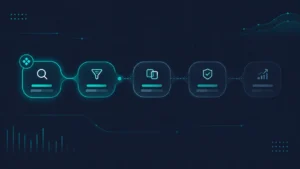
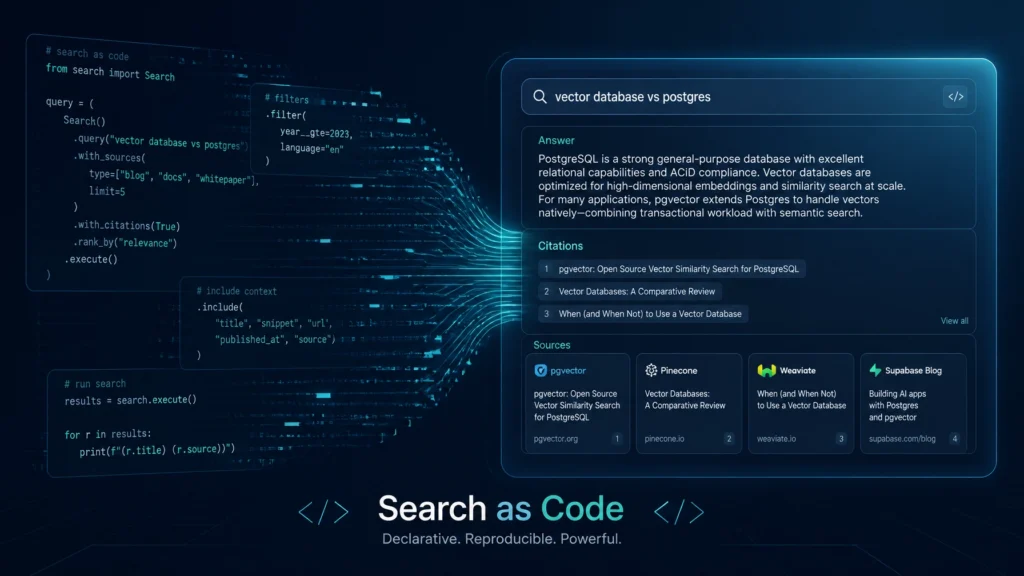
When a user enters a prompt, Perplexity’s model now writes and executes custom Python code on-the-fly to build a unique retrieval pipeline for that specific query. Instead of just "searching," the AI is:
- Decomposing your question into a series of logical tasks.
- Generating a custom SDK-based script to fan out across sources.
- Running conditional logic (if X is true, look at Source Y; if not, look at Source Z).
- Filtering and aggregating data in a secure sandbox before you ever see the answer.
In short: The search engine is rewriting its own code for every single query.

Why This Matters: The Death of the Static Ranking
In the old world, you could track your "rank" for a keyword. In the new SaC world, a "rank" doesn't really exist.
Since the retrieval pipeline is generated at runtime, whether your brand gets cited depends entirely on how the model’s generated code evaluates your site's data. If your content is buried behind a non-standard layout or lacks clear technical readiness, the AI’s custom script might silently exclude you because you’re "too expensive" or "too difficult" to parse in that specific compute turn.
This shifts the focus of AI search visibility from keywords to data accessibility and entity authority.
The New Playbook for AI Search Optimization
If the architecture is dynamic, your strategy has to be technical. Here is how brands and agencies are adapting to SaC:
1. Modular Content is Non-Negotiable
Because SaC pipelines are looking for specific data points to "join" together, long, rambling blog posts are a liability. You need "citation-ready" blocks: short, fact-dense paragraphs that lead with a direct answer. If a model is writing code to "get_competitor_pricing," and your pricing is buried in a PDF or a complex table, you're invisible.
2. Technical Readiness = AI Crawlability
If you haven't implemented an llms.txt file yet, you’re already behind. In a Search-as-Code environment, the model needs to know how to interact with your site quickly. Proper schema markup (FAQ, Product, Organization) acts as the API documentation for the AI's generated search code.
3. Entity Authority Over Keywords
SaC pipelines often use "entity-based" retrieval. They aren't just looking for words; they’re looking for the best source for a specific topic. Building deep topical authority is no longer a "nice to have": it’s the filter that determines if you make it into the model's candidate list.

You Can't Optimize What You Can't See
Here’s the hard truth: You cannot "optimize" for an architecture that changes every time someone hits "Enter."
Traditional SEO dashboards that show you "Position 4" are useless here. You need to know:
- Are you being cited?
- In what context?
- What is the sentiment of that citation?
This is exactly why we built CiteMetrix. While the underlying search code might be dynamic, the output: the answer the user sees: is measurable.
How CiteMetrix Bridges the Gap
With our proprietary ModelScore™, we track your brand's visibility across Perplexity, ChatGPT, Claude, and Gemini in real-time.
When Perplexity switches to a Search-as-Code architecture, CiteMetrix users don't have to guess if their strategy is working. They can see the immediate impact on their citation rate and share of voice.

The "Silent Exclusion" Risk
The biggest danger of SaC isn't that you'll rank lower: it's that you'll be silently excluded.
If an AI-generated retrieval script encounters a 403 error, a slow-loading page, or a block of text it can't parse, it doesn't try to "fix" it. It just moves to the next source. In a world of agentic search, being difficult to read is the same as being non-existent.
Agencies are now using CiteMetrix to run "AI Crawler Checks" to ensure that as these platforms evolve, their clients remain "readable" to the models that matter.

Conclusion: Are You Trackable?
The announcement of Search as Code is a signal that the "experimental" phase of AI search is over. It is becoming a sophisticated, programmable layer between your brand and your customers.
You can't control the code Perplexity writes. But you can control the data you provide and how you monitor the results. If you aren't tracking your AI search visibility daily, you're flying blind into the most significant architectural shift in the history of the web.
Ready to see how AI sees your brand?
Get your free AI Visibility Scan at citemetrix.com →